
Explore the principles and applications of the Soret Effect in thermal diffusion, uncovering its role in science and industry advancements.
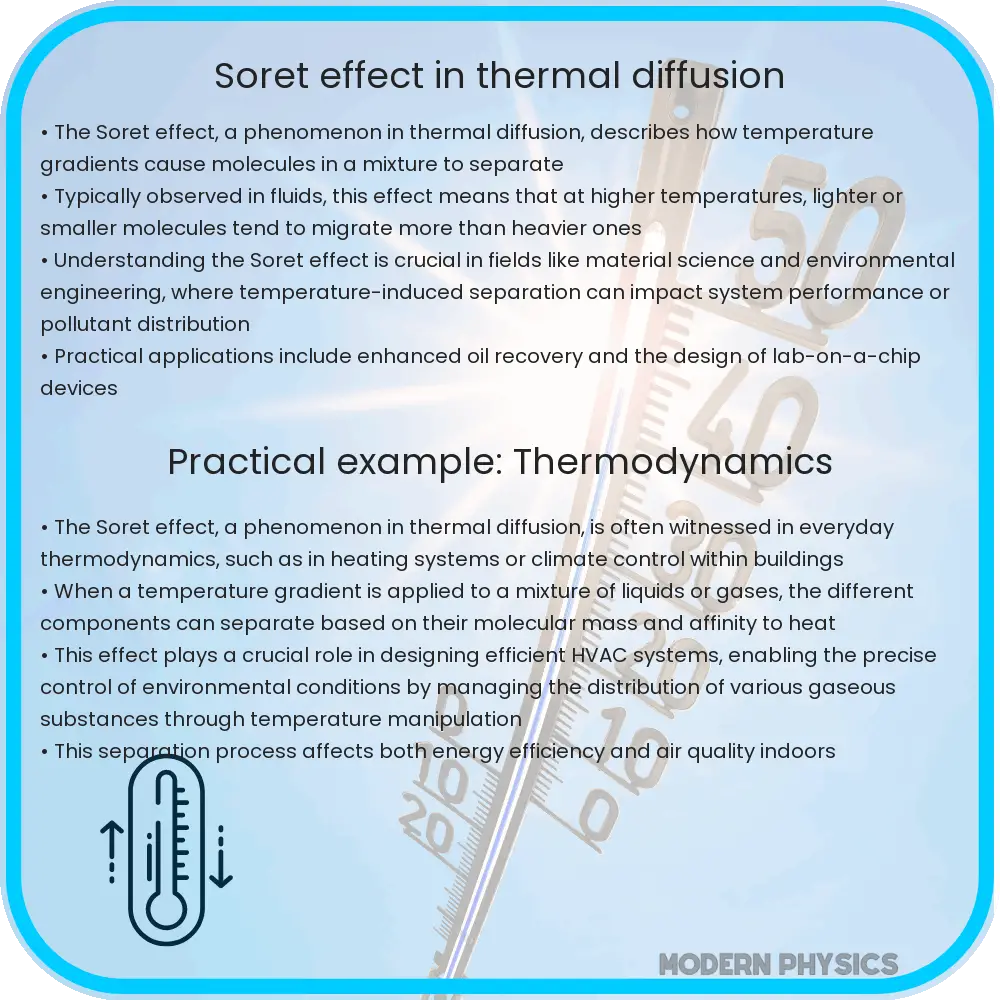
Understanding the Soret Effect in Thermal Diffusion
The Soret Effect, a fascinating phenomenon in the realm of thermal diffusion, plays a critical role in various scientific and industrial processes. This effect, also known as “thermal diffusion,” refers to the movement of particles in a mixture caused by a temperature gradient. In this article, we delve into the principles, applications, and detailed analysis of the Soret Effect, offering insights into its significance in modern technology and research.
Principles of the Soret Effect
At its core, the Soret Effect is governed by the principle that temperature differences in a mixture of substances can lead to concentration gradients. This phenomenon occurs because the different components of a mixture will generally have varying responses to temperature changes. For instance, in a binary mixture comprising particles A and B, if particle A moves faster at higher temperatures, a temperature gradient will cause A to accumulate in the warmer region, leaving a higher concentration of B in the cooler region.
Mathematical Representation
The Soret coefficient (ST), a key parameter in quantifying the Soret Effect, is defined as:
ST = - (1/C) * (∂C/∂T)
where C is the concentration of the component, and ∂C/∂T represents the concentration gradient relative to the temperature gradient. This coefficient is crucial for predicting how a particular substance will behave under thermal gradients.
Applications of the Soret Effect
- Petrochemical Industry: In petroleum engineering, the Soret Effect is essential for understanding the behavior of hydrocarbon mixtures in reservoirs. This understanding aids in enhanced oil recovery and efficient resource management.
- Biotechnology: In biotechnological applications, the effect is used to analyze the behavior of proteins and other macromolecules under thermal gradients, which is critical for various separation processes.
- Environmental Science: The Soret Effect is instrumental in studying pollutant dispersion in atmospheric and aquatic environments, contributing to more effective environmental monitoring and remediation strategies.
Analysis and Research Advances
Recent research in the field of thermal diffusion has focused on the precise measurement and understanding of the Soret Effect in complex mixtures. Advanced experimental techniques, such as laser-based methods, have been developed to accurately determine the Soret coefficients of various substances. Computational models are also being refined to simulate the behavior of mixtures under thermal gradients, providing deeper insights into this complex phenomenon.
Challenges and Future Directions in Soret Effect Research
Despite advancements, the study of the Soret Effect faces significant challenges. One of the primary challenges is the accurate measurement of Soret coefficients in multi-component systems, where interactions between different molecules add layers of complexity. Additionally, in systems with extreme temperatures or pressures, standard measurement techniques may not be applicable, necessitating the development of novel experimental methods.
Future research directions include the exploration of the Soret Effect in nano-scale systems and its implications in nanotechnology. Researchers are also interested in the impact of external forces, such as magnetic or electric fields, on the Soret Effect, which could lead to new applications in material science and engineering.
Conclusion
The Soret Effect, a cornerstone concept in thermal diffusion, has wide-ranging applications from petrochemical engineering to environmental science. Its principle, based on the movement of particles due to temperature gradients, has opened avenues for advanced research and technological innovation. Despite its challenges, ongoing research and the development of new experimental and computational techniques continue to enhance our understanding of this phenomenon. As we delve deeper into the intricacies of the Soret Effect, its potential to contribute to various scientific fields remains vast and largely untapped. The future of Soret Effect research not only promises to deepen our fundamental understanding of thermal diffusion processes but also to spur novel applications in diverse fields, making it an area of continued scientific intrigue and practical significance.