
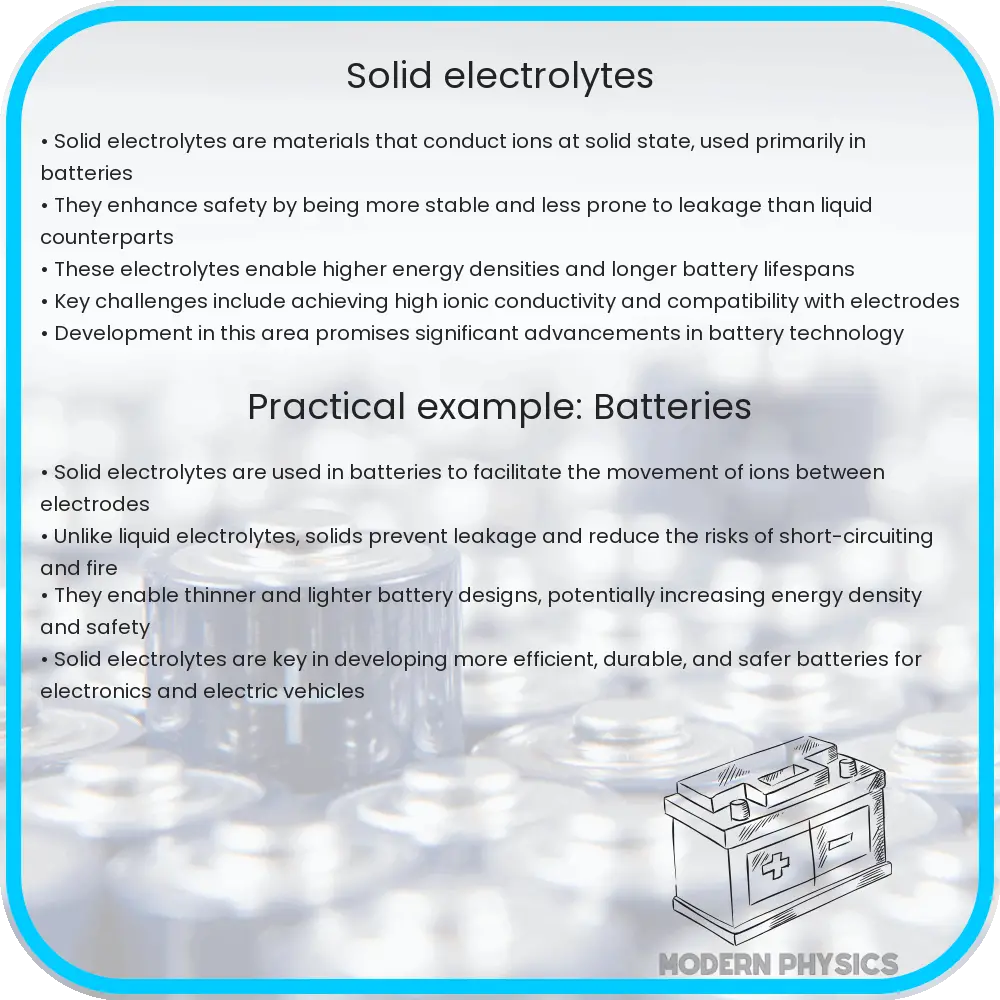
Solid electrolytes enhance battery safety, stability, and performance by replacing liquid counterparts and conducting ions in a solid state.
Understanding Solid Electrolytes
Solid electrolytes represent a significant advancement in the field of material science and have profound implications for battery technology. The concept revolves around materials that can conduct ions at solid state, potentially replacing traditional liquid electrolytes found in conventional batteries. This pivot not only promises enhanced conductivity and stability but also improves the safety parameters drastically, which is crucial for consumer electronics, electric vehicles, and large-scale energy storage systems.
Enhanced Conductivity
The conductivity of an electrolyte is crucial as it directly affects the efficiency and performance of a battery. Solid electrolytes can offer superior ionic conductivity, sometimes even comparable to their liquid counterparts. The ionic movement in solid electrolytes typically occurs through the lattice of the material. An ion in a solid electrolyte moves from one vacant site to another in the lattice through a process known as hopping. This mechanism can be influenced by the type of material used, the lattice structure, and the presence of defects or dopants within the crystal structure.
- Superionic Conductors: Certain materials, classified as superionic conductors, demonstrate exceptional ionic conductivities. Examples include materials like lithium lanthanum titanate (LLTO) and beta-alumina solid electrolyte (BASE).
- Temperature Effects: Unlike liquid electrolytes, the performance of solid electrolytes can often improve with an increase in temperature, helping the ions move more freely.
Stability and Compatibility
Chemical and electrochemical stability is paramount for battery materials. Solid electrolytes generally show excellent stability under a range of temperatures and chemical environments, which is a notable advantage over liquid electrolytes that can be reactive and flammable. Moreover, solid electrolytes can be more compatible with both the anode and cathode materials, reducing the degradation commonly seen in battery systems due to side reactions at the electrode-electrolyte interface.
- Wide Electrochemical Window: Solid electrolytes typically possess a wider electrochemical window, which can potentially enable the use of high-voltage cathodes and thus increase the energy density of batteries.
- Prevention of Dendrite Growth: One of the critical challenges in lithium batteries – dendrite growth, which can lead to short circuits, is significantly mitigated by using solid electrolytes. These materials are less prone to dendritic penetration thanks to their mechanical stiffness.
Improving Safety
The safety of battery systems is dramatically enhanced by the adoption of solid electrolytes. They are non-flammable and do not leak, unlike their liquid counterparts, thus reducing the risk of battery fires and chemical spills. In scenarios like car accidents, where battery integrity might be compromised, solid electrolytes can provide a much safer alternative by reducing the chances of ignition.
- Thermal Stability: Solid electrolytes are more resistant to extreme temperatures, which significantly minimizes the risk of thermal runaway—a condition where an increase in temperature can lead to a self-sustaining series of reactions followed by a rapid release of heat.
- Environmental Resistance: Solid electrolytes are also less susceptible to degradation from moisture or air exposure, which extends the life and reliability of the battery under different environmental conditions.
This discussion exemplifies how solid electrolytes are transforming battery technology, not just in improving performance but also in ensuring stability and safety. As research continues and technology advances, the adoption of solid electrolytes might herald a new era in energy storage systems, making them more efficient, durable, and environmentally friendly.
Future Prospects and Challenges
While the benefits of solid electrolytes are compelling, there are still significant challenges to overcome before these materials can be widely implemented in commercial applications. Addressing these obstacles is crucial for the future of solid-state batteries.
- Manufacturing Costs: Currently, the production of solid electrolytes and solid-state batteries is more expensive than that of their liquid counterparts. Reducing manufacturing costs is essential for their adoption in mainstream markets.
- Scaling Production: Scaling up the production to meet large-scale demands while maintaining quality and performance is another critical challenge.
- Interface Resistance: One significant issue is the high interface resistance between the solid electrolyte and the electrodes, which can affect the battery’s overall efficiency. Innovative solutions are needed to enhance the interface contact.
Despite these challenges, ongoing research and development are pushing the boundaries of what’s possible with solid electrolytes. Innovations in material science, engineering, and manufacturing processes continue to gradually address these issues, paving the way for a future dominated by safer and more efficient batteries.
Conclusion
Solid electrolytes stand at the forefront of revolutionizing battery technology. With their superior conductivity, enhanced safety features, and chemical stability, they offer a promising alternative to liquid electrolytes. Although there are hurdles like high manufacturing costs and scalability issues, the potential benefits make overcoming these challenges a worthy pursuit. As industries and researchers collaborate to refine these technologies, we may soon see a new era in energy storage solutions that are not only more efficient but also significantly safer and more sustainable. The journey of solid electrolytes from laboratory research to widespread practical application exemplifies the exciting progress and potential in the field of advanced battery technologies.
By understanding and supporting the development of solid electrolyte technologies, society can step towards more reliable, economically feasible, and environmentally friendly energy storage systems, powering everything from mobile devices to electric vehicles and beyond.