
Sodium Potassium Niobate (KNN) is a ceramic material noted for its exceptional piezoelectric properties and eco-friendly, lead-free composition.
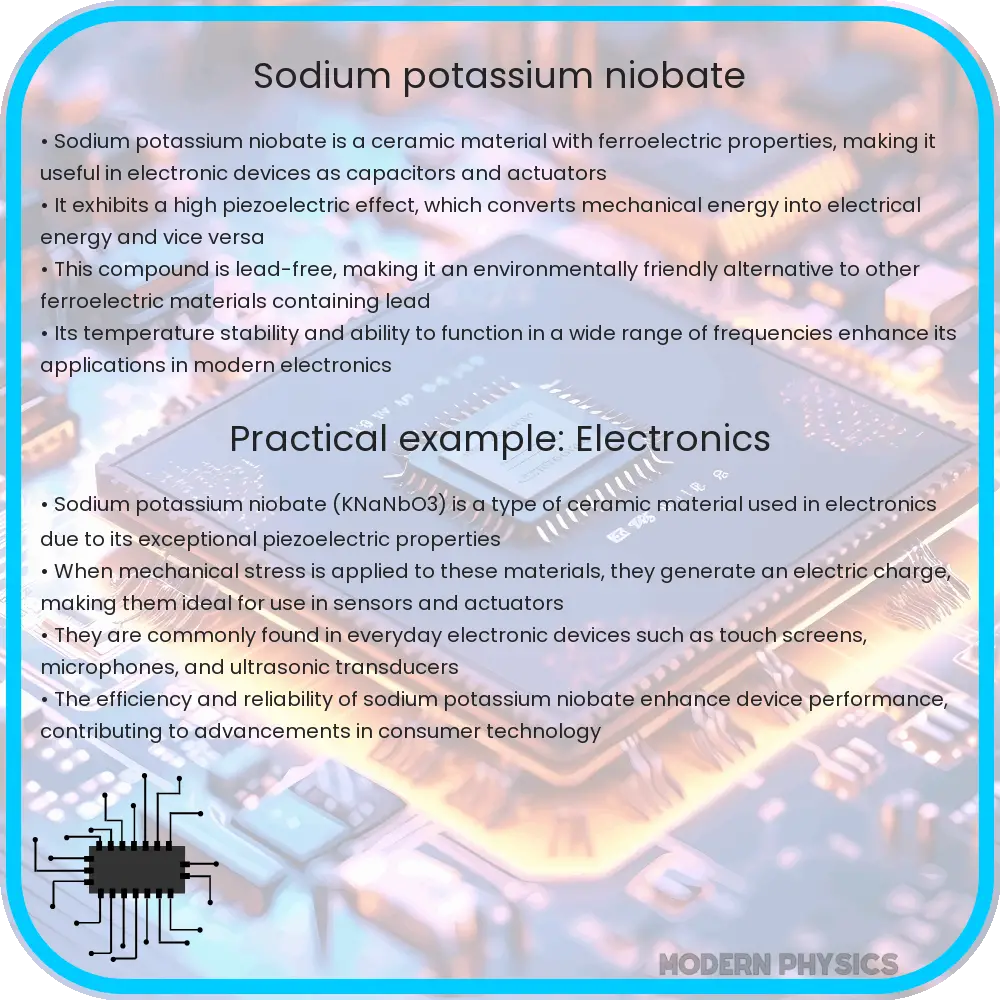
Understanding Sodium Potassium Niobate: An Efficient, Durable, and Eco-Friendly Material
Sodium Potassium Niobate (KNN) is an intriguing ceramic material that has garnered significant attention in the fields of material science and engineering due to its remarkable properties and potentials for various applications. Recognizing KNN’s significance involves diving into its unique combination of electrical, mechanical, and thermal properties, which makes it a standout candidate, especially for piezoelectric applications.
Composition and Structure of KNN
Chemically expressed as (K,Na)NbO3, Sodium Potassium Niobate is a solid solution of Sodium Niobate (NaNbO3) and Potassium Niobate (KNbO3). This material belongs to the group of perovskite structures, characterized by the general formula ABO3, where ‘A’ and ‘B’ are two different cations. In KNN, K+ and Na+ occupy the A sites while Nb5+ occupies the B site, surrounded by oxygen ions forming an octahedral structure.
Exceptional Piezoelectric Properties
Piezoelectric materials can generate an electrical charge in response to mechanical stress, a property that is extensively utilized in a myriad of applications from simple lighters to sophisticated sensors and actuators in aerospace applications. KNN is particularly noted for its impressive piezoelectric coefficients, which are comparable and in some cases, superior to those of other commonly used materials such as Lead Zirconate Titanate (PZT).
The efficiency of KNN as a piezoelectric material makes it highly desirable for use in electronic devices. For example, the piezoelectric coefficient (d33) of KNN can reach values up to 200 pC/N, which directly competes with the efficiency of PZT but without the environmental and health hazards associated with lead-based materials.
Environmental Impact and Sustainability
One of KNN’s most significant advantages is its lead-free composition. Many current piezoelectric materials contain lead, posing environmental and health risks during manufacture and disposal. KNN offers an eco-friendly alternative that reduces the use of hazardous substances, adhering to global regulations like the Restriction of Hazardous Substances Directive (RoHS), which restricts the use of specific hazardous materials in the manufacture of various types of electronic and electrical equipment.
Moreover, the robustness of KNN in terms of thermal stability also contributes to its sustainability. It exhibits excellent thermal stability up to temperatures of about 300°C, making it suitable for applications in environments where high temperatures are common, thus extending the material’s life and reducing replacement frequency.
- Lead-free and non-toxic
- High thermal stability
- Reduced environmental footprint
Applications in Modern Technology
The unique properties of Sodium Potassium Niobate pave the way for its integration into modern technological applications. It is increasingly being considered for use in actuators, sensors, energy harvesting devices, and capacitors. In particular, the telecommunications industry benefits from KNN’s piezoelectric properties in components such as filters and resonators, which are critical for enhancing the performance and efficiency of communication devices.
Furthermore, the automotive industry is exploring the use of KNN in sensors for precise control systems and in energy harvesting devices to convert mechanical stress or vibrations into electrical energy, thus improving the energy efficiency of vehicles.
Thermal Properties and Reliability
Continuing with its impressive attributes, the thermal properties of KNN contribute significantly to its reliability in various engineering applications. The material’s ability to withstand high temperatures without degrading its piezoelectric properties ensures long-term durability and performance. This thermal resilience is particularly beneficial in applications involving fluctuating operational temperatures, reducing the risk of failure and minimizing maintenance requirements.
Additionally, Sodium Potassium Niobate exhibits a low thermal expansion coefficient, which means it experiences minimal dimensional changes with temperature variations. This stability is crucial for maintaining the precision and accuracy of devices, especially in sensitive applications such as medical instruments and aerospace components.
Economic Potential and Manufacturing Challenges
While KNN offers numerous environmental and performance advantages, its widespread adoption faces economic and manufacturing challenges. The synthesis of high-quality KNN requires precise control over the material composition and crystal structure, which currently involves complex and costly manufacturing processes. Moreover, scaling these processes to meet industrial demand while maintaining quality and consistency remains a significant challenge.
However, ongoing research is aimed at refining the production techniques to reduce costs and improve the scalability of KNN. These advancements hold the potential to make Sodium Potassium Niobate a more economically viable option in the competitive market of electronic materials.
- Complex manufacturing process
- Research on cost reduction and scalability
- Increasing economic viability
Conclusion
In conclusion, Sodium Potassium Niobate (KNN) represents a breakthrough in material science and engineering, offering a combination of excellent piezoelectric properties, thermal stability, and environmental friendliness. Its composition allows for a lead-free, non-toxic alternative to traditional piezoelectric materials, aligning with global environmental standards and reducing health risks associated with lead. Despite the challenges in manufacturing and cost, its potential applications in modern technology—from telecommunications to automotive energy systems—showcase its capability to significantly impact various industry sectors. As research continues to overcome economic and production hurdles, KNN stands poised to become an even more integral part of future technological solutions, driving innovation in a sustainable and efficient manner.