
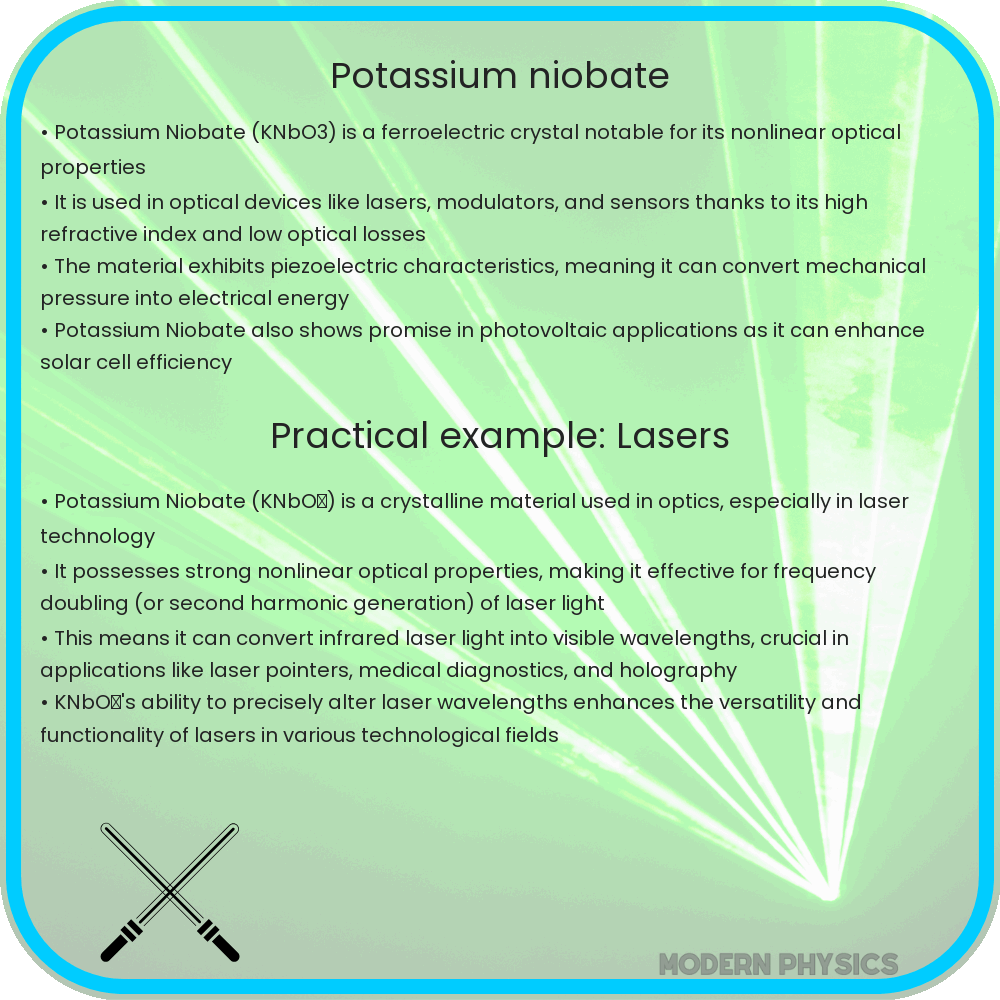
Potassium Niobate (KNbO3) is a ceramic material known for its piezoelectric, optical, and thermal properties, used in various scientific and industrial applications.
Introduction to Potassium Niobate
Potassium Niobate (KNbO3) is a fascinating ceramic material well-known for its piezoelectric properties, where mechanical energy is converted into electrical energy and vice versa. This material also exhibits impressive optical and thermal properties, making it a subject of interest in various scientific and industrial applications. In this article, we will delve into the characteristics of Potassium Niobate and explore how these properties are applied in real-world scenarios.
Piezoelectric Properties of Potassium Niobate
The piezoelectric effect in Potassium Niobate is one of its most prominent features. This occurs when a material produces an electric charge in response to applied mechanical stress. KNbO3 is particularly efficient in this regard due to its crystal structure. The piezoelectric coefficient in Potassium Niobate, represented as d33, is significantly high, making it very responsive and capable of producing substantial electrical output under stress.
- Applications of Piezoelectricity: This feature is exploited in various applications including precision actuators, sensors, and energy harvesting devices. In micro-electronics, KNbO3 can be used to fabricate components that precisely control mechanical movements motivated by electrical signals.
- Comparison with Other Piezoelectrics: When compared to other common piezoelectric materials like Quartz or PZT (Lead Zirconate Titanate), KNbO3 offers a higher piezoelectric coefficient, which can translate into more efficient performance in certain applications.
Optical Properties of Potassium Niobate
Known for its excellent optical nonlinearity, Potassium Niobate is widely used in non-linear optical applications. Non-linearity in optics refers to how certain materials change their refractive index in response to the electric field of light, affecting how light propagates through them.
- Second Harmonic Generation (SHG): KNbO3 is effectively used in generating second harmonic signals, where it converts incoming light to a light of double the frequency, thereby altering its color. This is crucial in various laser applications and in the creation of tunable lasers.
- Photorefractivity: Another significant optical property of KNbO3 is its photorefractive effect. This is the ability of the material to change its refractive index based on the intensity of light, useful in dynamic holographic imaging and optical data storage.
Thermal Properties of Potassium Niobate
The thermal properties of KNbO3 add to its adaptability in different environments. Its high Curie temperature, over 400°C, makes it suitable for applications in environments where high temperatures are prevalent. This high Curie temperature indicates that KNbO3 retains its piezoelectric properties even at elevated temperatures, which is critical for high-temperature sensors and actuators.
- Thermal Expansion Coefficient: KNbO3 has a relatively moderate thermal expansion coefficient, which means it experiences limited expansion or contraction in response to temperature changes. This property is crucial in applications requiring dimensional stability across a range of temperatures.
- Heat Capacity: Understanding the specific heat capacity of KNbO3 is essential for applications that involve heat management, such as thermal sensors and electronic cooling systems.
Real-World Applications of Potassium Niobate
The unique combination of piezoelectric, optical, and thermal properties of KNbO3 makes it an essential material in many cutting-edge technologies. From its role in advanced optics to its use in high-temperature sensor applications, potassium niobate continues to be a cornerstone in the development of new technology. Moreover, its efficacy in energy harvesting and efficiency in converting mechanical stress to electrical signals offers great promise for sustainable technology solutions.
In the following section, we will explore specific examples of these applications, highlighting how the properties of KNbO3 are utilized to create innovative solutions in science and engineering.
Specific Examples of Applications
Let’s explore some specific examples highlighting the real-world application of Potassium Niobate across various sectors:
- Telecommunications: In optical modulators, KNbO3 is used to manipulate light signals, effectively modulating optical communication signals for fiber optic networks. This capability is essential for the rapid and reliable transmission of data over long distances.
- Medical Devices: The high precision and responsiveness of KNbO3 make it invaluable in ultrasound technology. It is used in the production of ultrasonic transducers which are critical for diagnostic imaging, providing detailed and accurate images inside the human body.
- Environmental Monitoring: Due to its high sensitivity to temperature changes and the ability to operate under high temperatures, KNbO3 sensors are employed in environmental monitoring equipment. These sensors can detect and analyze environmental changes, aiding in early warning systems and research in climate change.
- Consumer Electronics: Potassium niobate is used in the actuators of precision-based devices like camera stabilizers and autofocus mechanisms. These applications benefit from the material’s quick response times and precise control over mechanical movements.
Conclusion
In conclusion, Potassium Niobate (KNbO3) stands out as a versatile and efficient ceramic material, particularly noted for its outstanding piezoelectric, optical, and thermal properties. Whether it’s enhancing the capabilities of telecommunications, pushing the boundaries of medical diagnostic tools, aiding in environmental monitoring, or refining consumer electronics, KNbO3 has proven to be indispensable in both traditional and innovative applications. Its continued use and research signify not only advancements in material science but also the possibility for future innovations that harness the unique characteristics of KNbO3 to solve complex challenges in science and engineering. With ongoing technological developments, the potential applications of Potassium Niobate are bound to expand, further cementing its role as a crucial material in the advancement of modern technology.