
Investigate shock wave interactions in hydrodynamics, focusing on their formation, properties, and applications across multiple fields.
Understanding Shock Wave Interactions in Hydrodynamics
Shock waves represent a fundamental concept in hydrodynamics, typically occurring when a medium’s fluid particles are displaced at a speed exceeding the local speed of sound. This phenomenon is crucial in various fields, including aerospace engineering, weather patterns, and even medical technologies. By understanding shock wave interactions, scientists and engineers can better predict and manage the often dramatic effects these waves impart on their surroundings.
What are Shock Waves?
A shock wave is a type of propagating disturbance that moves faster than the speed of sound in its medium. It is characterized by an almost instantaneous change in pressure, temperature, and density of the medium. Common examples include the sharp, cracking sound of a supersonic jet breaking the sound barrier or the explosive bangs in fireworks.
Formation and Properties of Shock Waves
Shock waves form when an object or disturbance moves through a fluid — including air, water, or any gas or liquid — faster than the speed of the fluid’s sound velocity. This rapid movement compresses the fluid molecules so tightly that they create a steep wave front. The basic properties of shock waves include:
- Sudden increase in pressure: As the wave front passes through the medium, the pressure rises abruptly to several times that of the ambient condition.
- Temperature rise: Coupled with high pressure, the temperature within the fluid medium also escalates sharply across the shock wave.
- Density jump: There is a substantial increase in fluid density across the wavefront due to the compression of particles.
Interaction of Shock Waves
When two or more shock waves meet, they interact with each other, leading to complex fluid dynamic phenomena. These interactions can cause changes in the structure and intensity of the shock waves, which can significantly influence the flow behind them. Types of shock wave interactions include:
- Regular Interaction: The simplest form, where two shock waves intersect at a single point and two new shock waves emanate from that point. This type is typically predictable and less chaotic.
- Mach Reflection: Occurs when a shock wave hits a reflective surface causing it to split into three parts: a reflected shock, an incident shock, and a Mach stem (a vertically oriented shock wave).
- Irregular Interaction: More complex interactions showcasing behavior like diffraction, refraction, or formation of additional wave patterns, often resulting in turbulent flows.
Practical Insights and Effects
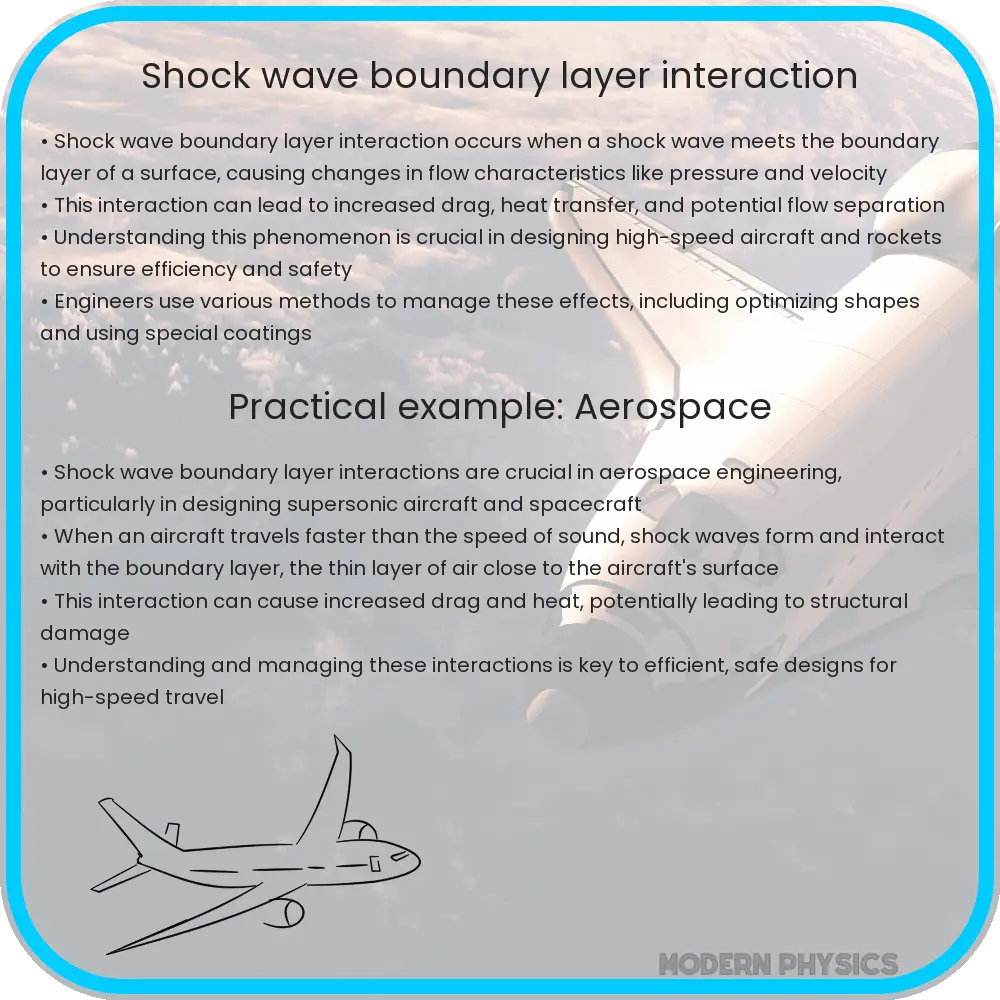
The study of shock wave interactions is not just academically intriguing; it also has practical implications. Engineers utilize this knowledge in designing supersonic aircraft, spacecraft, and even in medical procedures where shock waves can be used for lithotripsy to break up kidney stones without surgery. Additionally, understanding these interactions helps improve safety measures in mining and explosive detonations where shock waves play a crucial role.
From the roaring thunder of a jet to intricate vascular surgeries, the role of shock wave interactions is evident across various scenarios. As we delve deeper into specific examples and theoretical models, we gain a clearer picture of how these powerful phenomena are leveraged in both natural and human-made environments.
Models and Simulations of Shock Wave Dynamics
Understanding the behavior of shock waves in practical scenarios often requires sophisticated models and simulations. Computational fluid dynamics (CFD) is a key tool used by engineers and scientists to study and predict the behavior of shock waves under different conditions. These simulations help in enhancing the accuracy of theoretical models and contribute significantly towards optimized design strategies in engineering applications.
Challenges in Shock Wave Research
Despite the progress in simulation technology, researching shock waves poses several challenges. The transient nature of shock waves makes them difficult to capture and analyze accurately. High-speed cameras and advanced sensors are typically required to study these rapid phenomena. Moreover, the mathematical complexity involved in modeling shock interactions further complicates research efforts. This complexity often requires interdisciplinary knowledge, combining aspects of physics, engineering, and computational sciences.
Conclusion
Shock waves are a critical aspect of hydrodynamics with implications that span across various scientific and engineering disciplines. From the deafening roar of supersonic jets to the precise operations in medical procedures, understanding shock wave interactions enhances our ability to harness, manipulate, and mitigate their powerful effects. Continued research and technological advances in this field are essential for further discoveries and enhancements in safety, performance, and medical treatments. By demystifying the complexities of shock wave dynamics, we not only satisfy intellectual curiosity but also pave the way for innovations that impact our daily lives and future technologies.