
Relaminarization in fluid dynamics refers to the transition of turbulent flow back to a laminar state, impacting system efficiency and performance.
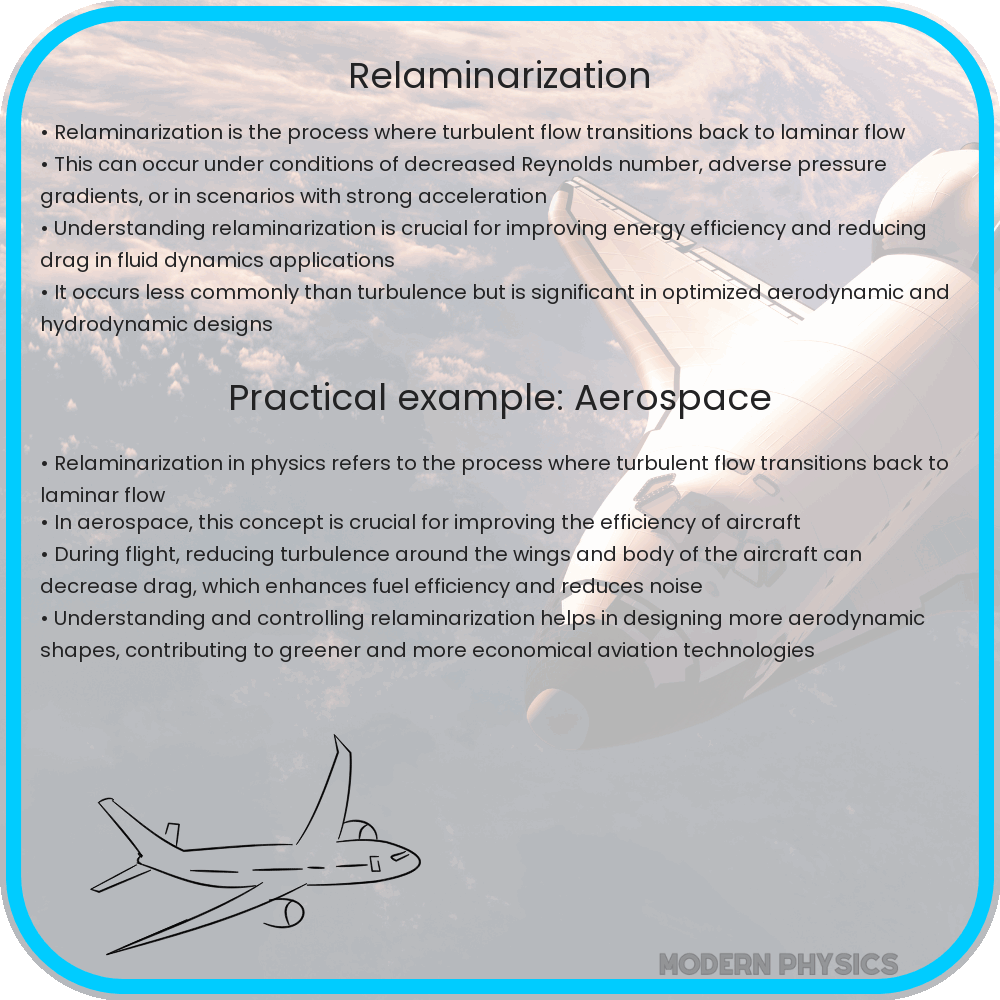
Understanding Relaminarization in Fluid Dynamics
Relaminarization is a significant phenomenon in the field of fluid dynamics, particularly within the context of hydrodynamic stability and control. It refers to the process by which a turbulent flow reverts to a laminar state. This transition can have profound effects on the efficiency and performance of various fluid-related systems, including pipelines, aircraft, and marine vehicles.
Hydrodynamic Stability: Turbulence vs. Laminarity
Before delving into the specifics of relaminarization, it’s crucial to understand the basic concepts of laminar and turbulent flows. Fluid flow, which refers to the motion of liquid or gas, can occur in two primary states:
- Laminar Flow: Characterized by smooth, parallel layers of fluid that move at different speeds. The flow is highly orderly and occurs at lower velocities or in fluids with higher viscosity.
- Turbulent Flow: Involves chaotic changes in pressure and flow velocity. It is generally more efficient at mixing and has a higher rate of momentum and mass transfer.
Turbulence is often undesirable due to its associated high energy losses and increased friction. Understanding and controlling the transition from turbulence to laminarity (relaminarization) can therefore enhance the performance and energy efficiency of various engineering systems.
Factors Influencing Relaminarization
Several factors can induce relaminarization, including:
- Pressure Gradients: Favorable pressure gradients (where pressure increases along the flow direction) can suppress turbulence and promote laminar flow.
- Flow Geometry: Modifications in the flow conduit, such as sudden expansions or contractions, can affect the flow’s turbulence intensity and potential for relaminarization.
- Fluid Properties: Changes in temperature or additives that affect the fluid’s viscosity can also lead to relaminarization.
Engineers can manipulate these factors through various hydrodynamic control techniques to achieve desired flow characteristics, enhancing system efficiency and stability.
Mathematical Description of Relaminarization
To quantify and predict relaminarization in fluid flows, several mathematical models and stability criteria are used. The Reynolds number (Re), a dimensionless quantity, is crucial in this analysis. It is defined as:
Re = (ρ * u * L) / μ
where:
- ρ is the fluid density,
- u is the mean flow velocity,
- L is the characteristic length, and
- μ is the dynamic viscosity of the fluid.
A lower Reynolds number suggests that the flow is more likely to remain or become laminar, while a higher Reynolds number indicates a propensity for turbulence. Understanding how operational and environmental changes affect the Reynolds number helps in controlling and predicting relaminarization.
Real-world Applications and Impacts of Relaminarization
Relaminarization has practical implications in various industries. For example, in aerospace engineering, controlling flow transition can reduce skin friction drag on aircraft, significantly improving fuel efficiency and reducing emissions. In the energy sector, relaminarization in pipelines can decrease the energy required to pump fluids, thus saving costs and decreasing environmental impact.
Moreover, in the realm of environmental engineering, enhanced understanding and control of turbulent flows can help in designing better wastewater treatment processes that are more efficient and less energy-intensive.
Understanding the complexities of relaminarization provides not only theoretical insights but also practical tools for engineers seeking to optimize systems involving fluid flow. By controlling the transition from turbulent to laminar states, energy consumption can be minimized while maximizing performance and stability in various engineering applications.
Challenges and Future Perspectives in Relaminarization
Despite the potential benefits, achieving and maintaining relaminarization in practical scenarios poses significant challenges. One of the main difficulties is the precise control of flow conditions required to induce relaminarization. External factors such as vibrations, surface roughness, and unforeseen changes in fluid properties can hinder the stabilization of laminar flow.
- Precision in Control: Maintaining the exact pressure gradients and flow velocities necessary for relaminarization demands high precision in control systems, which can be technically complex and economically expensive.
- Sensitivity to Conditions: Laminar flows are highly sensitive to external disturbances, making them difficult to sustain over long periods or large scales without sophisticated feedback and control mechanisms.
Future research in fluid dynamics aims to develop more robust models that account for these complexities. Advancements in sensors and control technology could lead to better prediction and management of flow states, thus making relaminarization a more practical option for industrial applications.
Education and Outreach in Fluid Dynamics
Educating upcoming generations of engineers and researchers about the importance of relaminarization and its potential applications is crucial. Enhanced curricula that include advanced fluid dynamics, hands-on experiments, and simulation-based learning can help in nurturing an informed and innovative workforce capable of tackling the challenges associated with turbulent and laminar flows.
- Interactive Learning: Developing interactive simulations and virtual labs to demonstrate the effects of relaminarization could make learning more engaging and impactful.
- Industry Partnerships: Collaborations between academic institutions and industry can facilitate real-world experience and foster innovation in fluid dynamics research and applications.
Conclusion
Relaminarization in fluid dynamics represents a critical area of research with broad implications across various engineering sectors. By understanding and influencing the transition from turbulent to laminar flow, engineers can optimize systems for higher efficiency and lower environmental impact. Despite the challenges, ongoing research and technological advancements promise new solutions to harness the benefits of relaminarization effectively. Through continued education and practical research, the field of fluid dynamics can continue to grow, contributing to sustainable and efficient engineering solutions.