
Learn about quantum efficiency and reliability in semiconductor devices, crucial for modern electronics performance and longevity.
Understanding Semiconductor Devices: Quantum Efficiency and Reliability
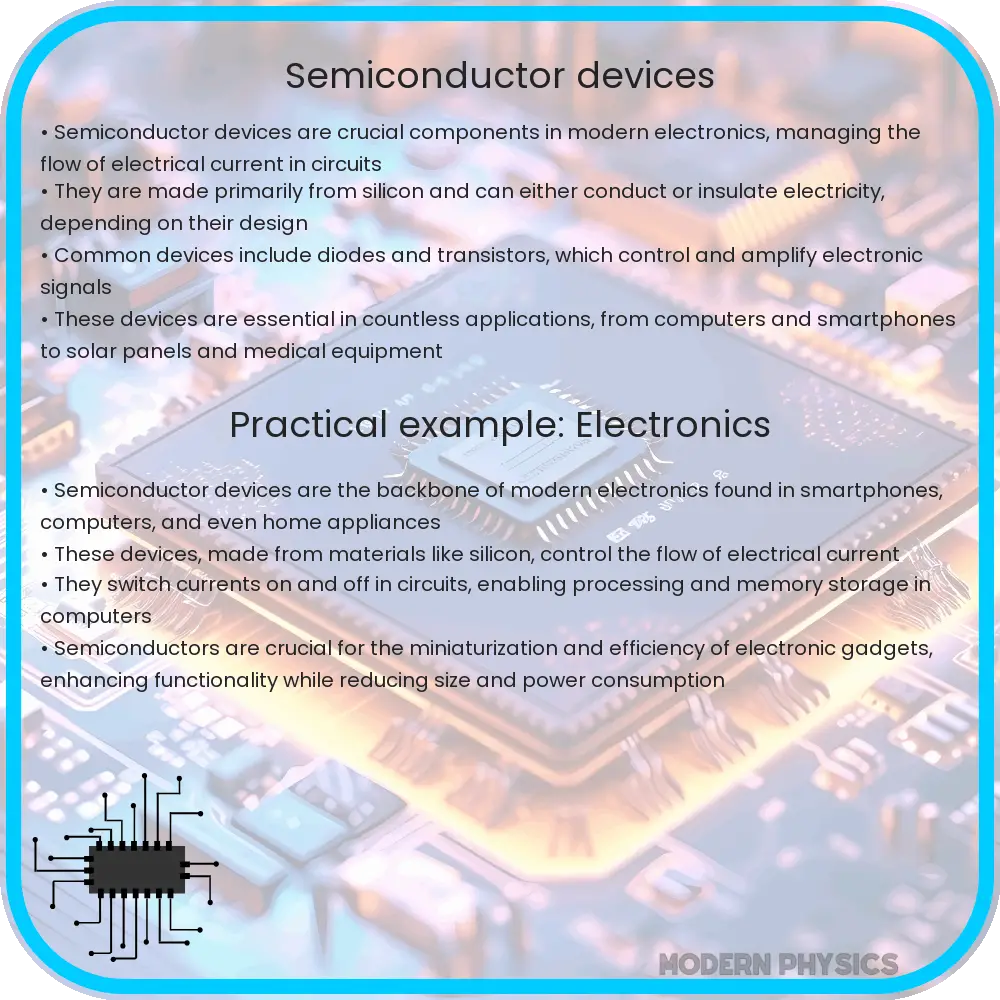
Semiconductor devices are the backbone of modern electronics, found in everything from smartphones to solar panels. At the heart of these devices is their ability to efficiently convert one form of energy into another, which is quantified by a parameter known as quantum efficiency. In addition, the reliability of semiconductor devices determines their longevity and performance stability over time. This article delves into the basics of quantum efficiency and reliability, shedding light on their critical roles in the functionality of semiconductor devices.
What is Quantum Efficiency?
Quantum efficiency (QE) is a measure of how effectively a semiconductor device converts incoming particles or photons into electric signals. It is particularly important in devices like photodetectors and solar cells. QE is defined as the ratio of the number of charge carriers generated to the number of photons absorbed. Mathematically, this is expressed as:
Quantum Efficiency (QE) = (Number of charge carriers generated / Number of photons absorbed) * 100%
This metric is crucial because it directly influences the performance and efficiency of devices by determining how well they harness energy from light. A higher QE means more efficient energy conversion, which is ideal for enhancing device performance.
Factors Affecting Quantum Efficiency
- Absorption Coefficient: Materials with a higher absorption coefficient can absorb photons more effectively, which generally leads to a higher quantum efficiency.
- Recombination: This is the process where electrons and holes recombine without generating current. Minimizing recombination is crucial for maximizing QE.
- Wavelength: The efficiency with which a semiconductor absorbs light can vary with the wavelength of the incoming photons. Devices need to be optimized for specific wavelengths depending on their application.
Understanding Device Reliability
Reliability in semiconductor devices refers to their ability to perform consistently over their intended lifetime. It encompasses various aspects including stability, durability, and resistance to environmental conditions such as temperature and humidity.
Several factors influence the reliability of these devices:
- Material Quality: Imperfections in the semiconductor material, such as impurities and crystal defects, can significantly affect the longevity and stability of devices.
- Device Design: Proper design and layout can mitigate stress and reduce the risk of failure. This includes considerations like thermal management and electrical loading configurations.
- Manufacturing Processes: The precision and conditions under which devices are manufactured also play a critical role in ensuring their reliability. This includes aspects such as doping concentrations and junction formations.
Ensuring reliability is crucial not only for the optimal performance of semiconductor devices but also for the trust and safety of the end-users relying on these devices in various applications.
Improving Quantum Efficiency and Reliability
To enhance both the quantum efficiency and reliability of semiconductor devices, researchers and engineers employ various strategies. These enhancements are vital for developing more efficient and durable electronic devices.
- Material Engineering: Developing new materials or modifying existing ones to improve absorption and minimize imperfections. This can lead to better quantum efficiency and device reliability.
- Advanced Fabrication Techniques: Utilizing precision fabrication techniques to reduce defects and achieve more accurate doping and junction depths, thereby enhancing both performance and reliability.
- Protective Coatings: Applying coatings to protect against environmental damage such as moisture or UV light, which helps extend the lifetime of the device.
Continuous research in these areas not only improves existing devices but also paves the way for the introduction of new technologies in the semiconductor industry.
Conclusion
Quantum efficiency and reliability are fundamental attributes that determine the performance and lifespan of semiconductor devices. Understanding these factors allows us to appreciate the complexities involved in developing cutting-edge electronic devices. As these components continue to play essential roles in our everyday technology, enhancements in their quantum efficiency and reliability hold the promise of more advanced, efficient, and robust electronic applications. Continuing advancements in material science, device design, and manufacturing techniques are key to achieving these improvements. This not only secures the future of semiconductor devices but also ensures their growing impact in various technological sectors, consequently making our dependency on electronics both sustainable and constructive.
With ongoing research and advancement, the journey of semiconductor devices from laboratory concepts to integral parts of daily life serves as a testament to the marvels of modern engineering and physics.