
Explore the uses and benefits of the Schmidt plate in astronomy and beyond, enhancing clarity, wide-field imaging, and correcting optical aberrations.
Schmidt Plate Uses and Benefits
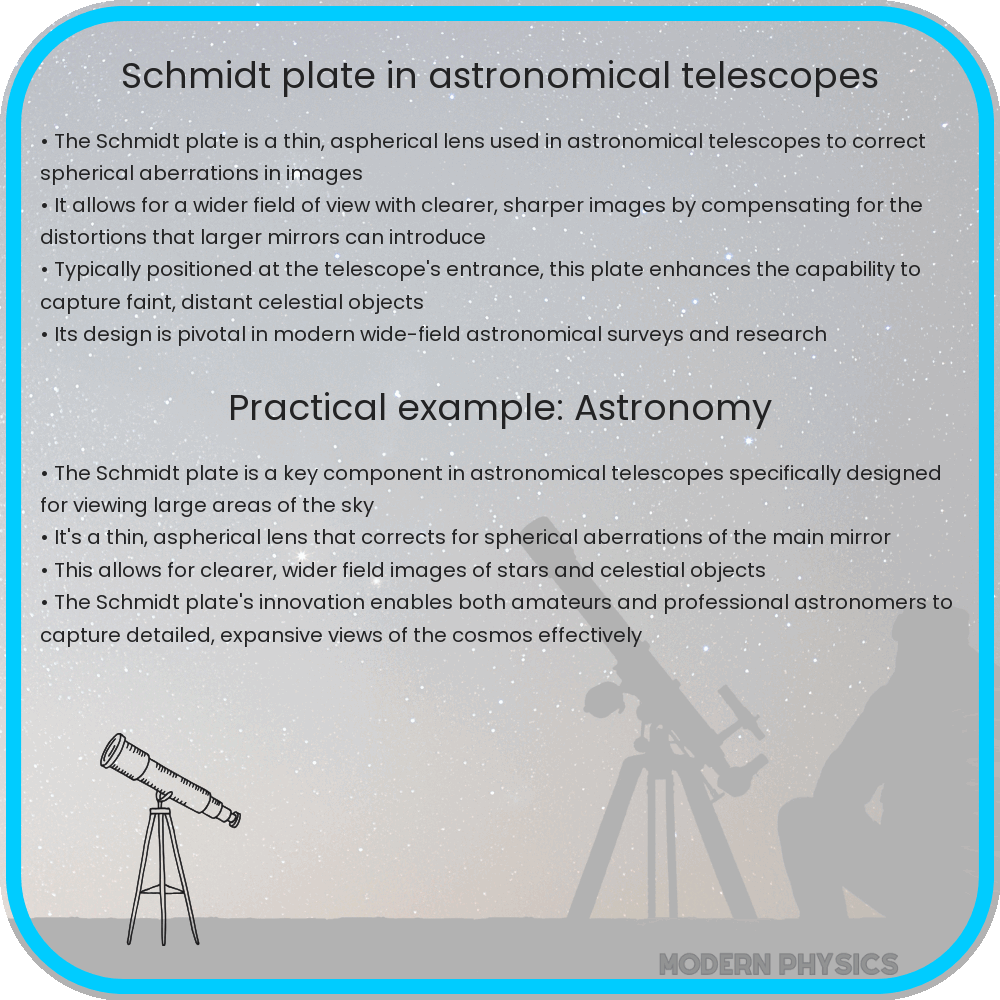
The Schmidt plate, a crucial component of the Schmidt camera, revolutionizes astronomical photography and observation. Its unique design and optical properties allow for clarity, wide-field imaging, and correction of common lens aberrations. This article explores the multifaceted uses and benefits of the Schmidt plate in modern astronomy and beyond.
Clarity in Astronomical Imaging
One of the primary advantages of the Schmidt plate is its ability to produce exceptionally clear images of celestial bodies. The plate, a thin, aspherical lens, corrects spherical aberration—an optical flaw common in telescopes that causes light rays from the edge of the lens to focus at different points than those from the center. This correction enables telescopes equipped with Schmidt plates to capture sharp, high-quality images across their entire field of view.
Wide-Field Imaging Capabilities
Astronomy benefits immensely from wide-field imaging, and the Schmidt plate excels in this domain. By correcting for optical aberrations over a large area, Schmidt cameras can observe vast swathes of the sky in a single shot. This capability is invaluable for surveying the cosmos, tracking near-Earth objects, and studying nebulae and galaxies. Wide-field imaging also facilitates the discovery of transient astronomical events, such as supernovae and comets, that might be missed with narrower fields of view.
Correction of Optical Aberrations
Beyond spherical aberration, the Schmidt plate also mitigates other optical imperfections. Its design allows for the correction of coma, a defect that causes off-axis points of light to appear comet-shaped, and astigmatism, which distorts images at the edge of the field. These corrections ensure that images are not only clear in the center but also across the entire field of view, making the Schmidt plate an essential tool for precision astronomy.
The innovative use of the Schmidt plate in telescopes has significantly advanced the field of astronomy, providing clearer images, wider fields of view, and comprehensive correction of optical aberrations. Its contributions extend beyond professional astronomy to amateur stargazers and educational institutions, democratizing access to high-quality astronomical observations.
Enhanced Photographic Capabilities
The Schmidt plate’s design not only benefits visual observation but also enhances photographic capabilities. Its ability to produce wide-field, distortion-free images is particularly advantageous for astrophotography, where capturing detailed, expansive views of the night sky is essential. The clarity and precision provided by the Schmidt plate allow for deep-sky imaging, revealing the intricate structures of distant celestial objects and phenomena with remarkable detail.
Applications Beyond Astronomy
While the Schmidt plate’s contributions to astronomy are well-documented, its applications extend into other fields as well. In satellite imaging and surveillance, the wide-field and high-resolution capabilities of the Schmidt plate enable the capture of large areas of the Earth’s surface with great detail, aiding in environmental monitoring, mapping, and national security. Additionally, its optical correction features are adapted for use in various optical instruments, including microscopes and cameras, enhancing image quality across different scales and contexts.
Future Prospects and Developments
The ongoing evolution of optical technology promises to expand the role of the Schmidt plate in both existing and new applications. Innovations in materials and manufacturing techniques are poised to further improve its performance and versatility, potentially leading to even wider fields of view and greater correction of optical aberrations. As these advancements continue, the Schmidt plate will undoubtedly play a pivotal role in pushing the boundaries of what is visually and photographically possible in astronomy and beyond.
Conclusion
The Schmidt plate stands as a testament to the ingenuity of optical design, offering unparalleled clarity, wide-field imaging capabilities, and comprehensive correction of optical aberrations. Its impact extends far beyond the realm of professional astronomy, enhancing photographic techniques, satellite imaging, and even applications in various scientific and industrial fields. As technology progresses, the potential uses and improvements of the Schmidt plate will continue to evolve, ensuring its place at the forefront of optical innovation. The enduring legacy of the Schmidt plate in advancing our understanding of the universe and improving the quality of optical imaging across disciplines is a compelling example of how specialized tools can have broad and lasting impacts.