
Explore the Sagnac Effect’s role in physics, linking relativity and rotation, its impact on technology, and implications in quantum mechanics.
Understanding the Sagnac Effect: Interplay of Relativity and Rotation
The Sagnac Effect, a fascinating phenomenon in the realm of physics, merges the concepts of relativity and rotation, offering crucial insights into our understanding of time and space. This effect, first observed by French physicist Georges Sagnac in 1913, has significant implications in fields ranging from geophysics to modern technology.
Basics of the Sagnac Effect
At its core, the Sagnac Effect occurs when a beam of light is split and sent in opposite directions around a rotating platform. After completing their respective circuits, the two beams are recombined. Remarkably, a phase difference is observed between them. This phase difference, or interference pattern, is directly proportional to the rate of rotation of the platform. The phenomenon is rooted in the principles of relativity and showcases how motion can affect the perception of time.
Relativity and the Sagnac Effect
Albert Einstein’s theory of relativity plays a pivotal role in explaining the Sagnac Effect. According to the Special Theory of Relativity, the speed of light is constant in all inertial frames of reference. However, when dealing with rotating frames, as in the case of the Sagnac Effect, we enter the realm of non-inertial frames. Here, the path length traveled by the light beams becomes crucial. The beam traveling in the direction of rotation has a longer path to cover than the one traveling against it, leading to the observed phase difference.
Applications of the Sagnac Effect
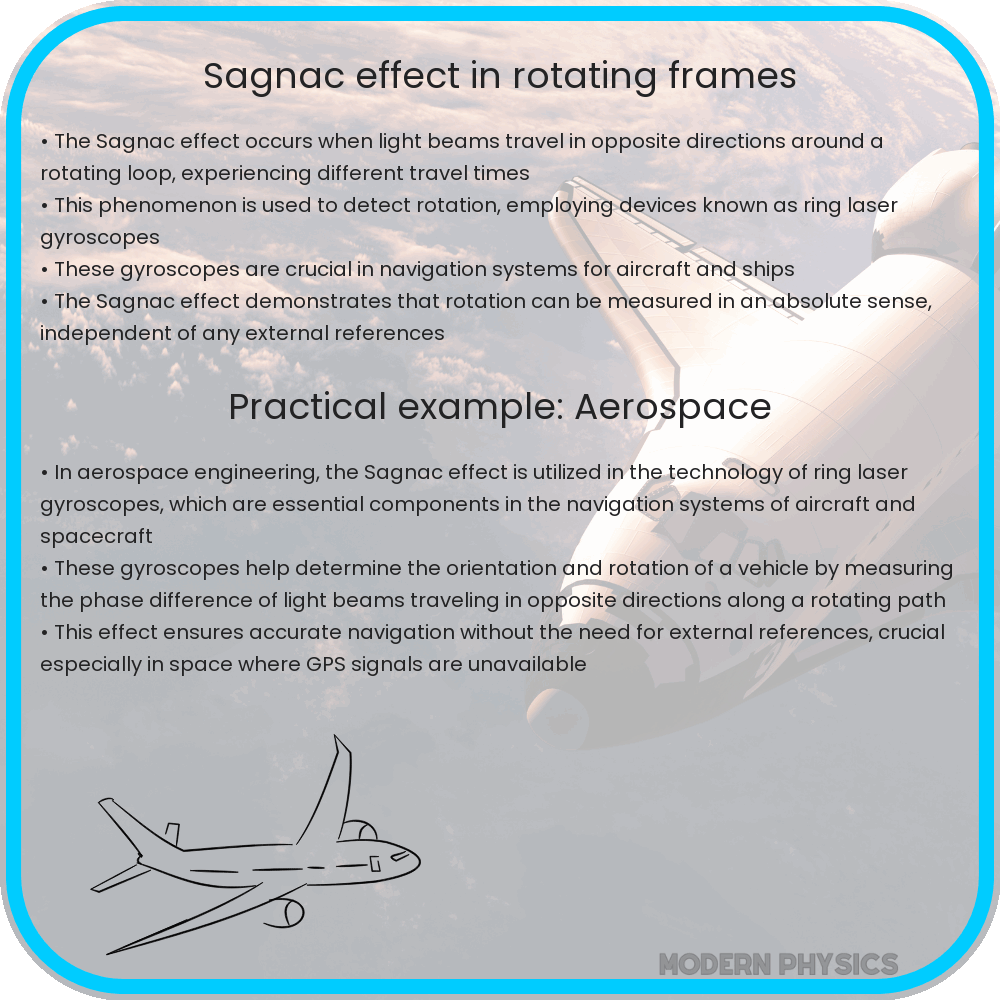
The practical applications of the Sagnac Effect are vast and diverse. It is the fundamental principle behind the operation of Ring Laser Gyroscopes and Fiber Optic Gyroscopes, which are integral components in modern navigation systems. These devices are used in various fields, including aerospace, for precise measurement of angular velocity. The effect also finds applications in geophysics, where it aids in measuring the rotation of the Earth.
Understanding the Sagnac Effect is not just a matter of theoretical interest. It provides a gateway to comprehending how rotation and relativity intertwine, affecting the very fabric of time and space. As we delve deeper into this topic, we uncover more about the intricate dance of light, motion, and gravity, revealing the complexities and wonders of our universe.
Advanced Insights into the Sagnac Effect
Delving deeper into the Sagnac Effect, it becomes evident that this phenomenon has far-reaching implications beyond its initial discovery. Advanced research has extended its application to the field of quantum mechanics and has played a crucial role in experiments involving rotational effects on space-time.
The Sagnac Effect and Quantum Mechanics
In the quantum realm, the Sagnac Effect has been instrumental in exploring the behavior of particles under rotational forces. Experiments involving atom interferometry have utilized this effect to observe the rotational influence on matter waves, thereby providing a unique perspective on quantum mechanics principles. This intersection of quantum mechanics and relativity through the Sagnac Effect is an area of active research, offering potential breakthroughs in our understanding of the universe at its most fundamental level.
Technological Advancements and Challenges
The technological implementations of the Sagnac Effect continue to evolve, with researchers striving to enhance the precision and sensitivity of gyroscopic devices. Challenges remain in minimizing errors due to environmental factors and in improving the stability and accuracy of these systems. These advancements have direct implications in sectors like autonomous navigation, where precision is paramount.
Conclusion
The Sagnac Effect stands as a testament to the relentless pursuit of knowledge in physics. From its early 20th-century origins to its role in modern technology and theoretical physics, it bridges classical mechanics and relativity, offering a nuanced understanding of motion and time. The effect’s practical applications in navigation and its potential in quantum mechanics research highlight its importance. As technology advances, the Sagnac Effect will undoubtedly continue to be a cornerstone in our quest to decipher the mysteries of the universe, demonstrating the profound impact of theoretical concepts on practical innovations.
In essence, the Sagnac Effect not only sheds light on the complex interplay between rotation and the fabric of space-time but also inspires future explorations in the vast realm of physics. It is a perfect example of how a singular scientific discovery can ripple through various domains, pushing the boundaries of our understanding and technological capabilities.