
Explore the Cassegrain telescope’s optics for superior clarity, precision, and depth in astronomical observation. A guide to its unique design and advantages.
Cassegrain Telescope Optics: A Gateway to the Universe
The Cassegrain telescope, a marvel of modern optics, combines clarity, precision, and depth to unlock the mysteries of the cosmos. Named after the French sculptor Sieur Guillaume Cassegrain, who is often credited with its invention in the 17th century, this telescope design has undergone various enhancements, making it a staple among amateur and professional astronomers alike.
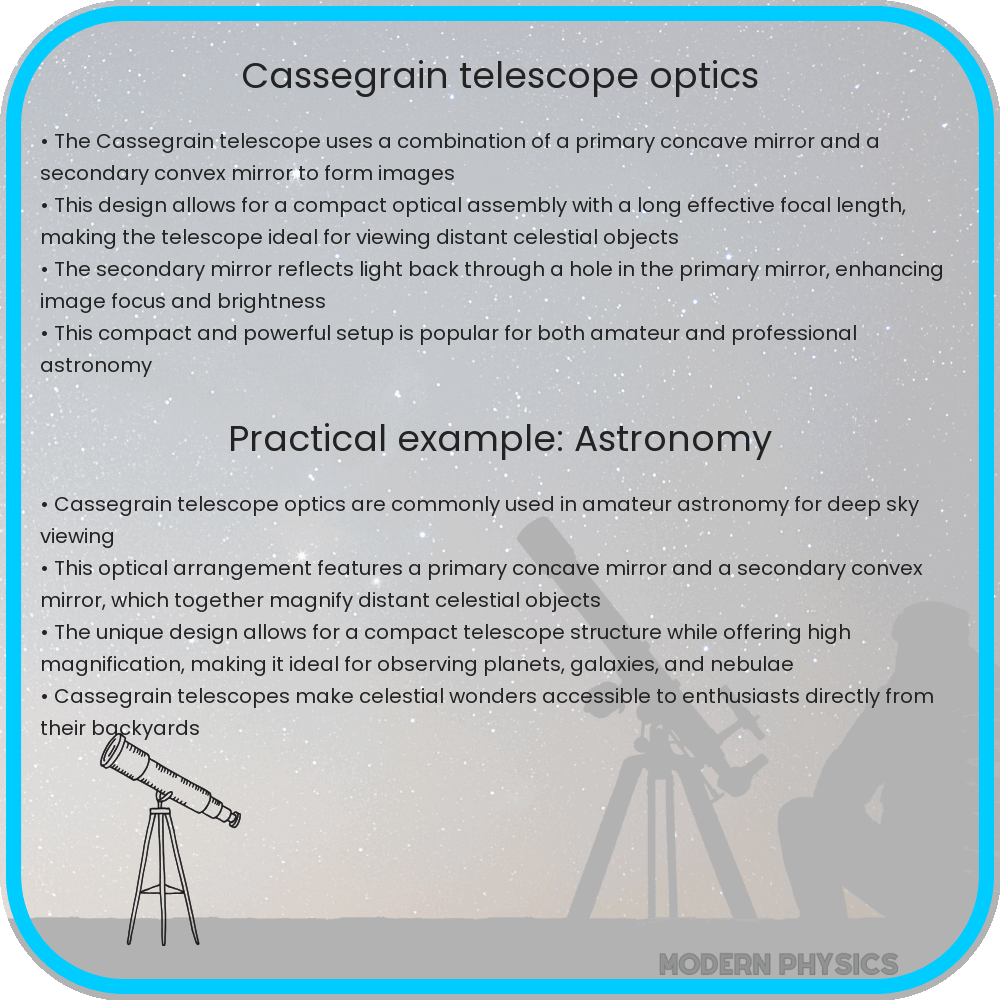
At its core, the Cassegrain telescope is distinguished by its unique optical layout. This design employs a primary concave mirror coupled with a secondary convex mirror, a configuration that not only compactly folds the optical path but also amplifies the focal length. The result is a powerful instrument capable of high magnification in a relatively compact body, making it ideal for observing distant celestial objects with remarkable clarity.
Optical Precision and Performance
The key to the Cassegrain telescope’s optical performance lies in its precision-engineered mirrors. The primary mirror, typically made from glass or a glass-ceramic hybrid like Zerodur, is meticulously shaped to a specific curvature. This curvature is crucial for focusing incoming light onto the secondary mirror, which then reflects the light through a hole in the primary mirror and into the eyepiece or camera. The quality of these mirrors, often coated with a layer of aluminum or silver to enhance reflectivity, directly influences the telescope’s ability to capture sharp, detailed images.
Another aspect that sets the Cassegrain telescope apart is its adaptability to various observing needs. Through the addition of Barlow lenses, which increase the effective focal length, or the use of different eyepieces, astronomers can easily adjust the magnification and field of view. This versatility makes the Cassegrain telescope an invaluable tool for both wide-field observations of nebulae and galaxies, and detailed studies of planetary surfaces.
The depth of view offered by Cassegrain telescopes is unparalleled. Their extended focal lengths allow for deep-sky observations, revealing the intricate structures of distant galaxies, nebulae, and star clusters. The ability to peer deeper into space, coupled with high-resolution imaging capabilities, makes the Cassegrain telescope a window to the universe’s most awe-inspiring phenomena.
Cassegrain Telescope Optics: Clarity, Precision & Depth
The Cassegrain telescope represents a significant advancement in optical technology, blending the best of clarity, precision, and depth in astronomical observations. Its unique design, featuring a primary parabolic mirror and a secondary hyperbolic mirror, allows it to capture distant celestial bodies with remarkable detail and brightness. This configuration not only minimizes optical aberrations but also provides a compact and durable structure ideal for both amateur astronomers and professional observatories.
At the heart of the Cassegrain’s optical superiority is its ability to gather light efficiently and focus it to a point of extraordinary sharpness. This efficiency is a result of the telescope’s reflective optics, which eliminate chromatic aberration—a common flaw in refractive systems where different wavelengths of light do not converge at the same point. The use of mirrors instead of lenses ensures that images are not only brighter but also more color-accurate.
Technological Innovations and Enhancements
Modern advancements have further elevated the Cassegrain telescope’s capabilities. Coatings such as aluminum or silver, often enhanced with a layer of silicon dioxide, are applied to the mirrors to reflect more light, thereby improving image brightness and contrast. Adaptive optics, another cutting-edge development, compensates for atmospheric turbulence, delivering images of celestial objects with unprecedented clarity and detail.
The versatility of the Cassegrain design also allows for various modifications, leading to subtypes like the Ritchey-Chrétien, popular among advanced astrophotographers and major observatories. This variant replaces the hyperbolic secondary mirror with one that is elliptical, further reducing spherical aberration and enhancing the telescope’s ability to capture wide-field images without distortion.
Conclusion
The Cassegrain telescope, with its refined optical system, continues to be a cornerstone in the exploration of the cosmos. Its design, combining clarity, precision, and depth, alongside technological enhancements, offers an unparalleled window into the universe. Whether used by a hobbyist stargazer or a professional researcher, the Cassegrain telescope remains a testament to human ingenuity and our endless quest to understand the vast, starry sky. As we push the boundaries of space and technology, the Cassegrain’s legacy of innovation and excellence ensures it will remain at the forefront of astronomical discovery for years to come.