
Explore the latest trends in RF Engineering and Electrodynamics, covering advancements like 5G, LPWAN, metamaterials, and THz technologies.
Understanding the Evolution of RF Engineering and Electrodynamics
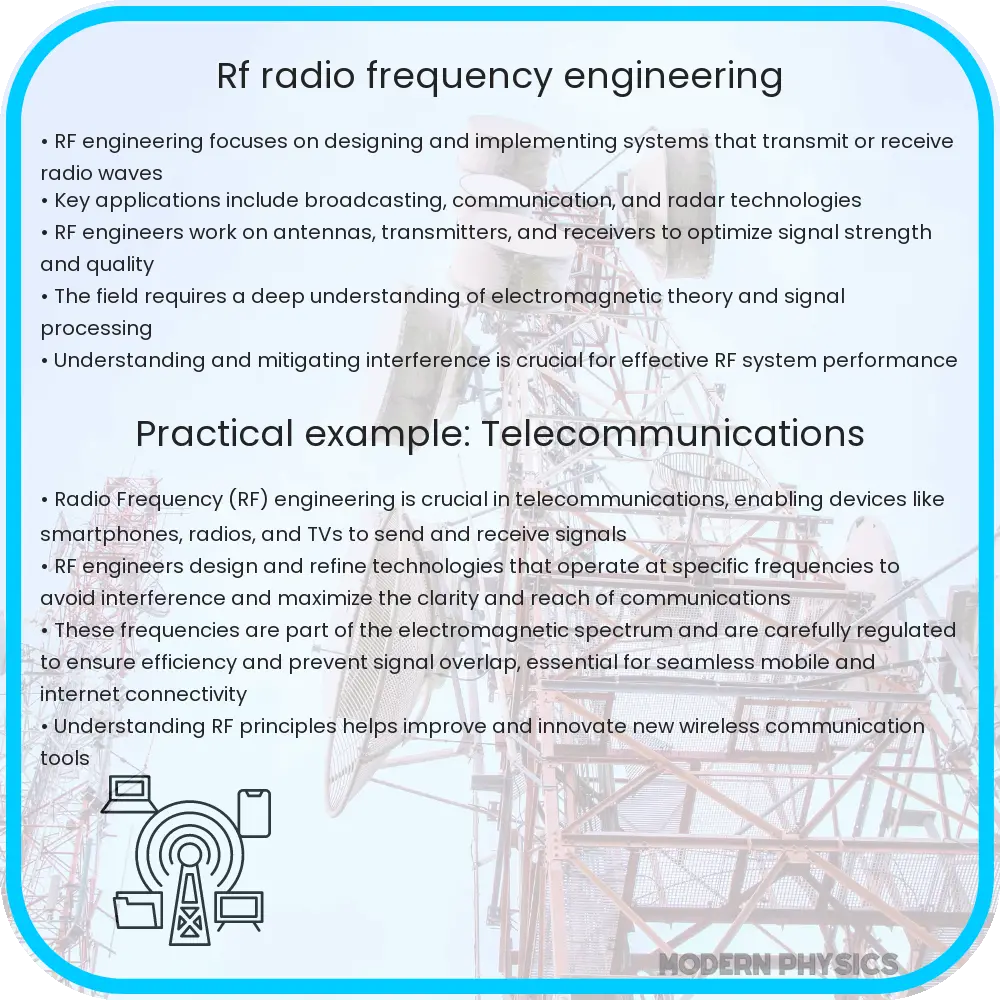
Radio Frequency (RF) Engineering and Electrodynamics are critical fields in the realm of wireless communication and electromagnetic theory. These sectors have undergone significant transformations over the years, driven by technological advancements and a deeper understanding of electromagnetic phenomena. This article delves into the key insights and trends that are shaping the future of RF Engineering and Electrodynamics.
Advancements in RF Engineering
RF Engineering focuses on the design and optimization of devices and systems that transmit or receive radio waves. Recent innovations in this field are predominantly centered around improving the efficiency and range of RF systems. One notable trend is the development of Low-Power Wide-Area Networks (LPWAN), which are becoming increasingly popular in Internet of Things (IoT) applications. LPWAN technologies like LoRa and Sigfox offer long-range communication with minimal power consumption, making them ideal for remote sensor networks and smart devices.
Another significant advancement is the evolution of 5G technology. 5G networks promise faster data rates, reduced latency, and higher capacity, revolutionizing how we interact with wireless devices. The implementation of 5G relies heavily on sophisticated RF designs that can handle higher frequencies and broader bandwidths, pushing the boundaries of conventional RF Engineering.
Breakthroughs in Electrodynamics
Electrodynamics, the study of electromagnetic forces, has been pivotal in enhancing our understanding of RF phenomena. A key area of research is the exploration of metamaterials. These artificially engineered materials exhibit unique properties not found in nature, such as negative refraction. They hold immense potential in manipulating electromagnetic waves, paving the way for innovations like superlenses and stealth technology.
Recent studies in quantum electrodynamics (QED) have also provided profound insights. QED, which combines quantum mechanics and the theory of relativity with electrodynamics, has led to the development of highly accurate models for the interaction of light and matter. This has implications not only in theoretical physics but also in practical applications like laser technology and quantum computing.
The integration of machine learning algorithms with electrodynamics is another emerging trend. By leveraging data-driven approaches, researchers are gaining new perspectives in antenna design, signal processing, and electromagnetic interference (EMI) mitigation. This confluence of disciplines is expected to yield more efficient and intelligent RF systems in the near future.
Emerging Trends in RF Engineering and Electrodynamics
As we continue to explore the realms of RF Engineering and Electrodynamics, several emerging trends stand out. One such development is the increasing use of software-defined radio (SDR). SDR offers unparalleled flexibility, allowing the characteristics of a radio to be altered through software updates rather than hardware changes. This adaptability is crucial in a rapidly evolving technological landscape, especially in applications like military communication and cellular networks.
Another area gaining traction is the study of terahertz (THz) frequencies. These frequencies, which lie between the microwave and infrared bands of the electromagnetic spectrum, offer promising opportunities for high-speed wireless communication and imaging techniques. Research in THz technology is opening doors to faster data transmission rates and improved medical imaging solutions.
Future Directions and Challenges
Looking ahead, the fusion of RF Engineering and Electrodynamics with other scientific disciplines suggests an exciting future. However, this integration also presents challenges. For instance, as we push towards higher frequency bands for communication, issues like signal attenuation and hardware limitations become more pronounced. Addressing these challenges requires innovative materials, sophisticated signal processing techniques, and new antenna designs.
Additionally, with the proliferation of wireless devices, managing electromagnetic spectrum congestion and interference is increasingly critical. Future developments in RF Engineering must consider not only technical efficiency but also spectrum allocation and regulation.
Conclusion
The fields of RF Engineering and Electrodynamics are at an exciting juncture, with advancements like LPWAN, 5G, metamaterials, and quantum electrodynamics reshaping our understanding and capabilities. The emergence of SDR and THz technologies points to a future where wireless communication and electromagnetic applications are more versatile and powerful. However, as we venture into these new territories, the need for innovative solutions to overcome the inherent challenges becomes paramount. With continued research and collaboration across disciplines, the potential for groundbreaking applications in communication, healthcare, and beyond is immense, signaling a new era in electromagnetic technology.