
Explore the principles, applications, and impact of Relativistic Lagrangian Mechanics, bridging classical physics and high-speed phenomena.
Understanding Relativistic Lagrangian Mechanics
Relativistic Lagrangian Mechanics, a cornerstone of modern physics, extends the principles of classical Lagrangian mechanics into the realm of special relativity. This extension is crucial for understanding the behavior of particles at velocities close to the speed of light. The theory harmonizes the principles of least action and relativistic invariance, providing a sophisticated framework for analyzing dynamic systems in high-speed environments.
Principles of Relativistic Lagrangian Mechanics
The foundation of Relativistic Lagrangian Mechanics lies in the Lagrangian function, which, in relativistic contexts, is modified to incorporate the effects of special relativity. Unlike in classical mechanics, where the Lagrangian is a simple difference between kinetic and potential energy (L = T – V), the relativistic Lagrangian incorporates Lorentz transformations, ensuring the laws of physics remain consistent across inertial frames moving at high velocities relative to each other. This modification is encapsulated in the formula:
L = -mc2sqrt(1 – v2/c2) – V, where m is the rest mass, c is the speed of light, v is the velocity of the particle, and V represents the potential energy.
Applications of Relativistic Lagrangian Mechanics
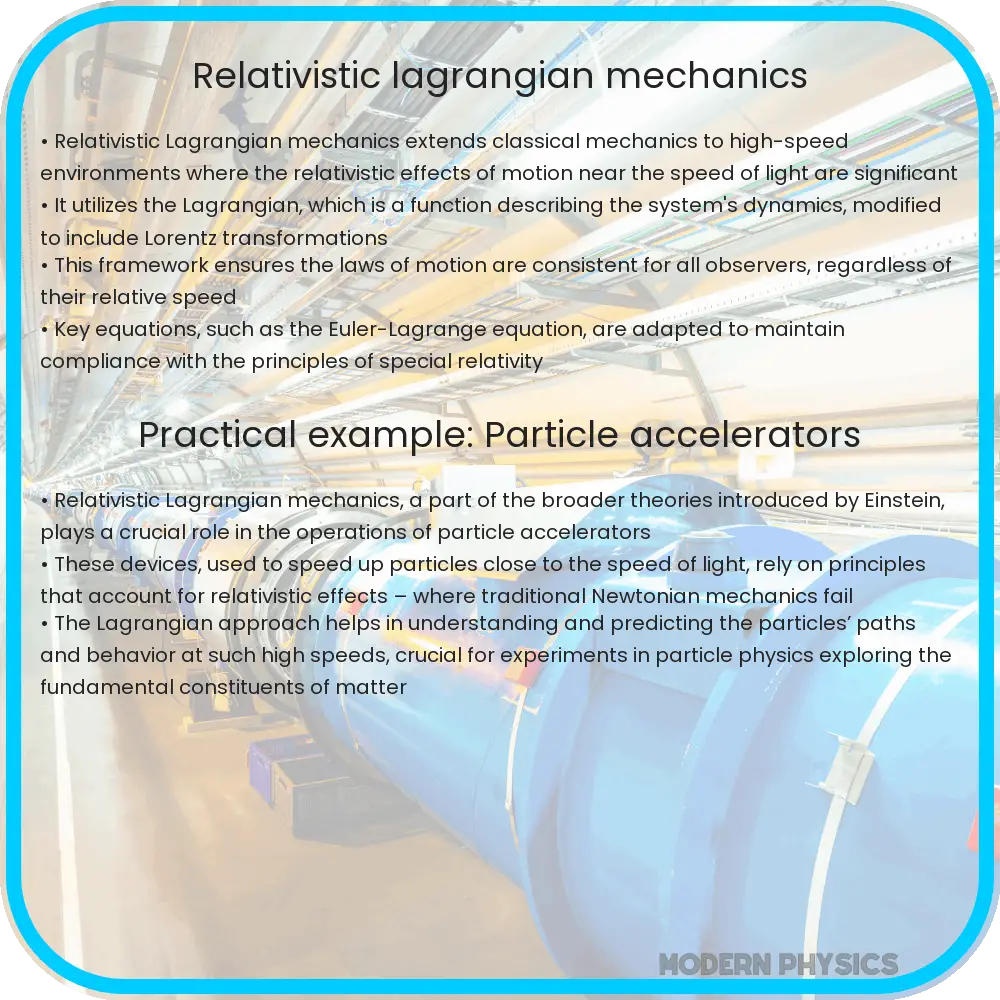
This framework has wide-ranging applications, particularly in fields where high-speed particles are prevalent. In particle physics, it provides insights into the behavior of subatomic particles in accelerators, where velocities approach that of light. Astrophysics also benefits from these principles, especially in the study of cosmic phenomena involving massive bodies moving at high speeds, such as neutron stars and black holes.
Impact on Modern Physics
The impact of Relativistic Lagrangian Mechanics on modern physics is profound. It has been instrumental in the development of quantum field theory and the Standard Model of particle physics. By enabling a deeper understanding of the fundamental forces and particles of the universe, it has paved the way for groundbreaking discoveries and technological advancements.
The integration of relativistic principles into Lagrangian mechanics represents a significant leap in our ability to describe and predict the behavior of systems under extreme conditions. As we continue to explore the universe and develop technologies that operate at high velocities, the importance of Relativistic Lagrangian Mechanics only grows, highlighting its enduring relevance in the ever-evolving landscape of physics.
Challenges and Future Directions in Relativistic Lagrangian Mechanics
Despite its successes, Relativistic Lagrangian Mechanics faces challenges, particularly in integrating with the quantum realm. The theory excels in macroscopic relativistic contexts but encounters difficulties when applied to quantum scales. This challenge has spurred developments in quantum field theory, where efforts are ongoing to create a unified framework that encompasses both quantum mechanics and relativity.
Another frontier is the exploration of extreme gravitational fields, like those near black holes, where general relativity becomes significant. Extending Lagrangian mechanics to accommodate general relativity is an area of active research, with potential implications for understanding the universe’s most enigmatic phenomena.
Technological Implications
The principles of Relativistic Lagrangian Mechanics also have practical applications in technology. For instance, in GPS systems, where the precision of satellite clocks is critical, relativistic effects must be accounted for to ensure accuracy. Similarly, in designing particle accelerators and high-energy physics experiments, these principles guide the understanding and manipulation of particles moving at relativistic speeds.
Educational and Theoretical Significance
In educational contexts, the study of Relativistic Lagrangian Mechanics offers a compelling gateway to advanced topics in physics. It bridges classical mechanics and modern physics, providing students with a deeper understanding of fundamental principles. Theoretically, it continues to inspire new models and hypotheses in physics, driving forward our understanding of the universe.
Conclusion
Relativistic Lagrangian Mechanics, a pivotal concept in modern physics, extends classical mechanics into the realm of high velocities and special relativity. It has significantly impacted various fields, from particle physics and astrophysics to technology and education. While challenges remain, particularly in reconciling it with quantum mechanics and general relativity, its foundational role in our understanding of the universe is indisputable. As we continue to probe the limits of the cosmos and the particles within it, Relativistic Lagrangian Mechanics will undoubtedly remain a crucial tool in deciphering the mysteries of the physical world.