
Explore the essentials of covariant formulation in physics, linking relativity, quantum mechanics, and the universe’s consistent laws.
Covariant Formulation of Physics Laws: Unveiling the Core Principles
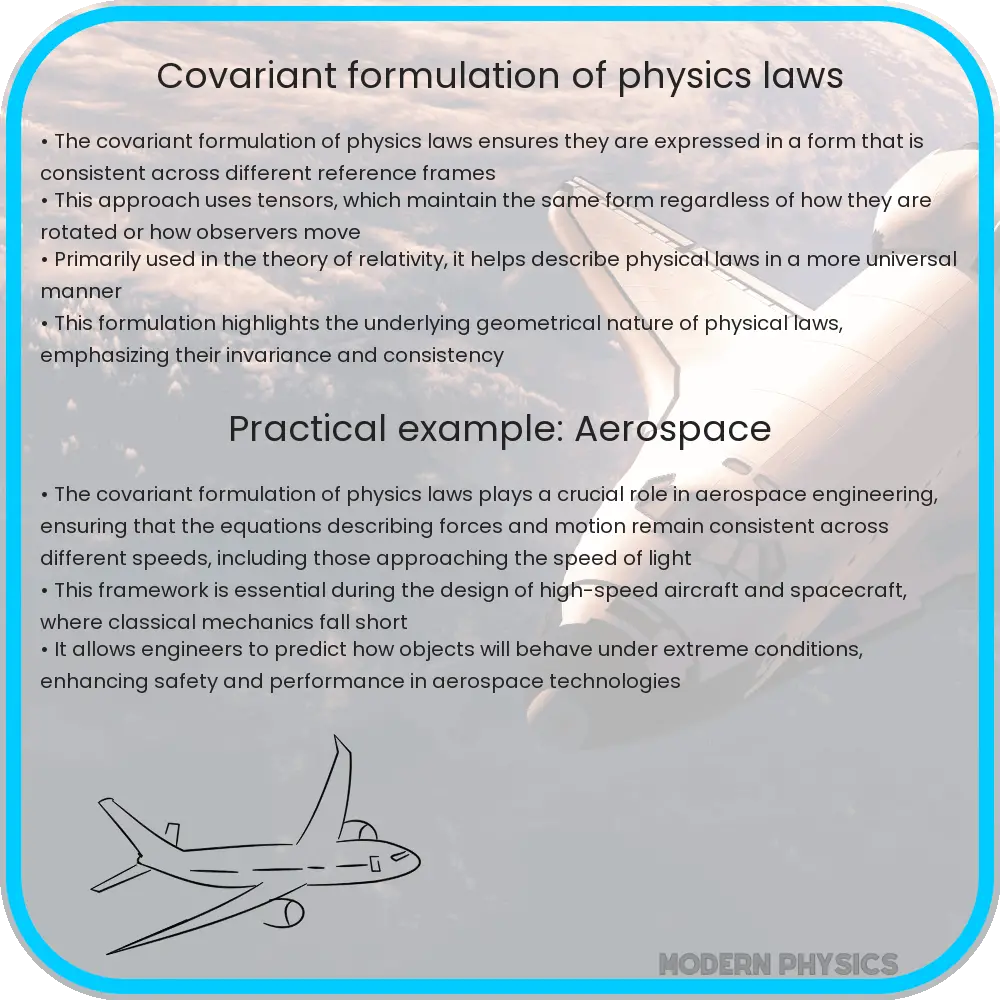
The covariant formulation of physics laws stands as a pivotal concept in modern theoretical physics, intertwining accuracy, consistency, and relativity in a profound manner. This approach is crucial for ensuring that physical laws hold true in all coordinate systems, thereby maintaining their universal applicability. The journey into this realm begins with understanding the necessity for a covariant approach in physics.
The Imperative for Covariance
Historically, the laws of physics were often expressed in forms that appeared to depend on the specific coordinate system used for their description. This raised a fundamental question: Shouldn’t physical laws be universal and independent of the observer’s frame of reference? The answer lay in the concept of covariance. Covariance ensures that the form of physical laws remains consistent across different coordinate systems, reflecting the inherent uniformity of the physical world.
Relativity and Covariance
The theory of relativity, proposed by Albert Einstein, is a quintessential example of the application of covariance. Einstein’s special relativity introduced the idea that the laws of physics are the same in all inertial frames. This principle of relativity was extended to include non-inertial frames in general relativity, where the covariance of laws becomes even more crucial. In these realms, the metrics of spacetime itself become dynamic, necessitating laws that are invariant under transformations of spacetime coordinates.
Mathematical Tools for Covariance
To achieve covariance, physicists employ mathematical tools like tensors and differential geometry. Tensors, objects that generalize vectors and matrices, remain invariant under coordinate transformations, making them ideal for expressing physical laws covariantly. For example, in Einstein’s field equations of general relativity, the stress-energy tensor \( T_{\mu\nu} \) and the Ricci curvature tensor \( R_{\mu\nu} \) play central roles. Differential geometry further aids in describing the curved spacetime of general relativity, where the usual rules of Euclidean geometry no longer apply.
The covariant formulation does not merely ensure mathematical elegance; it is a fundamental aspect of the consistency and accuracy of physical laws in describing the universe. As we delve deeper, the implications of covariance in different areas of physics, including quantum mechanics and cosmology, reveal a universe that is coherent and astonishingly interconnected.
Covariance in Quantum Mechanics and Cosmology
Extending beyond the realms of relativity, the covariant approach profoundly impacts other areas like quantum mechanics and cosmology. In quantum field theory, covariance underlies the very structure of the equations governing subatomic particles. The Lorentz invariance, a key aspect of special relativity, ensures that the behavior of these particles remains consistent across different frames of reference. Similarly, in cosmology, the principles of covariance guide our understanding of the universe’s large-scale structure and evolution, as evidenced in the cosmological principle which posits that the universe is homogeneous and isotropic on large scales.
Challenges and Future Prospects
Despite its successes, the covariant formulation of physical laws faces challenges, particularly in the quest for a theory of quantum gravity. The difficulty lies in unifying the general theory of relativity, a classical theory grounded in covariance, with quantum mechanics, which operates on a fundamentally different scale and principles. This quest for unification, often termed as the search for a ‘Theory of Everything’, remains one of the most intriguing and challenging areas in modern physics.
Conclusion
The covariant formulation of physics laws is more than a mathematical convenience; it is a testament to the underlying symmetry and unity of the natural world. Through its lens, we see a universe where the laws of physics hold invariant across the vast tapestry of spacetime, from the microscopic realms of quantum particles to the cosmic scale of galaxies. The journey of understanding and applying covariance in physics is ongoing, driving forward the boundaries of our knowledge. As we continue to grapple with the mysteries of the universe, the principles of covariance remain a guiding beacon, reminding us of the elegance and consistency that underlie the fabric of our reality.