
Explore the fundamentals of relativistic energy density, its formula, applications in physics, and insights into quantum mechanics and astrophysics.
Understanding Relativistic Energy Density
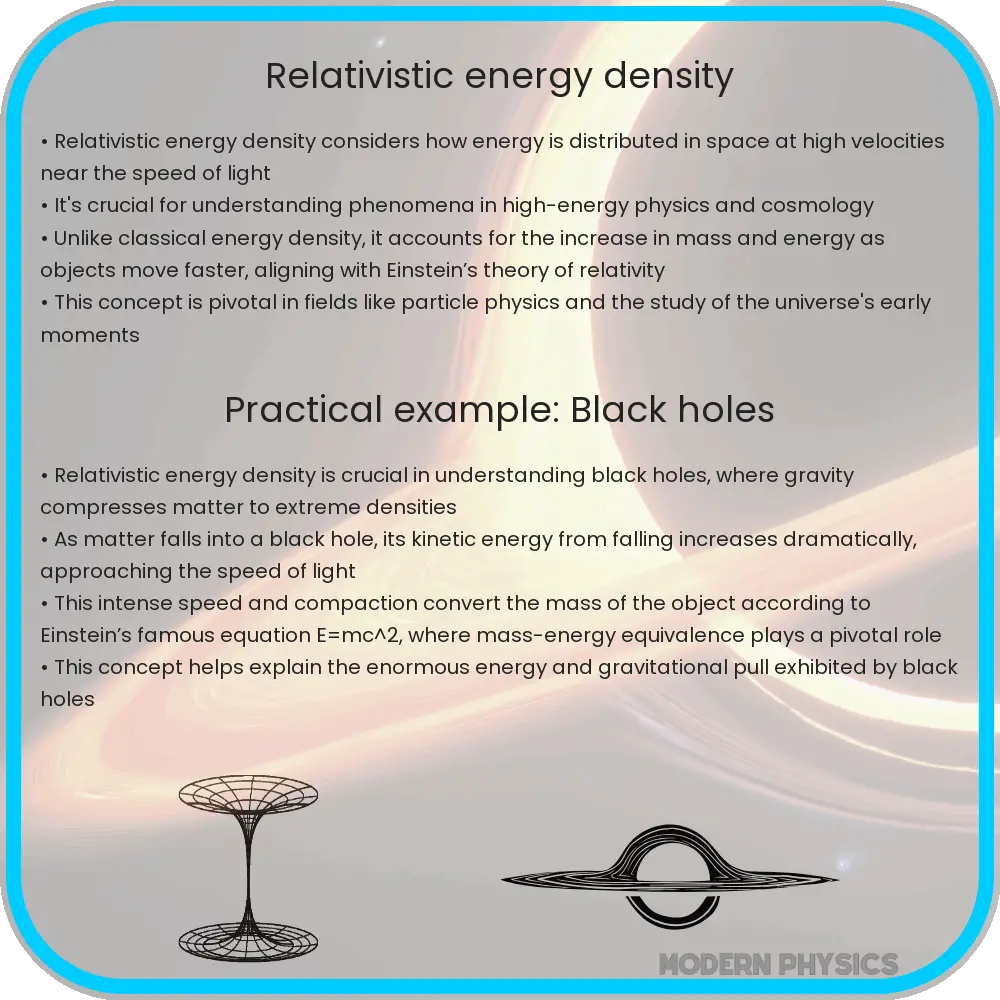
Relativistic energy density is a fundamental concept in physics, particularly in the realms of special relativity and astrophysics. It revolves around the energy contained within a system or region of space, taking into account the principles of Einstein’s theory of relativity. This concept is crucial for understanding high-energy phenomena in the universe, such as those involving particles moving at speeds close to the speed of light.
Formula and Derivation
The relativistic energy density is derived from Einstein’s famous equation, \( E = mc^2 \), where \( E \) represents energy, \( m \) is mass, and \( c \) is the speed of light in a vacuum. In a relativistic context, the energy of a particle is not only its rest mass energy (given by \( mc^2 \)) but also includes its kinetic energy due to motion. The total relativistic energy \( E \) of a particle is given by:
\[ E = \gamma mc^2 \]
Here, \( \gamma \) is the Lorentz factor, defined as \( \gamma = \frac{1}{\sqrt{1 – \frac{v^2}{c^2}}} \), where \( v \) is the velocity of the particle. As the velocity approaches the speed of light, \( \gamma \) increases significantly, leading to a substantial rise in the energy of the particle.
Applications in Physics
Relativistic energy density finds applications in several areas of physics:
- Astrophysics: It is essential for understanding the behavior of celestial bodies moving at high velocities, such as in the case of pulsars and black holes.
- Particle Physics: In particle accelerators, particles are accelerated to velocities close to the speed of light, making relativistic effects significant for their energy calculations.
- Nuclear Physics: The concept is also crucial in nuclear reactions, especially in scenarios involving high energy collisions.
These applications demonstrate the importance of relativistic energy density in explaining and predicting phenomena that occur under extreme conditions, such as high velocities or in strong gravitational fields. This concept not only enhances our understanding of the universe but also contributes to advancements in technology, such as in the development of particle accelerators and nuclear reactors.
Insights from Relativistic Energy Density
The study of relativistic energy density offers profound insights into the nature of matter and energy. It challenges classical notions of space and time, introducing a more dynamic and interconnected view of the universe. This concept also lays the groundwork for further exploration into the mysteries of quantum mechanics and general relativity, paving the way for a deeper comprehension of the fundamental forces and constituents of the universe.
Exploring Quantum Mechanics and General Relativity
Relativistic energy density plays a pivotal role in bridging the gap between quantum mechanics and general relativity. Quantum mechanics, which deals with the behavior of particles at the smallest scales, and general relativity, governing the dynamics of massive objects and spacetime, both find common ground in the concept of energy density. This convergence is particularly evident in the study of black holes and the early universe, where both quantum effects and gravitational forces are immensely strong.
Technological Implications
The practical implications of understanding relativistic energy density extend to various technological advancements. For instance, in medical physics, particle accelerators used for radiation therapy rely on precise calculations of energy densities to target cancer cells without harming surrounding healthy tissue. Additionally, the principles of relativistic energy density underpin the development of new energy sources, such as fusion reactors, potentially leading to more efficient and sustainable energy solutions.
Challenges and Future Directions
Despite its significant contributions, the field of relativistic energy density faces numerous challenges. One of the primary challenges is integrating the principles of quantum mechanics with general relativity, a quest that continues to elude physicists. Additionally, understanding energy density under extreme conditions, such as those present in the early universe or inside black holes, requires further experimental and theoretical advancements.
The future of research in relativistic energy density promises exciting possibilities. The ongoing development of more powerful particle accelerators and advanced observational technologies in astrophysics will provide deeper insights into high-energy phenomena. Furthermore, this research has the potential to contribute to the discovery of new particles and the understanding of dark matter and dark energy, which constitute a significant portion of the universe’s mass-energy content.
Conclusion
In conclusion, relativistic energy density is a cornerstone concept in modern physics, offering critical insights into the behavior of matter and energy under extreme conditions. Its applications span across astrophysics, particle physics, and nuclear physics, significantly enhancing our understanding of the universe. The study of relativistic energy density not only challenges our classical views of space and time but also drives technological innovations and lays the groundwork for future discoveries. As research continues, this field will undoubtedly unveil more mysteries of the cosmos, contributing profoundly to our quest for understanding the fundamental nature of reality.