
Explore the role of proper velocity in special relativity, its applications in astrophysics, GPS tech, and the limits of Einstein’s theories.
Understanding Proper Velocity in Special Relativity
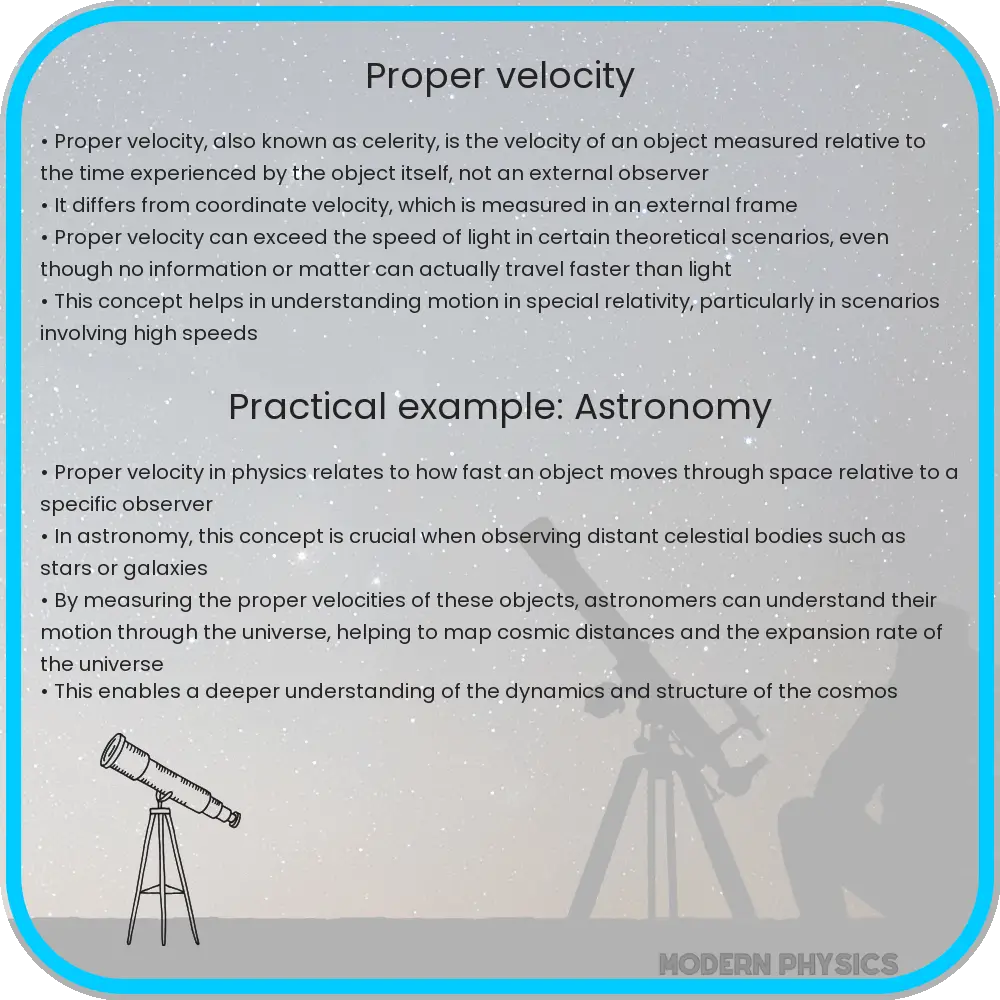
Special Relativity, a theory established by Albert Einstein in 1905, revolutionized the way we understand time and space. Among its intriguing concepts is proper velocity, a measure that extends the classical idea of velocity in the context of relativistic physics. Proper velocity, often symbolized as \( w \), is defined as the rate at which distance is traversed in a frame at rest relative to the distance experienced in the proper time of an object. This concept becomes particularly significant at velocities approaching the speed of light, denoted as \( c \).
Insights from Proper Velocity
Proper velocity offers a deeper insight into the behavior of objects moving at high speeds. It addresses the limitations of classical velocity, which breaks down near the speed of light. In classical mechanics, velocity is simply the rate of change of position with respect to time. However, as per Einstein’s theory, time itself is a relative quantity, differing for observers in different inertial frames. Proper velocity incorporates this relativistic time dilation, providing a more accurate description of motion at relativistic speeds.
For an object moving at a high velocity, its proper velocity \( w \) is given by the equation \( w = \gamma v \), where \( v \) is the classical velocity and \( \gamma \) is the Lorentz factor, calculated as \( \gamma = \frac{1}{\sqrt{1 – \frac{v^2}{c^2}}} \). This equation demonstrates how proper velocity increases indefinitely as the object’s speed approaches the speed of light, unlike classical velocity, which is capped at \( c \).
Applications of Proper Velocity
The concept of proper velocity is not just a theoretical construct but has practical applications in various fields. One significant area is astrophysics, particularly in the study of high-speed cosmic phenomena. For instance, proper velocity helps in accurately describing the speeds of distant galaxies and particles in high-energy astrophysics. Additionally, it is crucial in the field of particle physics, where particles are accelerated to near-light speeds, and their behavior needs to be understood in the framework of special relativity.
In the realm of space travel, proper velocity becomes a vital tool for planning missions involving high-speed interstellar travel. By taking into account the relativistic effects, it enables more precise calculations of travel time and fuel requirements for spacecraft moving at relativistic speeds.
Is this conversation helpful so far?
Further Implications of Proper Velocity
Proper velocity also plays a pivotal role in the synchronization of clocks in GPS satellites. These satellites orbit the Earth at high velocities, leading to significant time dilation effects as predicted by special relativity. The use of proper velocity allows for precise adjustments, ensuring that the time kept by these satellites is synchronized with clocks on the Earth’s surface.
Beyond practical applications, proper velocity contributes to our fundamental understanding of the universe. It challenges the traditional notions of space and time, inviting us to view them as interconnected dimensions. This perspective is crucial in advanced theoretical physics, especially in theories that aim to unify gravity with the other fundamental forces.
Understanding the Limits
While proper velocity is a powerful tool in relativistic physics, it’s important to acknowledge its limitations. It is most effective when dealing with objects moving in a straight line at constant speed. In scenarios involving acceleration or curved trajectories, the concept becomes more complex and other relativistic factors need to be considered.
Additionally, proper velocity does not negate the cosmic speed limit set by the speed of light. It offers a way to quantify motion in a manner that aligns with our understanding of space-time, but it does not permit superluminal (faster-than-light) travel, adhering to the fundamental postulates of special relativity.
Conclusion
In conclusion, proper velocity is a fascinating and useful concept in the realm of special relativity, providing a more nuanced understanding of motion at relativistic speeds. Its applications range from astrophysics to GPS technology, showcasing the profound impact of Einstein’s theory in both theoretical and practical domains. While it has its limitations, proper velocity is an essential concept for anyone delving into the complexities of modern physics. It not only enriches our understanding of high-speed phenomena but also serves as a bridge to more advanced theories, continuing to inspire awe and curiosity in the ever-evolving field of physics.