
Explore the fascinating world of relativistic aberration, speed of light, and Lorentz transformation in physics and astronomy.
Understanding Relativistic Aberration in the Context of the Speed of Light and Lorentz Transformation
Relativistic aberration is a fascinating phenomenon in physics that occurs due to the finite speed of light and the relative motion between an observer and a light source. It is intricately linked with the concepts of the speed of light and Lorentz transformation, both cornerstones in the theory of Special Relativity proposed by Albert Einstein. This article delves into these concepts to provide a comprehensive understanding of relativistic aberration.
The Speed of Light: A Fundamental Constant
The speed of light in a vacuum, denoted as ‘c’, is a fundamental physical constant with a value of approximately 299,792,458 meters per second. This speed is significant in physics as it represents the maximum speed at which all energy, matter, and information in the universe can travel. It forms the basis of Einstein’s Special Theory of Relativity, which revolutionized our understanding of space, time, and gravity.
Lorentz Transformation: Bridging Space and Time
The Lorentz transformation equations are pivotal in Special Relativity. They describe how, according to an observer, the measurements of time and space of a moving object differ from those taken by an observer at rest. The transformation is given by:
\[ x’ = \gamma (x – vt) \]
\[ t’ = \gamma (t – \frac{vx}{c^2}) \]
where \( x \) and \( t \) are the space and time coordinates in the stationary frame, \( x’ \) and \( t’ \) are the coordinates in the moving frame, \( v \) is the relative velocity between the observer and the moving frame, and \( \gamma \) is the Lorentz factor defined as:
\[ \gamma = \frac{1}{\sqrt{1 – \frac{v^2}{c^2}}} \]
This transformation demonstrates how time dilates and lengths contract when objects move at speeds close to that of light.
Relativistic Aberration: An Observable Effect
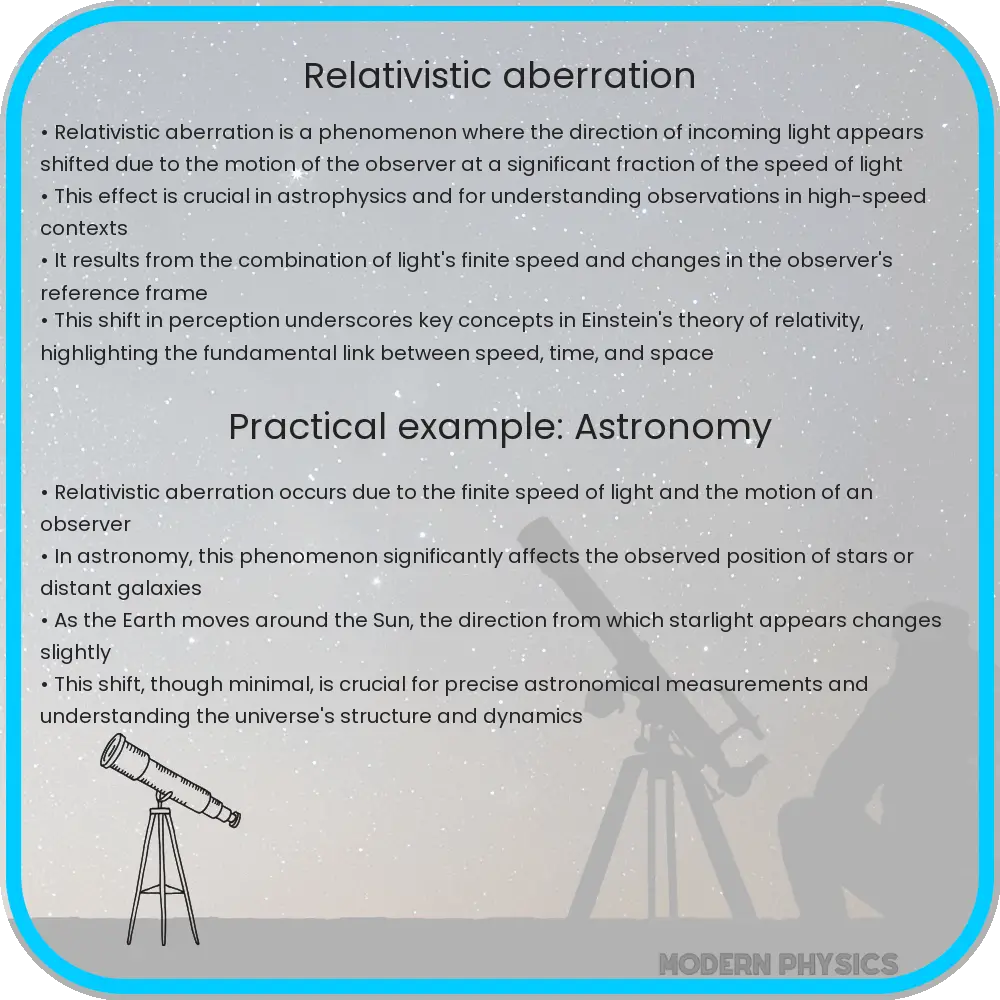
Relativistic aberration is observed when the direction in which light appears to be coming from is altered due to the relative motion between the observer and the light source. This effect can be mathematically derived using the Lorentz transformation. It illustrates how the observed angle of incoming light changes as an observer moves towards or away from the light source.
For an observer moving at a velocity \( v \) relative to a light source, the observed angle \( \theta’ \) of incoming light is different from the angle \( \theta \) observed in the stationary frame. This relationship is described by the aberration formula:
\[ \cos \theta’ = \frac{\cos \theta – \frac{v}{c}}{1 – \frac{v}{c} \cos \theta} \]
This formula indicates that the direction of incoming light appears shifted in the direction of motion of the observer.
Practical Implications and Applications
The concept of relativistic aberration has practical applications in various fields of physics and astronomy. One notable application is in the observation of stars. As the Earth moves in its orbit around the Sun, the apparent position of stars shifts due to relativistic aberration. This effect is crucial for precise astronomical measurements and for understanding the dynamics of distant celestial objects.
In the realm of satellite communication and Global Positioning Systems (GPS), the principles of relativistic aberration and Lorentz transformation are essential. Satellites in orbit move at high velocities relative to the Earth, and the signals they transmit experience aberration. Accurate GPS positioning requires accounting for these relativistic effects to ensure precision and reliability.
Relativistic Aberration and Modern Physics
Relativistic aberration also plays a significant role in modern physics, particularly in the study of high-energy astrophysical phenomena. For instance, the observation of gamma-ray bursts and quasars involves analyzing light that has traveled across vast distances in the universe. Understanding how relativistic aberration affects the light from these distant sources is crucial for interpreting observational data correctly.
Moreover, experiments in particle physics often involve particles moving at speeds close to that of light. The principles of relativistic aberration and Lorentz transformation are fundamental in designing experiments and interpreting results in high-energy particle accelerators, like the Large Hadron Collider (LHC).
Conclusion
Relativistic aberration, rooted in the finite speed of light and the Lorentz transformation, is a key concept in the realm of modern physics. It demonstrates the profound interplay between motion, space, and time, as envisaged in Einstein’s theory of Special Relativity. From enhancing our understanding of the universe to its applications in satellite communications and particle physics, relativistic aberration underscores the intricate and dynamic nature of the cosmos. As we continue to explore the universe, both near and far, the principles of relativistic aberration will remain instrumental in shaping our comprehension of the fundamental workings of the universe.