
Explore the intriguing Doppler Shift in Special Relativity, its effects, applications in astronomy, GPS, and the profound impact on our universe.
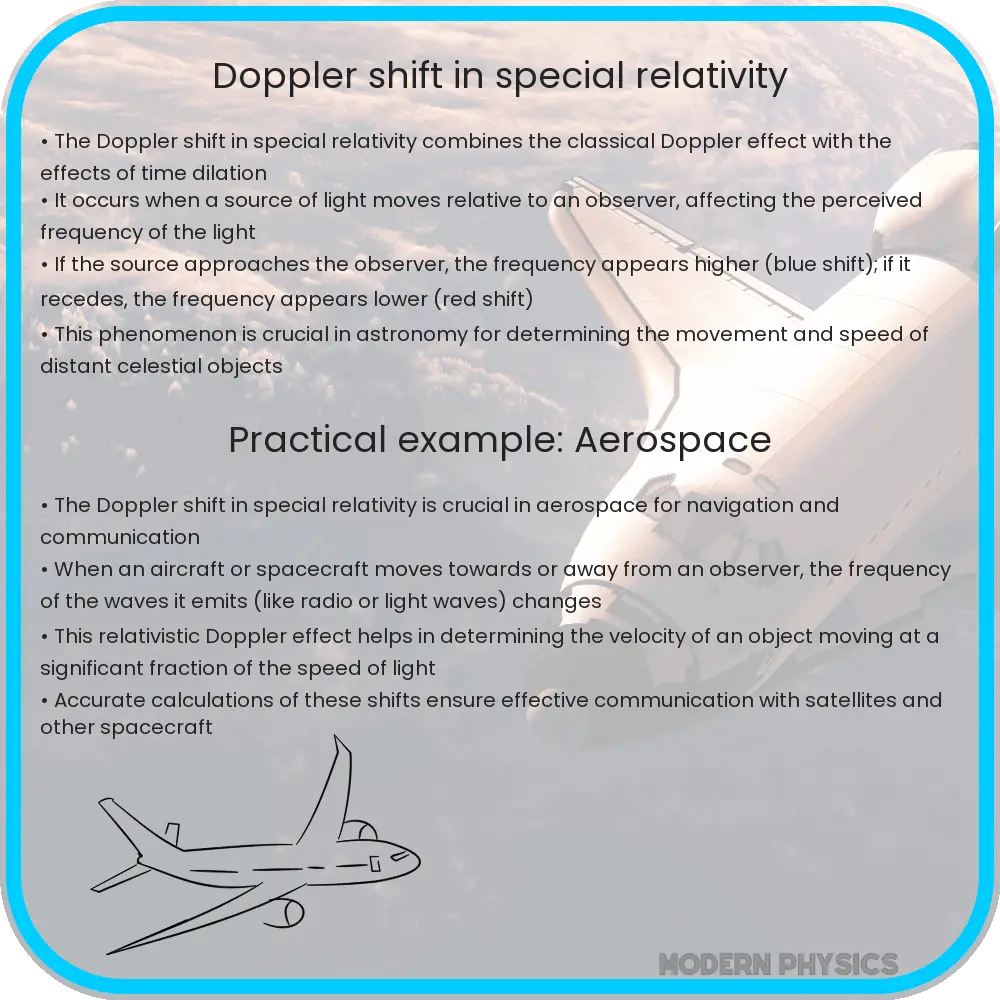
Understanding Doppler Shift in Special Relativity
The concept of Doppler Shift, widely known in classical physics, takes a fascinating turn under the framework of Special Relativity. Introduced by Albert Einstein in 1905, Special Relativity fundamentally altered our understanding of space and time. The Doppler Shift, in this context, refers to the change in frequency or wavelength of a wave in relation to an observer moving relative to the source of the wave. This phenomenon is not limited to sound waves but is also significantly observed in electromagnetic waves, such as light.
Theoretical Background
In special relativity, the Doppler Shift is derived from two fundamental postulates: the constancy of the speed of light and the principle of relativity. According to the first postulate, the speed of light in vacuum is the same for all observers, regardless of the motion of the light source or observer. The second postulate states that the laws of physics are the same in all inertial frames. These postulates lead to the relativistic Doppler effect, which describes how the observed frequency of light changes due to the relative motion of the source and observer.
Mathematical Expression
The relativistic Doppler shift formula can be expressed as:
\[ f’ = f \sqrt{\frac{1 + \frac{v}{c}}{1 – \frac{v}{c}}} \]
where f’ is the observed frequency, f is the actual frequency of the source, v is the relative velocity between the observer and the source, and c is the speed of light. This formula demonstrates that the observed frequency increases (blue shift) if the source is approaching the observer and decreases (red shift) if the source is receding.
Applications and Significance
The Doppler Shift in special relativity has profound applications in various fields of science. In astronomy, it is used to determine the movement and velocity of stars and galaxies. The redshift of distant galaxies serves as evidence for the expansion of the universe. In medical imaging, Doppler ultrasound utilizes this principle to view the motion of body fluids. The relativistic Doppler effect also plays a critical role in technologies like GPS and Doppler radar, where precise measurements of frequencies are crucial for accurate positioning and velocity detection.
This concept not only demonstrates the fascinating interplay between motion and perception but also underscores the revolutionary impact of Einstein’s theory in reshaping our understanding of the universe.
Effects of Relativistic Doppler Shift
The relativistic Doppler Shift has intriguing effects on our perception of the universe. One such effect is the time dilation, a direct consequence of the theory of relativity. Time dilation implies that a moving clock, from the perspective of a stationary observer, ticks slower than a clock at rest. This effect becomes significant at speeds close to the speed of light and has been experimentally verified using atomic clocks on fast-moving planes.
Transverse Doppler Shift
A unique aspect of the relativistic Doppler Shift is the Transverse Doppler Shift. It occurs when the source of light moves perpendicular to the line of sight of the observer. In this scenario, even though the source is not moving towards or away from the observer, a redshift is observed. This phenomenon, which has no analogy in classical physics, further confirms the relativistic concept that time itself is affected by motion.
Challenges and Misconceptions
Understanding the Doppler Shift in special relativity can be challenging. Common misconceptions arise, particularly in differentiating between the classical and relativistic Doppler effects. In classical physics, the Doppler Shift depends only on the relative speed of the source and observer. However, in relativity, the direction of motion and the speed of light’s constancy play crucial roles, leading to more complex and counterintuitive phenomena.
Conclusion
The study of Doppler Shift within the framework of Special Relativity not only enriches our understanding of wave phenomena but also provides profound insights into the nature of space and time. The relativistic Doppler effect, with its applications in astronomy, medicine, and technology, stands as a testament to the far-reaching implications of Einstein’s theories. It challenges our intuitive notions of time and motion, offering a glimpse into the intricate and interconnected fabric of the universe. As technology advances, our ability to observe and utilize this fascinating phenomenon will only grow, further unraveling the mysteries of the cosmos and the fundamental laws that govern it.