
Explore the fascinating world of Regge Theory and its applications in particle physics and astrophysics, shedding light on cosmic mysteries and particle behaviors.
Understanding Regge Theory in Particle Astrophysics
Regge Theory, a significant concept within the realm of particle physics and astrophysics, offers profound insights into the behavior of subatomic particles and the fundamental forces of nature. Initially developed by Italian physicist Tullio Regge in the late 1950s, this theory has evolved to become an essential tool in the exploration of quantum chromodynamics (QCD) and the analysis of scattering processes.
At its core, Regge Theory provides a framework for understanding the angular momentum and mass relationship of particles, particularly in high-energy collisions. This relationship, depicted in what is known as Regge trajectories, reveals how particles with the same spin characteristics are connected and how these connections influence particle behavior under extreme conditions.
Applications in Particle Astrophysics
The implications of Regge Theory extend beyond mere particle interactions; they are pivotal in astrophysical contexts as well. One of the most notable applications is in the analysis of cosmic rays and high-energy astrophysical phenomena. By applying Regge theory, scientists can decipher the properties and origins of cosmic particles, which are often accelerated to high energies in astrophysical settings such as supernovae and active galactic nuclei.
Additionally, Regge Theory aids in the understanding of gravitational waves and black hole physics. It provides a mathematical framework that helps in describing the orbital dynamics and collision processes of celestial bodies. This is crucial for predicting gravitational wave signatures and understanding the fabric of spacetime around massive objects.
In the context of dark matter and dark energy research, Regge Theory offers a unique perspective. By examining the interactions and decay processes of hypothetical dark matter particles, researchers can gain insights into the nature and properties of these elusive components of the universe.
Furthermore, the theory’s contribution to the study of hadron structure and interactions is invaluable. It allows for a deeper understanding of the strong force, one of the four fundamental forces of nature, which governs the interactions between quarks and gluons, the building blocks of matter.
Introduction to Regge Theory
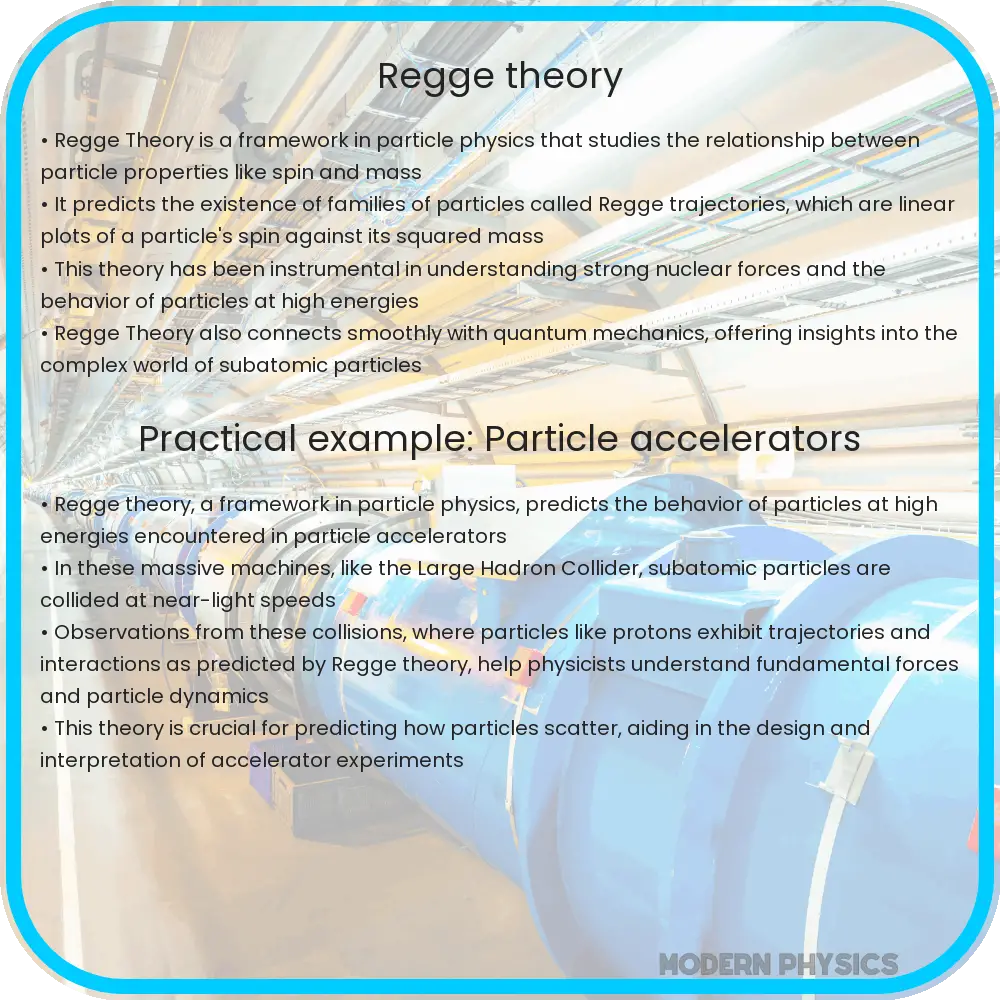
Regge Theory is a framework in particle physics that provides a unique approach to understanding the scattering and properties of particles at high energies. Developed by Italian physicist Tullio Regge in the 1950s, this theory introduces the concept of ‘Regge trajectories,’ which are graphical plots relating the spin (J) and mass squared (M2) of hadrons (particles like protons, neutrons, and pions). These trajectories reveal patterns that help physicists categorize hadrons and predict the existence of new particles.
Application in Particle Astrophysics
In the realm of particle astrophysics, Regge Theory offers insights into the cosmic rays and energetic particles from space interacting with Earth’s atmosphere. By applying Regge Theory, scientists can better understand the composition and behavior of high-energy cosmic particles, which are otherwise challenging to analyze due to their rare and unpredictable nature. This understanding aids in unraveling mysteries surrounding cosmic phenomena such as gamma-ray bursts, neutron stars, and black hole physics.
Regge Theory’s Role in Particle Collisions
The practical application of Regge Theory extends to the analysis of particle collisions, particularly in accelerators where particles are smashed at high energies to recreate conditions similar to those just after the Big Bang. In these experiments, Regge Theory helps predict the scattering angles and energy distributions of particles post-collision, providing vital clues to the fundamental forces and structures within atoms.
Implications for Quantum Chromodynamics (QCD)
Regge Theory also intersects with Quantum Chromodynamics (QCD), the theory describing the strong force (one of the four fundamental forces in physics) that binds quarks and gluons inside hadrons. The trajectories predicted by Regge Theory have been instrumental in developing QCD models, enhancing our understanding of the strong force’s behavior at various energy scales.
Conclusion
Regge Theory has profoundly impacted the field of particle physics and astrophysics, providing a unique perspective on particle interactions and the fundamental forces of nature. Its applications range from understanding cosmic ray phenomena to aiding in the design and interpretation of particle accelerator experiments. By offering a framework to categorize and predict particle behaviors, Regge Theory continues to be an invaluable tool in the ongoing exploration of the quantum universe. As research progresses, the integration of Regge Theory with other areas of physics promises to unveil further mysteries surrounding the fabric of our universe.