
Quark-gluon plasma (QGP) is a high-temperature phase of quantum chromodynamics where quarks and gluons are liberated from hadronic confinement.
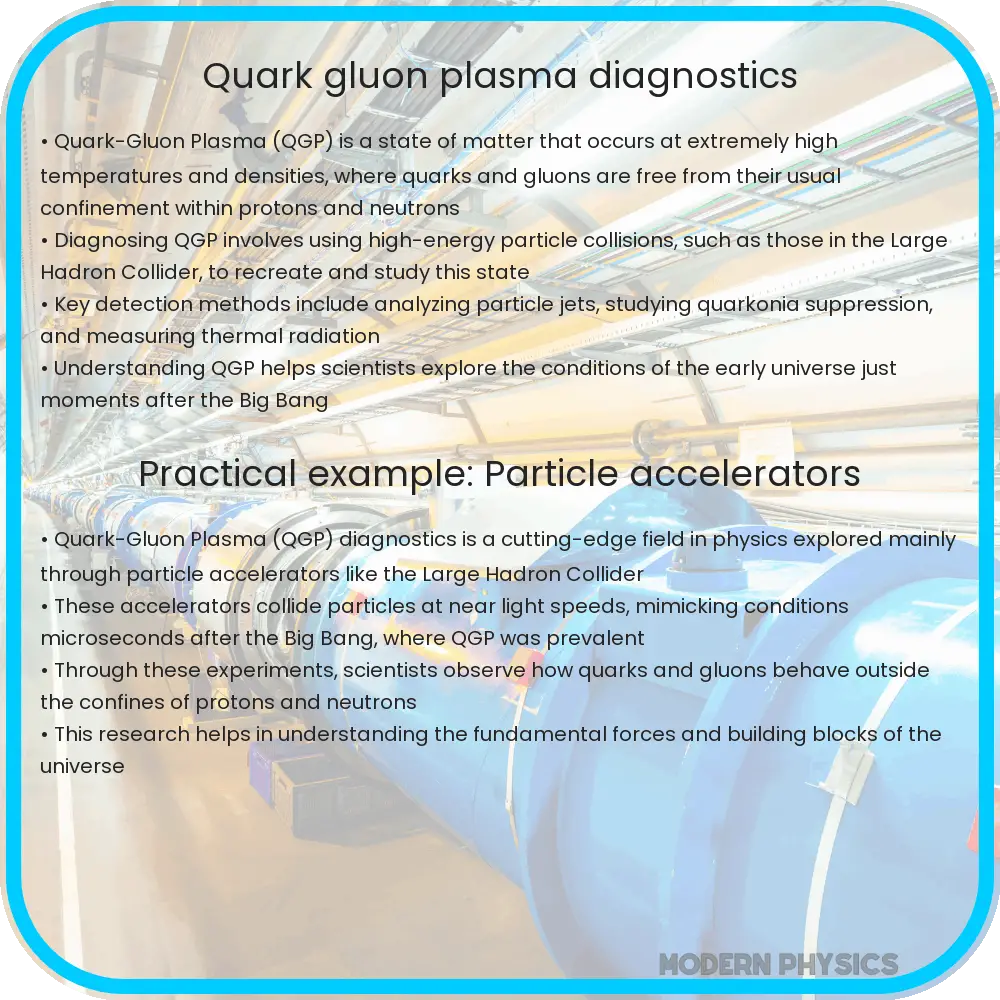
Introduction to Quark-Gluon Plasma
The study of quark-gluon plasma (QGP) stands as a significant frontier in modern physics, providing profound insights into the state of matter that existed just microseconds after the Big Bang. QGP is a phase of quantum chromodynamics (QCD) which occurs at extremely high temperature and/or density, where quarks and gluons – the fundamental constituents of protons, neutrons, and other hadrons – are freed from their usual confinement within hadrons.
Challenges in Studying Quark-Gluon Plasma
Investigating QGP is challenging because it can only be created under extreme conditions, such as those achieved in high-energy particle collisions produced in large accelerators like the Large Hadron Collider (LHC) at CERN or the Relativistic Heavy Ion Collider (RHIC) at Brookhaven National Laboratory. Moreover, QGP exists only fleetingly before it cools down and transitions back into ordinary matter made up of hadrons. Thus, our understanding of QGP relies heavily on advanced diagnostic techniques.
Diagnostic Techniques for Quark-Gluon Plasma
- High-Energy Particle Collisions: By colliding heavy ions at near-light speeds, physicists recreate the temperatures and pressures necessary for QGP formation. The analysis of the particles emitted from these collisions provides clues about the behavior and properties of QGP.
- Jet Quenching: This technique examines how the energy of jets (collimated beams of particles) is diminished as they pass through the plasma. The degree of energy loss can offer information on the density and opacity of the quark-gluon plasma.
- Direct Photon Production: Photons produced during the QGP phase can escape without being affected by the strong nuclear force, providing a direct glimpse into the plasma’s characteristics at the moment of their emission.
Insights Gained from Quark-Gluon Plasma Research
Research into quark-gluon plasma has not only expanded our understanding of the universe’s beginning but has also refined our knowledge of the strong force, one of the four fundamental forces in physics. One of the intriguing aspects deduced from QGP studies is the surprisingly fluid-like nature of the plasma, with minimal viscosity, suggesting a “perfect fluid”. This revelation has implications for understanding not just particle physics but also complex fluid dynamics in other scientific fields.
Significant Discoveries in Quark-Gluon Plasma Studies
One landmark discovery was the observation of the “ridge” in particle correlations by experiments at the LHC. When two particles are produced at close angles, a mysterious ridge-like structure appears in the data, indicative of the intense interactions within the plasma. Such findings continue to pose exciting challenges and opportunities for theoretical explanations and further experimental exploration.
Another breakthrough was the detection of charmonium suppression patterns, which provided evidence of QGP formation. Charmonium, a bound state of charm quark and anti-charm quark, is expected to dissolve in the QGP, so its reduced presence in collision aftermaths supports the idea that a deconfined state was indeed created.
Exploring quark-gluon plasma not only enriches our understanding of the fundamental forces that shape the universe, but it also brings new tools and methodologies into the realm of physics and engineering, helping to solve complex problems and innovate in various applications.
Applications of Quark-Gluon Plasma Research
The advancements in understanding and researching quark-gluon plasma have far-reaching applications beyond fundamental physics. For instance, the study of QGP can influence the development of materials science, especially in creating substances that can withstand extreme conditions. Engineers and scientists utilize insights from QGP to design more resilient materials for aerospace, nuclear reactors, and high-temperature industrial processes. Additionally, the computational models developed to simulate QGP dynamics are now being adapted for complex simulations in weather forecasting and even in financial markets.
Educational and Collaborative Impact
The study of QGP also has significant educational implications. It provides an excellent platform for interdisciplinary learning, combining physics, chemistry, computer science, and engineering. Universities and research institutions foster collaborations that bridge various scientific disciplines, utilizing collective knowledge to push the boundaries of what we understand about high-energy physics. These collaborations often lead to innovations in experimental techniques and technology transfers that benefit broader scientific and technological communities.
Future Directions in Quark-Gluon Plasma Research
Looking forward, the research on quark-gluon plasma is poised to unlock more secrets of the early universe and the fundamental laws of physics. Future experiments aim to map out more detailed phases of QGP at different temperatures and densities, exploring unknown aspects of the strong force. Advances in accelerator technology and detection methods will likely open new vistas in this intriguing field.
Conclusion
The study of quark-gluon plasma is a vivid reminder of the beauty and complexity of the universe. From shedding light on the microseconds following the Big Bang to enhancing materials science and contributing to other areas of technology and innovation, QGP research embodies a crucial intersection of theoretical and applied sciences. As we continue to explore this extreme state of matter, we not only decipher the building blocks of matter but also pave the way for future technological advancements inspired by the very fabric of the cosmos.