
Explore the intricacies of ray bundle dynamics in optical physics, including precision modeling, analysis techniques, and future directions in technology.
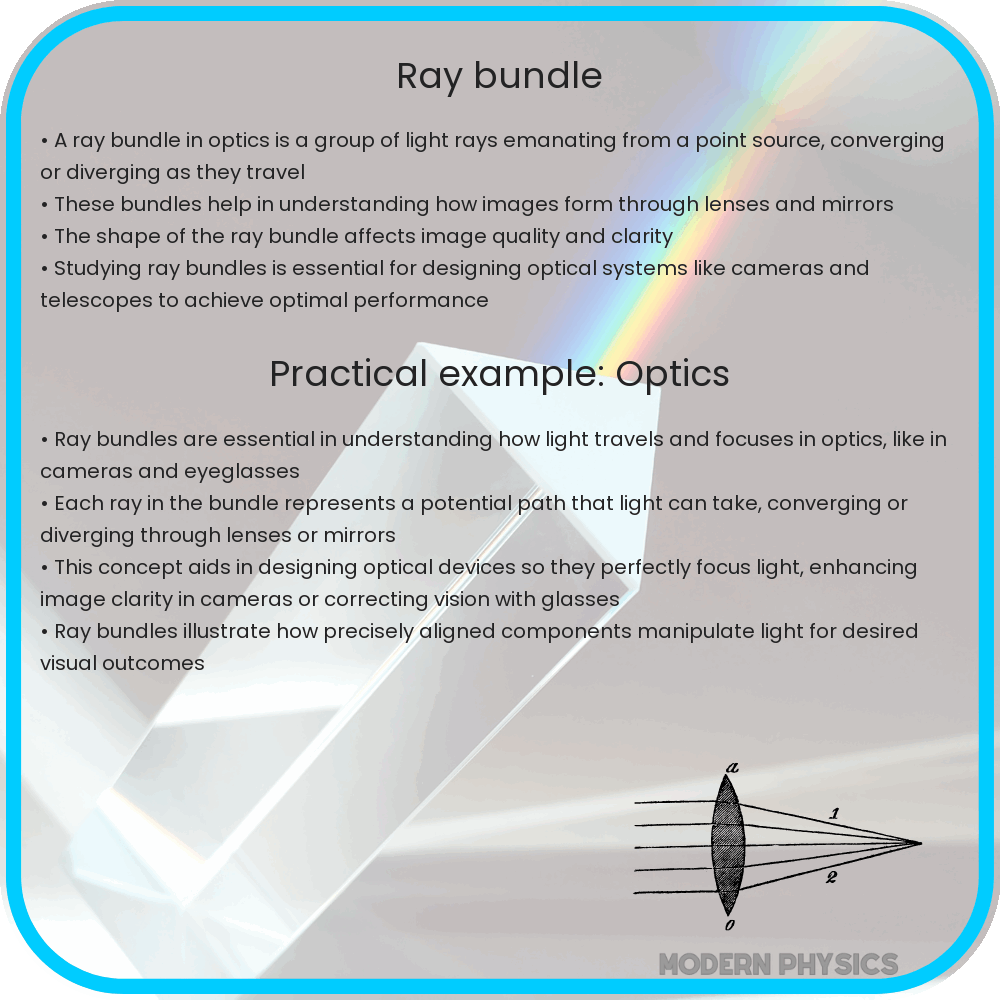
Understanding Ray Bundle Dynamics
Ray bundle dynamics is a critical concept in the realms of optical physics and engineering, offering a sophisticated approach to analyze and predict the behavior of light as it travels through different media. This analysis is essential for designing optical systems with high precision, such as lenses, telescopes, and fiber optics, where the accurate control and manipulation of light are paramount.
Precision in Optical Modeling
The precision in optical modeling is significantly enhanced by understanding ray bundle dynamics. By considering the properties of light rays grouped in bundles, scientists and engineers can predict how these rays will interact with optical components. This approach allows for the optimization of optical devices, ensuring that they perform as intended with minimal loss of quality or efficiency. The mathematical modeling of ray bundles involves complex calculations, including ray tracing algorithms and wavefront analysis, to simulate the propagation of light with high accuracy.
Ray Bundle Analysis Techniques
Several analysis techniques are pivotal in the study of ray bundle dynamics. Among these, the most notable include:
- Geometrical Optics: This technique simplifies light propagation by treating light as rays that travel in straight lines, bending and changing direction when passing through different media.
- Wave Optics: For situations where light exhibits wave-like behaviors, wave optics principles are applied to model diffraction and interference, providing a more comprehensive analysis of ray bundle dynamics.
- Computational Methods: Advanced computational methods, such as Finite Difference Time Domain (FDTD) and Beam Propagation Method (BPM), are utilized to numerically solve Maxwell’s equations, offering detailed insights into the complex interactions within ray bundles.
Each technique plays a crucial role in unraveling the complexities of light behavior, aiding in the design and analysis of cutting-edge optical systems. The choice of analysis method depends on the specific characteristics of the optical system under study and the precision requirements of the application.
Applications and Implications
The insights gained from studying ray bundle dynamics have far-reaching implications across various fields. In medical imaging, for instance, understanding the intricacies of light propagation enhances the quality of images obtained from devices like MRI scanners and endoscopes. In telecommunications, the efficiency and bandwidth of fiber optic cables are optimized by applying principles derived from ray bundle analysis. Additionally, in astronomy, telescopes are designed with greater precision to capture clearer images of distant celestial bodies.
Challenges in Modeling Ray Bundle Dynamics
Despite the advances in technology and computational methods, modeling ray bundle dynamics presents several challenges. One of the primary issues is the accurate representation of complex material properties and their interaction with light. Materials with non-uniform refractive indices, anisotropy, or nonlinear optical properties require sophisticated models to accurately predict how light rays within a bundle will behave. Additionally, the computational resources required for simulating large-scale optical systems using detailed ray bundle dynamics can be significant, necessitating the use of high-performance computing solutions.
Future Directions in Ray Bundle Dynamics
The future of ray bundle dynamics lies in the development of more efficient computational algorithms and the integration of artificial intelligence (AI) and machine learning (ML) techniques. AI and ML can potentially revolutionize the field by optimizing simulation processes, identifying patterns in optical behavior that are not apparent through traditional analysis, and predicting the performance of optical systems with unprecedented accuracy. Furthermore, advancements in materials science will likely introduce new types of optical materials, which will expand the capabilities of optical devices through better control and manipulation of ray bundles.
Conclusion
Ray bundle dynamics is a fundamental aspect of optical physics that has a profound impact on the design and analysis of optical systems. Through precise modeling and sophisticated analysis techniques, it enables the optimization of devices across various industries, from medical imaging to telecommunications and astronomy. Despite the challenges, ongoing research and technological advancements promise to further enhance our understanding and manipulation of light. As computational methods evolve and integrate with AI and ML, the potential for innovative optical solutions continues to grow. The study of ray bundle dynamics not only deepens our comprehension of light’s complex behaviors but also paves the way for future breakthroughs in optical technology.