
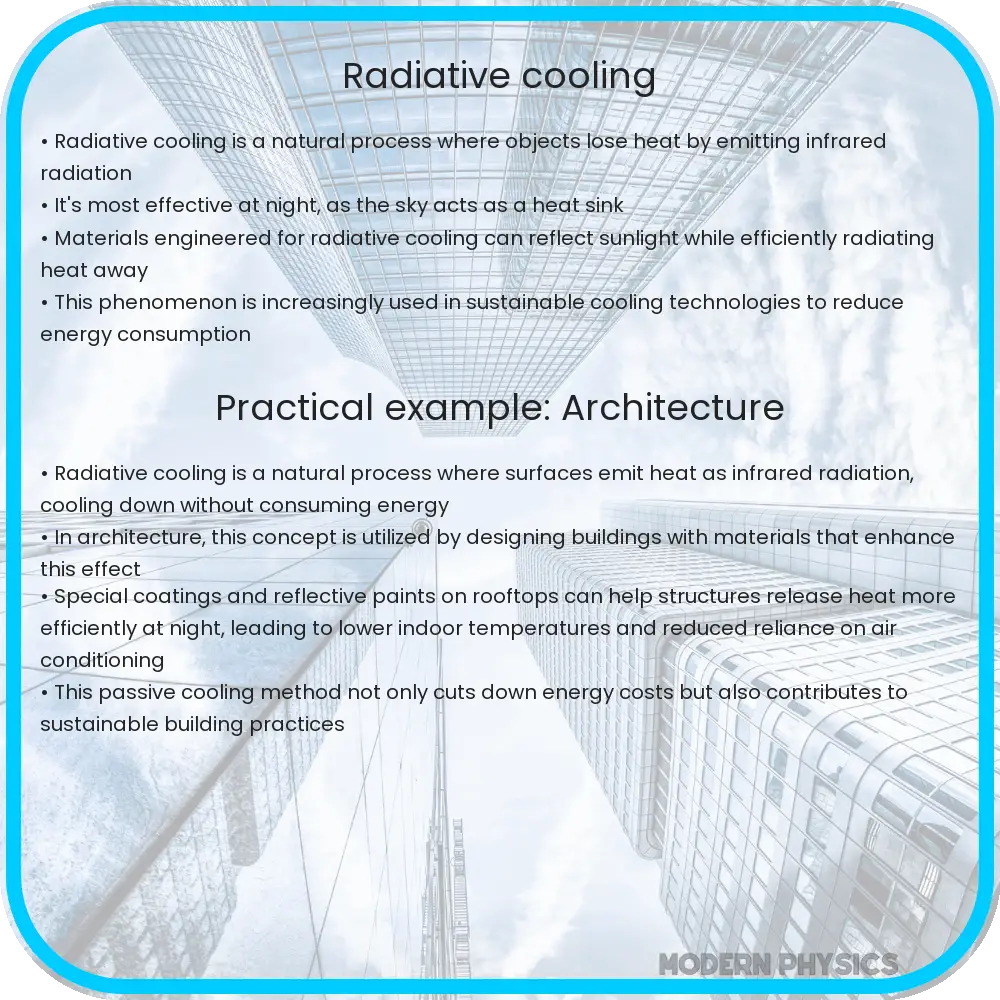
Radiative cooling is a process where objects emit infrared radiation to lose heat, offering an energy-efficient solution to traditional cooling systems.
Understanding Radiative Cooling: An Efficient and Natural Climate Solution
Radiative cooling is a natural process through which objects lose heat by emitting infrared radiation. Despite its complexity, this principle holds promise for developing energy-efficient cooling systems that can operate without electricity, reducing the demand on power grids and lowering greenhouse gas emissions. This article explores how radiative cooling works and its potential applications in climate-smart technologies.
The Science Behind Radiative Cooling
Every object that has a temperature above absolute zero emits heat in the form of thermal radiation. At night, the earth itself radiates heat into the cold outer space, resulting in a drop in temperature. This phenomenon, exploited by radiative cooling technologies, hinges on the basic principles of thermodynamics and electromagnetic radiation.
Objects emit energy across a range of wavelengths, but for the purpose of cooling, the key is to emit energy in the mid-infrared range of 8 to 13 micrometers. This specific range corresponds to a “transparency window” in the Earth’s atmosphere through which radiation can pass freely into space without being absorbed by atmospheric gases like water vapor and carbon dioxide.
Materials and Technology
The efficiency of radiative cooling materials depends on their ability to reflect sunlight while simultaneously emitting infrared radiation. Recent advancements have led to the development of specialized photonic materials that can do exactly this. Such materials are structured at a microscopic level to enhance their radiative properties.
One of the most promising materials developed is based on silicon dioxide (SiO2) and hafnium oxide (HfO2). These materials are engineered to have properties that maximize the emission of infrared radiation while minimizing the absorption of visible light.
- High reflectivity: To avoid absorbing heat from the sun, radiative cooling materials are designed to reflect most of the solar spectrum.
- Thermal emission: These materials emit infrared radiation efficiently, especially in the atmospheric transparency window, enabling them to cool down even under direct sunlight.
Real-World Applications
Radiative cooling technology can be integrated into a variety of applications, offering a sustainable solution to reduce air conditioning and refrigeration costs. Here are some potential uses:
- Building Cooling: Radiative cooling materials can be incorporated into the roofs and walls of buildings to dissipate heat more effectively, reducing the reliance on traditional air conditioning systems.
- Sustainable Agriculture: Cooling systems based on this technology could be used to maintain optimal temperatures in greenhouses, improving crop yields while minimizing energy consumption.
- Energy Generation: Radiative cooling can enhance the efficiency of thermoelectric power generation by effectively dissipating heat, thereby increasing the output of power plants.
By integrating radiative cooling technologies into our infrastructure, we can attain a significant reduction in energy usage, contributing to a more sustainable and climate-resilient world.
Challenges and Future Prospects
Despite its potential, radiative cooling faces several challenges that must be addressed to achieve widespread adoption. First, the performance of radiative cooling systems can be significantly influenced by local weather conditions, including humidity and cloud coverage, which can obstruct the infrared window and reduce efficiency. Additionally, the production of specialized materials like silicon dioxide and hafnium oxide at a commercial scale requires sophisticated manufacturing techniques that are currently costly.
Future research is essential to overcome these barriers. Innovations that could enhance the viability of radiative cooling include developing more cost-effective materials and improving the atmospheric transparency of radiation. Moreover, integrating these technologies with existing cooling systems to create hybrid solutions could provide a more consistent and reliable cooling effect, accommodating a range of environmental conditions.
Conclusion
Radiative cooling presents a fascinating example of how principles from physics can be harnessed to address real-world problems. By utilizing the natural process of heat emission into outer space, this technology offers a pathway to reduce energy consumption in cooling systems, which is crucial in our ongoing battle against global warming. While there are challenges to its practical implementation, the ongoing advancements in material science and engineering promise to enhance its feasibility and effectiveness.
The potential of radiative cooling extends beyond simple temperature management; it embodies the broader goal of creating sustainable technologies that coexist harmoniously with our environment. As researchers continue to innovate and refine this technology, it holds the promise of playing a pivotal role in our sustainable development efforts, making our buildings, agricultural practices, and power generation more environmentally friendly. With continued investment and research, radiative cooling could become a cornerstone of climate-smart technology in the near future.