
Explore the potential of quantum state swapping for efficient, precise, and scalable quantum networks, paving the way for the future quantum internet.
Introduction to Quantum State Swapping
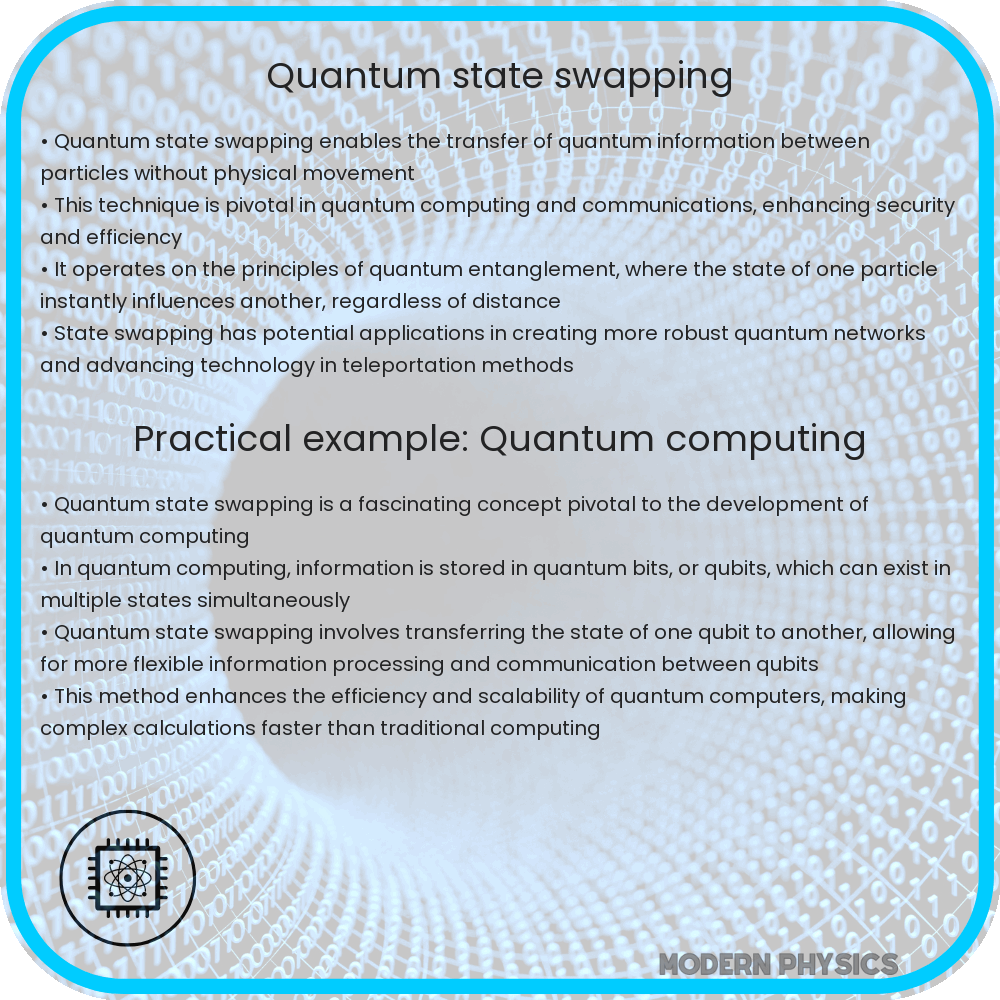
Quantum state swapping represents a pivotal technique in the realm of quantum computing and quantum communication, offering a pathway to achieve efficient, precise, and scalable quantum networks. This method allows for the exchange of quantum states between particles, even if they are not directly interacting, leveraging the entanglement property of quantum mechanics. Understanding this process is essential for advancements in quantum encryption, teleportation, and the realization of a quantum internet.
The Mechanics of Quantum State Swapping
At its core, quantum state swapping relies on quantum entanglement, a phenomenon where particles become interconnected such that the state of one (regardless of distance) instantaneously affects the state of another. To initiate a swap, two pairs of entangled particles are prepared. One particle from each pair is then subjected to a joint measurement. This action projects these particles onto a new state, effectively swapping their initial quantum states without a direct physical interaction.
Efficiency and Precision in Quantum Swapping
The efficiency and precision of quantum state swapping hinge on the ability to create high-fidelity entanglement and perform accurate measurements. Recent advancements in quantum optics and superconducting circuits have significantly improved these aspects, making quantum swapping more reliable. Techniques like Bell-state measurements and error correction protocols enhance the precision and scalability of the process, paving the way for practical quantum networking applications.
Scalability Challenges and Solutions
Scaling quantum networks through state swapping presents technical hurdles, primarily related to maintaining entanglement over large distances and among multiple qubits. Innovative solutions, such as quantum repeaters and the development of robust error correction methods, are crucial for overcoming these challenges. These technologies aim to extend the range and complexity of quantum networks, ensuring that quantum state swapping can serve as a backbone for a future quantum internet.
Quantum state swapping is not just a theoretical concept but a practical tool that is shaping the future of communication and computing. Its efficient, precise, and scalable nature holds the key to unlocking new possibilities in secure communication, distributed quantum computing, and beyond.
Applications and Future Prospects
The potential applications of quantum state swapping are vast and varied, encompassing secure quantum communication, distributed quantum computing, and quantum sensing. By enabling the exchange of quantum information across different nodes without loss of coherence, it lays the groundwork for the quantum internet, where information is transmitted with unprecedented security and efficiency. Moreover, quantum state swapping is instrumental in quantum teleportation protocols, facilitating the transfer of quantum states without physical transportation of the particle itself.
Integrating Quantum State Swapping in Quantum Networks
Integrating quantum state swapping into quantum networks requires meticulous engineering and the development of scalable quantum technologies. Quantum routers, which direct quantum information based on its state, and quantum memories, capable of storing quantum states for prolonged periods, are critical components. The advancement in these areas will dictate the pace at which quantum networks evolve, moving from laboratory experiments to real-world applications.
Challenges Ahead
Despite the promising outlook, several challenges remain in the quest for widespread implementation of quantum state swapping. The creation and maintenance of entanglement over long distances without significant fidelity loss is a major hurdle. Additionally, the need for highly efficient detection and error correction mechanisms cannot be overstated, as even minor inaccuracies can lead to significant errors in quantum information processes. Overcoming these challenges requires ongoing research and innovation in quantum physics, materials science, and engineering.
Conclusion
Quantum state swapping stands as a cornerstone technology in the burgeoning field of quantum information science. Its ability to efficiently, precisely, and scalably transfer quantum states across particles without direct interaction is revolutionary, promising to transform the landscape of secure communication, computing, and sensing. The path forward involves surmounting significant technical challenges, particularly in entanglement generation and maintenance, error correction, and network integration. However, with rapid advancements in quantum technologies and a growing understanding of quantum mechanics, the future of quantum state swapping and its applications in a global quantum network appears increasingly feasible. As research continues to push the boundaries of what’s possible, the realization of a fully interconnected quantum internet moves ever closer to reality, heralding a new era of communication and computation.