
Explore the essentials of Quantum Frequency Conversion, its impact on quantum optics, efficiency, and coherence challenges, and future prospects.
Understanding Quantum Frequency Conversion
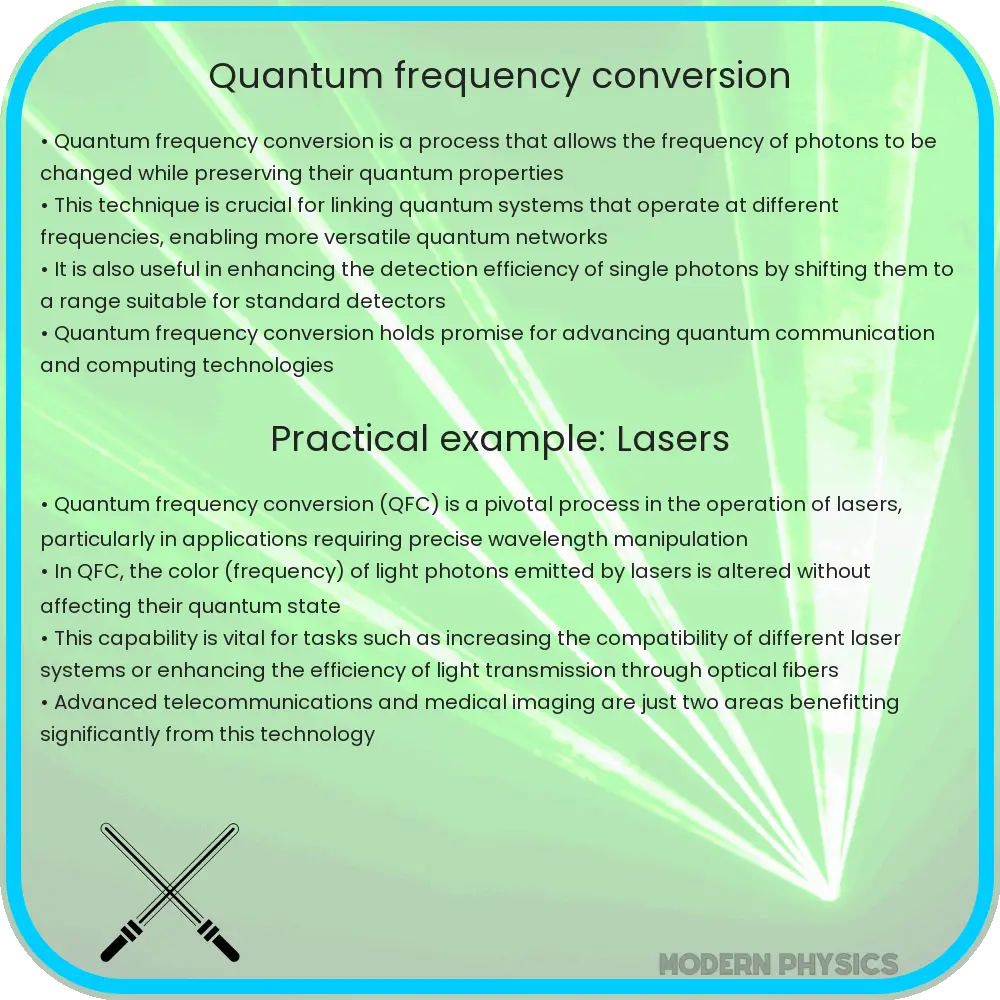
Quantum Frequency Conversion (QFC) is a pivotal technology in the field of quantum optics, offering a bridge between different quantum systems that operate at incompatible frequencies. This technique enables the coherent transfer of quantum states from one optical frequency to another, facilitating interoperability in quantum networks and enhancing the efficiency and scalability of quantum communication systems.
Principles of Quantum Frequency Conversion
At its core, QFC leverages nonlinear optical processes to alter the frequency of photons while preserving their quantum states. This process is crucial for quantum communication, as it allows for the integration of disparate quantum systems into a unified network. For instance, photons generated by a quantum dot can be frequency-converted to match the operational bandwidth of a fiber optic network, thereby enabling long-distance quantum communication.
Efficiency in Quantum Frequency Conversion
The efficiency of QFC is a critical parameter, determining how effectively quantum information is transferred between different frequencies. High conversion efficiency is essential for minimizing losses and maintaining the fidelity of the quantum state post-conversion. Various strategies, such as optimizing the nonlinear medium and the pump laser parameters, are employed to enhance this efficiency.
Coherence in Quantum Frequency Conversion
Preserving coherence during frequency conversion is paramount for the integrity of quantum information. Coherence measures the phase relationship between quantum states, and its preservation is essential for applications in quantum computing and secure quantum communication. Techniques like phase-matching in the nonlinear medium are implemented to ensure that the quantum states maintain their coherence throughout the conversion process.
Applications in Quantum Optics
QFC finds its application across various domains of quantum optics, including quantum communication, quantum computation, and quantum sensing. By enabling the coherent linking of different quantum systems, QFC paves the way for more robust and scalable quantum networks, capable of supporting secure communication protocols and distributed quantum computing architectures.
Challenges and Future Directions in Quantum Frequency Conversion
Despite its significant advantages, QFC faces several challenges that must be overcome to realize its full potential. One of the primary hurdles is the need for highly efficient nonlinear materials that can facilitate effective frequency conversion without introducing excessive noise or loss. Additionally, the integration of QFC systems into practical quantum networks requires compact and reliable devices capable of operating at room temperature.
Future research in QFC is geared towards addressing these challenges through the development of new materials and technologies. Advanced photonics integration techniques, such as on-chip nonlinear waveguides, are being explored to miniaturize QFC devices and improve their performance. Furthermore, efforts are being made to enhance the coherence preservation capabilities of QFC processes, enabling longer-distance quantum communication and more complex quantum computing operations.
Conclusion
Quantum Frequency Conversion stands as a cornerstone technology in the advancement of quantum optics, playing a crucial role in bridging the gap between different quantum systems. By allowing for the coherent transfer of quantum states across disparate frequencies, QFC enhances the efficiency, scalability, and interoperability of quantum networks. Despite facing challenges related to efficiency, coherence preservation, and device integration, ongoing research and development promise to overcome these obstacles, paving the way for a new era of quantum technology. As we continue to push the boundaries of what is possible in quantum optics, QFC will undoubtedly remain at the forefront of innovations, driving forward the realization of global quantum networks and the myriad applications they will support.