
Explore the efficiency, precision, and scalability of quantum simulation platforms, revolutionizing industries from pharmaceuticals to cryptography.
Exploring Quantum Simulation Platforms: A Dive into Efficiency, Precision, and Scalability
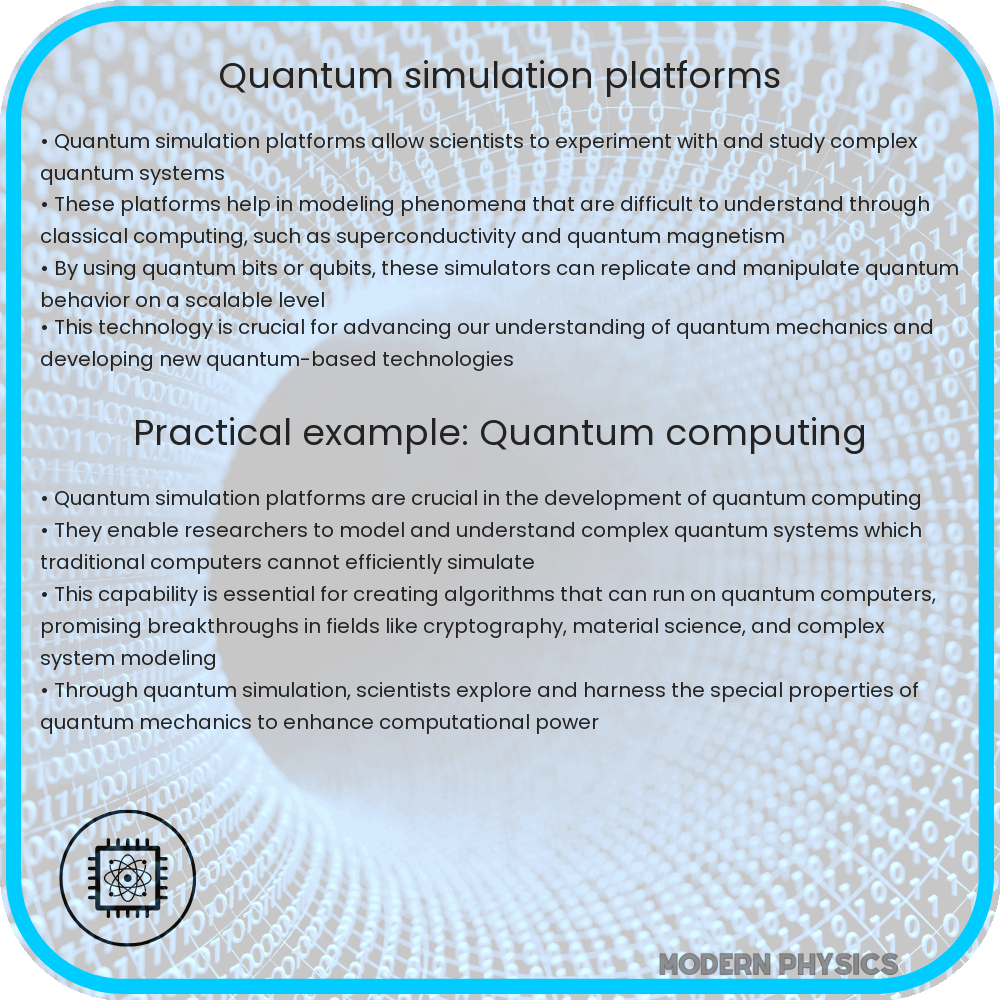
The advent of quantum computing has ushered in a new era of scientific exploration and technological innovation, particularly in the realm of quantum simulation platforms. These platforms are at the forefront of solving complex problems that are beyond the reach of classical computers, offering unprecedented precision and scalability. This article delves into the efficiency, precision, and scalability of quantum simulation platforms, highlighting their impact on research and industry.
Efficiency in Quantum Simulations
Quantum simulation platforms leverage the principles of quantum mechanics to model complex systems more efficiently than classical computers. The efficiency of these platforms is attributed to quantum bits, or qubits, which can represent and process a vast amount of information simultaneously due to their ability to exist in multiple states. This parallelism allows for the rapid simulation of complex quantum systems, reducing the computational time from years to mere hours in some cases.
Precision in Quantum Modeling
The precision offered by quantum simulation platforms is unparalleled, particularly in the fields of chemistry and material science. By precisely controlling qubits, these platforms can simulate the behavior of molecules and materials at the quantum level, revealing insights into their properties and interactions. For example, the accurate modeling of the hydrogen molecule, H2, has been a benchmark for quantum simulations, showcasing their capability to predict chemical reactions and material properties with high fidelity.
Scalability Challenges and Advances
While quantum simulation platforms offer remarkable advantages, scalability remains a significant challenge. Increasing the number of qubits for larger simulations introduces noise and errors, making it difficult to maintain precision. However, advancements in quantum error correction and noise reduction techniques are paving the way for more scalable quantum simulations. These improvements are crucial for the practical application of quantum computing in solving real-world problems, from drug discovery to climate modeling.
As research and development in quantum computing continue to accelerate, the efficiency, precision, and scalability of quantum simulation platforms are expected to reach new heights. This progress holds the promise of revolutionizing various fields by providing insights into the quantum world that were previously thought impossible to obtain.
Integrating Quantum Simulations with Classical Computing
The integration of quantum simulations with classical computing systems is a strategic approach to overcome current limitations and enhance computational capabilities. Hybrid quantum-classical systems utilize the strengths of both paradigms, where quantum processors perform complex simulations and classical systems manage data processing and optimization tasks. This synergy not only improves computational efficiency but also extends the applicability of quantum simulations to a broader range of problems.
Applications Across Industries
The impact of quantum simulation platforms transcends academic research, with significant implications for various industries. In pharmaceuticals, quantum simulations accelerate the drug discovery process by efficiently modeling molecular interactions. In materials science, they enable the design of new materials with tailored properties for use in electronics, energy storage, and quantum technologies. Moreover, in the field of cryptography, quantum simulations are essential for developing quantum-resistant encryption methods, ensuring data security in a post-quantum world.
Future Prospects and Challenges
The future of quantum simulation platforms is bright, with ongoing advancements in quantum computing technology promising to address current challenges. The development of more stable qubits, scalable architectures, and sophisticated error correction algorithms will enhance the efficiency, precision, and scalability of quantum simulations. Nonetheless, achieving these advancements requires sustained investment in research and development, alongside collaborative efforts between academia, industry, and government entities.
Conclusion
Quantum simulation platforms represent a groundbreaking development in the field of computation, offering efficiency, precision, and scalability that surpass the capabilities of classical computing in modeling complex quantum systems. While challenges such as scalability and integration with classical systems remain, the continuous advancements in quantum technology and error correction are paving the way for their resolution. The integration of quantum simulations into various industries is not only revolutionizing research and development processes but also has the potential to solve some of the most perplexing problems facing humanity today. As we stand on the brink of a quantum era, the exploration of quantum simulation platforms continues to be a beacon of scientific and technological progress, promising a future where the quantum and classical worlds converge to unlock new realms of possibilities.