
Explore the breakthroughs in optical quantum computing, offering unmatched speed, precision, and scalability, and its potential to revolutionize technology.
Exploring the Frontier of Optical Quantum Computing
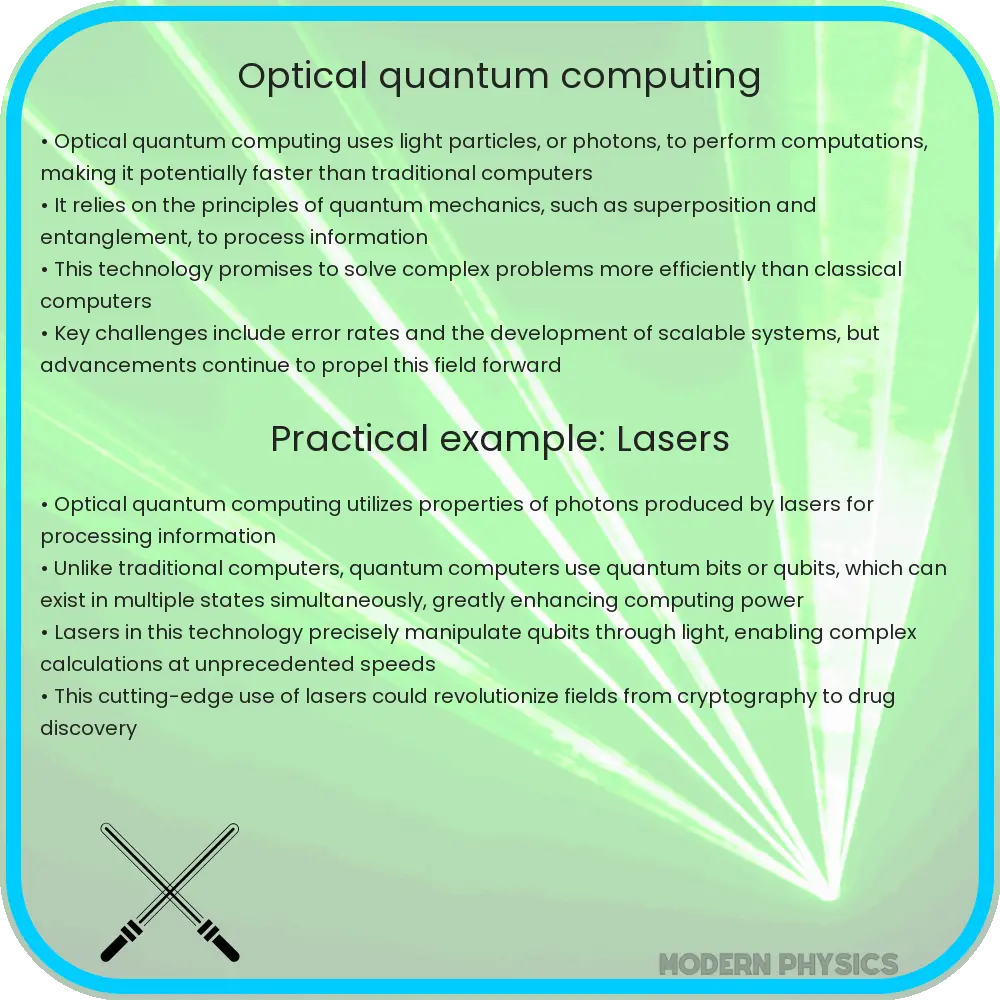
The realm of quantum computing represents a significant leap forward from traditional computing, offering unprecedented speed, precision, and scalability. Among the various approaches to quantum computing, optical quantum computing stands out for its unique use of photons to perform calculations, potentially revolutionizing how we process information. This article delves into the principles of optical quantum computing, highlighting its advantages and challenges.
Speed and Precision: The Quantum Advantage
Optical quantum computing harnesses the peculiar properties of quantum mechanics, such as superposition and entanglement, to perform complex calculations at speeds unattainable by classical computers. By operating with photons, which travel at the speed of light, optical quantum systems can process information with incredible speed and precision. This quantum advantage enables the execution of algorithms, such as Shor’s algorithm for factoring large numbers or Grover’s algorithm for database searching, much more efficiently than classical counterparts.
Scalability: Overcoming Classical Limitations
Scalability remains a critical challenge for quantum computing. However, optical quantum computing offers promising solutions thanks to its ability to manipulate light. Photons do not interact with each other as strongly as matter-based qubits, reducing the need for error correction and allowing for more scalable quantum circuits. Furthermore, the use of integrated photonic circuits can miniaturize quantum components, paving the way for larger and more complex quantum systems. These developments are crucial for achieving quantum supremacy, where quantum computers can solve problems that are practically impossible for classical computers.
Challenges and Future Directions
Despite its potential, optical quantum computing faces several obstacles. Creating and maintaining high-quality qubits and entangled states with photons is challenging, requiring precise control and isolation from environmental interference. Additionally, the development of efficient quantum error correction methods is vital for reliable computation. Researchers are exploring various approaches, such as topological photonics and hybrid systems, to overcome these challenges and harness the full potential of optical quantum computing.
As research progresses, the future of optical quantum computing looks promising, with potential applications ranging from cryptography and drug discovery to solving complex optimization problems. The ongoing advancements in speed, precision, and scalability are setting the stage for a new era of computing, poised to redefine the boundaries of technology.
Advancements in Optical Quantum Computing Technologies
Recent technological breakthroughs have significantly advanced the field of optical quantum computing. Innovations in photon generation, detection, and manipulation have led to more stable and controllable quantum systems. For instance, the development of single-photon sources and high-efficiency detectors enhances the precision of quantum operations, while integrated photonic circuits enable the miniaturization and scalability of quantum devices. These advancements are crucial for constructing practical optical quantum computers capable of tackling real-world problems.
Integration with Classical Systems
A key area of focus in the advancement of optical quantum computing is its integration with existing classical computing infrastructure. Hybrid quantum-classical systems are being developed to combine the best of both worlds: the extraordinary computing power of quantum systems for specific tasks and the versatility and ease of use of classical systems for general-purpose computing. This approach aims to make quantum computing more accessible and useful for a broader range of applications, bridging the gap between theoretical quantum advantages and practical computational solutions.
Future Applications and Impact
The potential applications of optical quantum computing are vast and varied. In cryptography, quantum computers can break many of the encryption techniques currently in use, necessitating the development of quantum-resistant encryption methods. In the field of materials science and chemistry, they can simulate complex molecules and reactions with high accuracy, accelerating drug discovery and the development of new materials. Moreover, in optimization and machine learning, quantum algorithms can analyze and process large datasets more efficiently than classical algorithms, offering new insights and solutions to complex problems.
Conclusion
Optical quantum computing represents a frontier in the evolution of computational technology, offering unparalleled speed, precision, and scalability. While challenges remain in the creation of practical and scalable quantum devices, recent advancements in photonics and integrated circuits are paving the way for the future of computing. The integration of optical quantum computers with classical systems and their potential applications in various fields highlight the transformative impact of this technology. As we continue to explore and harness the capabilities of optical quantum computing, we stand on the brink of a new era of technological innovation, poised to solve some of the most pressing challenges of our time.