
Explore the cutting-edge potential of quantum-optical modulators for enhancing efficiency, speed, and innovation in photonics and quantum computing.
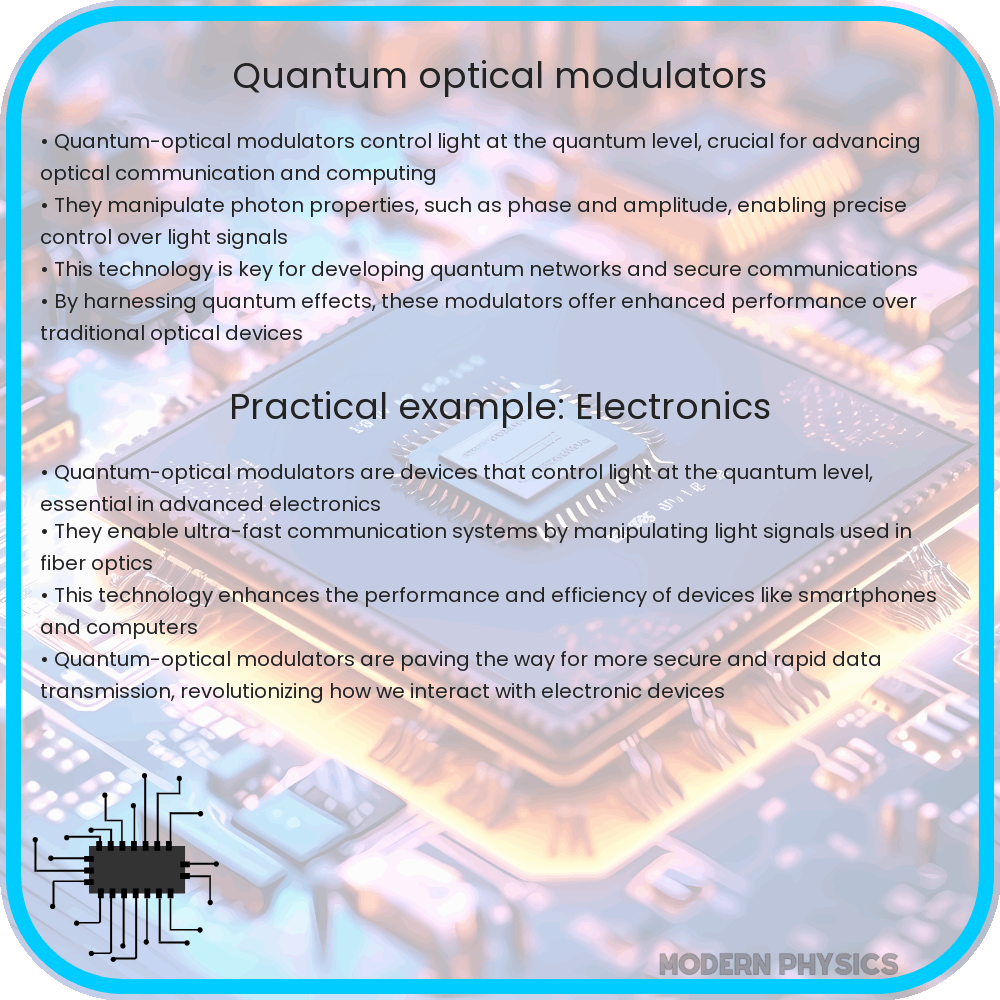
Exploring the Frontiers of Quantum-Optical Modulators
Quantum-optical modulators represent a pivotal advancement in the field of photonics, offering revolutionary enhancements in efficiency, speed, and the potential to innovate across various sectors, including telecommunications, quantum computing, and optical networking. These devices leverage the principles of quantum mechanics to modulate the properties of light, enabling unparalleled control and manipulation of optical signals.
Efficiency: A Leap Forward
The efficiency of quantum-optical modulators is measured by their ability to convert input electrical signals into modulated optical signals with minimal energy loss. Traditional optical modulators often grapple with issues of high power consumption and thermal inefficiency. In contrast, quantum-optical modulators, utilizing quantum effects such as electromagnetically induced transparency (EIT) and quantum confinement, achieve higher modulation efficiency. This efficiency is crucial for reducing power consumption in optical networks and enhancing the performance of photonic integrated circuits.
Speed: Breaking the Limits
Speed is another domain where quantum-optical modulators excel. The need for high-speed data transmission in modern networks necessitates devices capable of operating at the speed of light. Quantum-optical modulators, with their ability to manipulate light signals at incredibly fast rates, meet this demand. They can operate at speeds of tens to hundreds of gigahertz, surpassing the capabilities of conventional modulators. This speed enhancement is vital for high-bandwidth applications, from ultra-fast internet services to real-time data processing in quantum computers.
Innovation: Paving New Pathways
The innovative potential of quantum-optical modulators extends beyond efficiency and speed. They are at the forefront of enabling new technologies such as quantum cryptography and quantum networking, where the secure transmission of information is paramount. By leveraging the unique properties of quantum states, these modulators can encode and transmit data in ways that are fundamentally secure from eavesdropping. Additionally, their precision and speed open avenues for research in optical quantum computing, where they could play a role in realizing qubit manipulation and entanglement distribution.
The journey of quantum-optical modulators from theoretical concepts to practical devices showcases the remarkable potential of quantum technologies. As research and development continue, these modulators are set to redefine the boundaries of optical communication and computation, marking a significant milestone in the quest for faster, more efficient, and secure data transmission.
Challenges and Future Directions
Despite their promising advantages, the development and implementation of quantum-optical modulators face several challenges. One of the primary hurdles is the integration of these devices into existing optical networks and computing architectures. The quantum nature of these modulators requires precise control over environmental conditions to maintain quantum coherence, posing a significant challenge for their scalability and practical application. Moreover, the fabrication of quantum-optical modulators demands advanced materials and nanofabrication techniques, necessitating ongoing research and innovation in materials science and engineering.
Advancements in Material Science
Material science plays a crucial role in the evolution of quantum-optical modulators. The discovery and development of novel materials with exceptional optical and quantum properties, such as two-dimensional materials like graphene and transition metal dichalcogenides (TMDs), are paving the way for more efficient and versatile modulators. These materials offer unique advantages, including high electro-optic coefficients, strong light-matter interactions, and the ability to operate at room temperature, making them ideal candidates for next-generation quantum-optical modulators.
Interdisciplinary Collaboration
The advancement of quantum-optical modulators also underscores the importance of interdisciplinary collaboration. Bridging the gap between quantum physics, optical engineering, materials science, and information technology is essential for overcoming the technical challenges and realizing the full potential of these devices. Collaborative efforts are key to innovating new designs, optimizing performance, and integrating quantum-optical modulators into practical applications.
Conclusion
Quantum-optical modulators stand at the confluence of quantum mechanics and photonics, offering transformative prospects for communication and computing technologies. Their unparalleled efficiency, speed, and capacity for innovation hold the promise of revolutionizing data transmission, quantum computing, and secure communications. Despite the challenges ahead, ongoing research, advancements in material science, and interdisciplinary collaboration are paving the way for these quantum devices to become integral components of future optical systems. As we continue to explore the quantum frontier, quantum-optical modulators embody the spirit of innovation, pushing the boundaries of what is possible in the manipulation and control of light.