
Optical modulators are crucial in photonics and optoelectronics, modulating light properties for efficient, high-speed, and controlled wavelength optical communications.
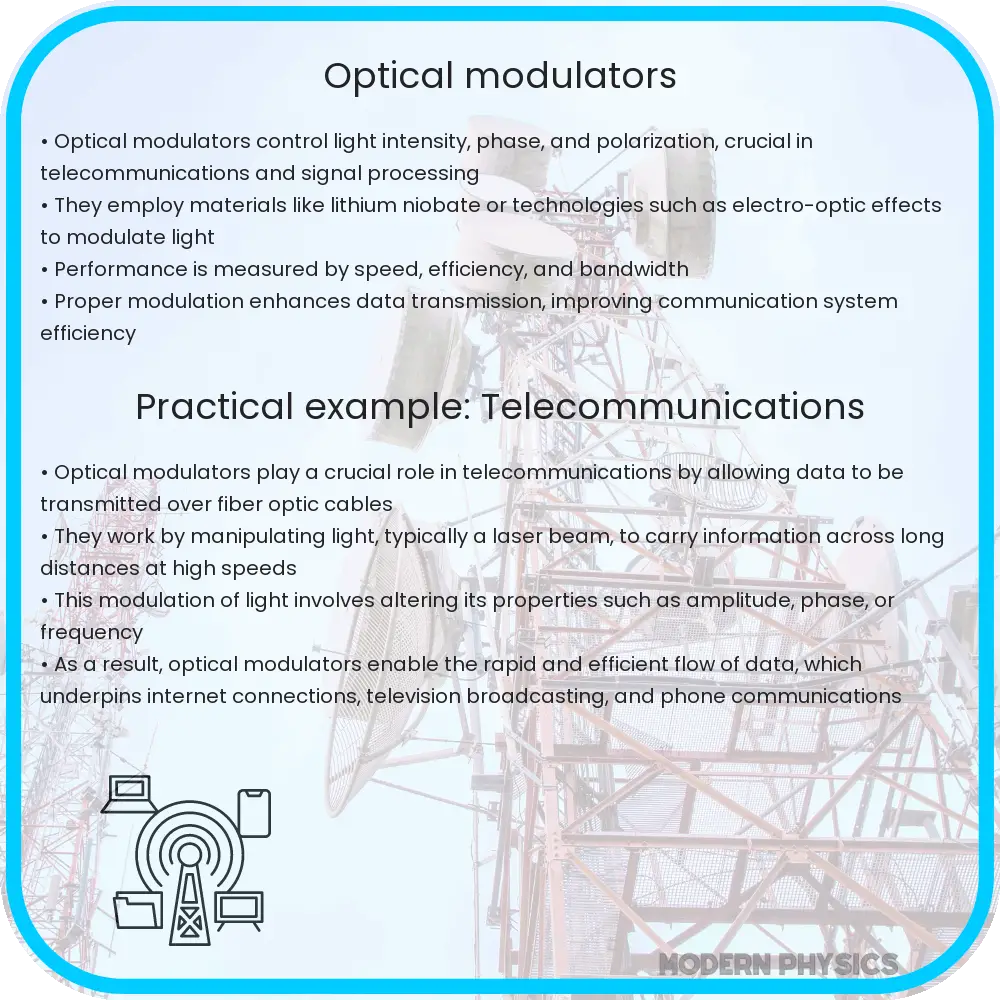
Optical Modulators: Efficiency, Speed & Wavelength Control
Optical modulators are essential devices in the field of photonics and optoelectronics. They modulate a property of light waves, such as their intensity, phase, or frequency, enabling the transmission and processing of information in optical communication systems. In this article, we will delve into three crucial aspects of optical modulators: efficiency, speed, and wavelength control.
Efficiency of Optical Modulators
Efficiency is a key performance metric for optical modulators. It refers to how effectively an optical modulator converts the input electrical signal into a modulated optical signal. Higher efficiency means that less electrical power is required to achieve the desired modulation, which is crucial for reducing the power consumption of optical communication systems.
- Insertion Loss: Insertion loss is the amount of signal power lost when the light passes through the modulator. Lower insertion loss correlates with higher efficiency.
- Extinction Ratio: This measures the contrast between the on and off states of the modulator. A higher extinction ratio indicates more effective modulation of the light signal.
Various materials and technologies can affect the efficiency of optical modulators. For instance, Lithium Niobate (LiNbO3) is widely used due to its favorable electro-optic properties, offering low insertion losses and high extinction ratios.
Speed of Optical Modulators
The speed of an optical modulator dictates how rapidly it can switch between different states, impacting the data transmission rate. High-speed modulators are critical for modern communication systems that require the transfer of large amounts of data in a short period.
- Modulation Bandwidth: The bandwidth of an optical modulator is the range of frequencies over which it can perform effectively. Wider bandwidth contributes to higher speeds.
- Response Time: This is the time it takes for the modulator to respond to changes in the input signal. Shorter response times are essential for high-speed operations.
Technologies such as electro-absorption modulators (EAMs) and Mach-Zehnder modulators (MZMs) are commonly employed to achieve high modulation speeds. EAMs, in particular, offer extremely fast response times by using the quantum-confined Stark effect to modulate light.
Wavelength Control in Optical Modulators
Wavelength control is crucial for wavelength-division multiplexing (WDM) systems, where multiple optical signals of different wavelengths are transmitted simultaneously over a single fiber. Effective wavelength control ensures that each channel remains distinct and minimizes cross-talk between channels.
- Tunability: Some optical modulators offer tunable wavelengths, allowing them to adapt to different communication channels and wavelengths as needed.
- Temperature Stability: The wavelength stability of a modulated signal can be affected by temperature fluctuations. Advanced materials and designs help maintain consistent performance over a range of temperatures.
Semiconductor-based modulators, such as those incorporating Indium Phosphide (InP) and Gallium Arsenide (GaAs), provide the capability for fine wavelength tuning, making them suitable for WDM applications.
Applications of Optical Modulators
Optical modulators find applications in various fields beyond optical communication systems. Their ability to precisely control light properties makes them valuable in a wide range of technologies:
- Data Centers: As the demand for cloud storage and high-speed internet services increases, data centers rely on optical modulators to efficiently manage and route vast amounts of data.
- Medical Imaging: Optical coherence tomography (OCT) and other advanced imaging techniques use optical modulators to improve image quality and resolution, aiding in accurate diagnostics.
- Military and Aerospace: Optical modulators are incorporated in various defense and aerospace applications, including secure communications and advanced radar systems.
Challenges and Future Directions
While optical modulators have already made a significant impact, several challenges and future directions aim to enhance their performance even further:
- Integration: Future optical systems seek to integrate modulators directly onto silicon photonic chips, reducing size and power consumption while improving performance.
- Cost Reduction: Researchers are looking for cost-effective materials and fabrication techniques to make high-performance modulators more affordable for widespread use.
- Improved Thermal Management: Managing the heat generated by high-speed modulations is crucial to maintaining the reliability and longevity of optical devices.
- Hybrid Technologies: Combining different modulation techniques, such as electro-optic and thermo-optic modulation, could yield modulators with enhanced capabilities and efficiency.
Conclusion
Optical modulators play a vital role in modern technology, enabling efficient, high-speed, and precise control of light in various applications. By understanding and improving their efficiency, speed, and wavelength control, as well as exploring their diverse applications and future trends, we can continue to advance the frontiers of photonics and optoelectronics. The ongoing research and development in this field hold the promise of even more powerful and versatile optical modulators, paving the way for future innovations in communication, imaging, and beyond.