
Discover how quantum metrology is revolutionizing precision measurement with innovative instruments, enhancing accuracy in science and technology.
Exploring the Frontier of Quantum Metrology Instruments
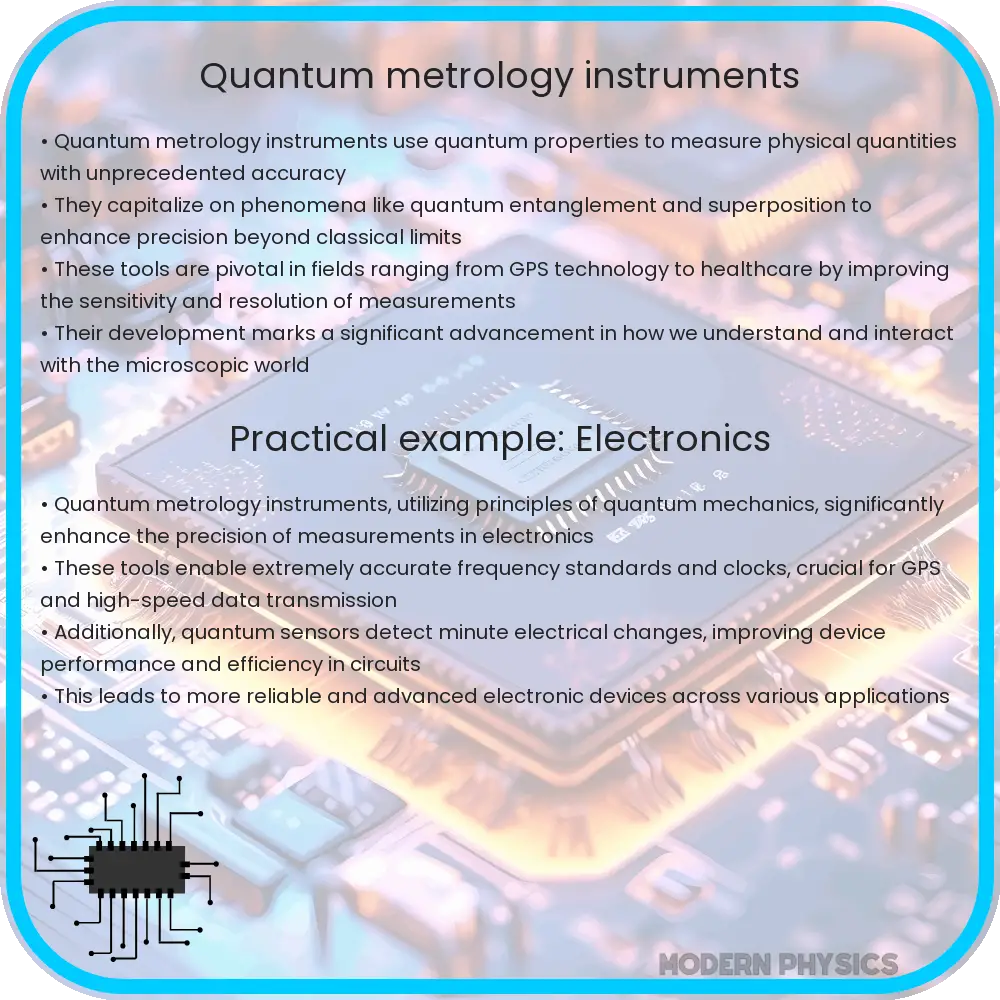
Quantum metrology represents a cutting-edge field where the principles of quantum mechanics are applied to enhance the precision and sensitivity of measurement instruments. This innovative approach is revolutionizing various sectors, including but not limited to, healthcare, navigation, and environmental monitoring. By exploiting quantum properties such as superposition and entanglement, researchers and engineers are developing instruments capable of measurements with unprecedented accuracy.
The Essence of Quantum Metrology
At its core, quantum metrology seeks to surpass the classical limits of measurement, pushing the boundaries of how accurately we can gauge physical quantities. The traditional methods, confined by classical physics, reach a saturation point beyond which no further refinement in measurement is possible. Quantum metrology, however, leverages quantum states that are sensitive to very faint changes in the environment, enabling the detection of signals that would otherwise be imperceptible.
Innovative Instruments and Their Applications
One of the flagship applications of quantum metrology is in the development of atomic clocks. These clocks, which use the vibration frequencies of atoms as their reference, have achieved accuracies so high that they would only lose a second over billions of years. Similarly, quantum sensors are making waves in the field of geodesy and seismology, where they are used to detect minute changes in gravitational fields with a level of precision that was previously unimaginable.
Another area of significant advancement is in medical imaging techniques. Quantum-enhanced sensors are being explored to improve the resolution and sensitivity of magnetic resonance imaging (MRI) machines. This could lead to earlier detection of diseases by identifying subtle changes in the body’s tissues that current technologies might miss.
The Role of Quantum Entanglement
Quantum entanglement plays a pivotal role in enhancing the sensitivity of measurements. Instruments that utilize entangled particles can measure quantities such as time, frequency, and magnetic fields with a precision that exceeds that of instruments using non-entangled particles. This phenomenon allows for the correlation of measurements across vast distances, opening new avenues for research in fundamental physics and beyond.
In conclusion, quantum metrology instruments are at the forefront of a measurement revolution, offering precision, sensitivity, and innovation. As these technologies mature, their impact is expected to grow, paving the way for new discoveries and advancements across a wide range of fields.
Challenges and Future Directions
Despite the promising advancements in quantum metrology, several challenges remain. One of the primary hurdles is the complexity of creating and maintaining quantum states, which are incredibly sensitive to external disturbances. This sensitivity requires sophisticated isolation and control techniques to preserve the quantum properties necessary for enhanced measurement. Additionally, the transition from laboratory prototypes to commercially viable products demands significant investment in both time and resources, posing a barrier to widespread adoption.
Another challenge lies in the need for specialized knowledge and training to develop and operate quantum metrology instruments. As these technologies advance, there will be an increasing demand for professionals skilled in quantum mechanics, engineering, and data analysis. Addressing this skills gap is crucial for the continued growth and innovation in the field.
Advancing Beyond the Horizon
Looking ahead, the future of quantum metrology is bright with potential. Ongoing research is focused on overcoming current limitations and expanding the capabilities of quantum instruments. For instance, efforts are underway to develop more robust quantum states that can withstand environmental perturbations, enabling more practical and versatile applications. Furthermore, the integration of quantum metrology with emerging technologies such as quantum computing and quantum communications promises to open new frontiers in precision measurement.
Innovations in material science and nanotechnology are also expected to play a key role in advancing quantum metrology. By discovering and utilizing new materials that exhibit favorable quantum properties, researchers can build more efficient and sensitive instruments. This synergy between materials science and quantum physics is likely to accelerate the development of groundbreaking metrology tools.
Conclusion
Quantum metrology is poised to redefine the boundaries of precision measurement, offering capabilities far beyond what is currently possible with classical techniques. By harnessing the peculiarities of quantum mechanics, this field is unlocking new possibilities in science and technology, from enhancing the accuracy of timekeeping to improving medical diagnostics. Despite the challenges that lie ahead, the ongoing research and development efforts are paving the way for a future where quantum metrology instruments become integral to a wide array of applications. As we continue to explore the quantum realm, the potential for innovation appears limitless, promising to bring about a new era of measurement that is more precise, sensitive, and innovative than ever before.