
Explore the fundamentals of Quantum Flavor Dynamics, the role of gauge bosons, quark mixing with the CKM matrix, and groundbreaking neutrino oscillations.
Understanding Quantum Flavor Dynamics
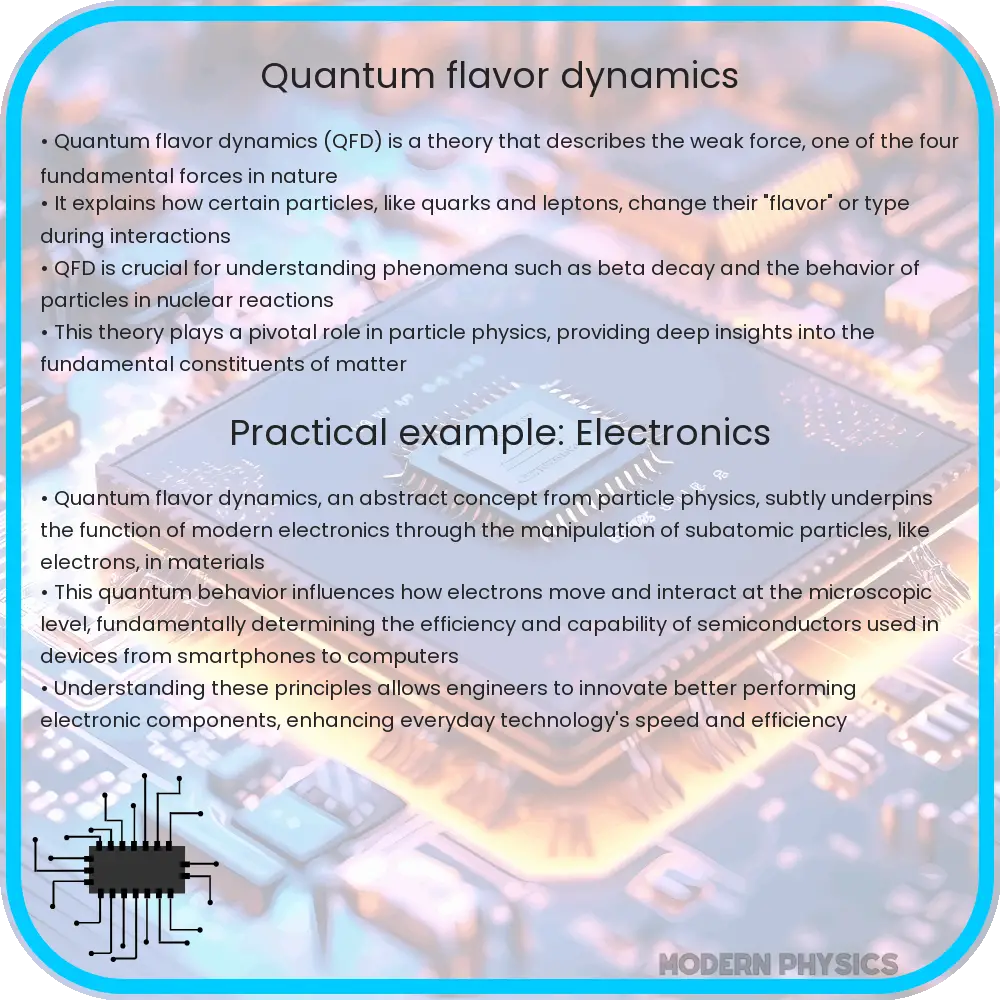
Quantum Flavor Dynamics (QFD) represents a cornerstone of modern particle physics, intertwining with the theory of particle interactions and the standard model. At its core, QFD is concerned with the behavior and interactions of quarks and leptons, the fundamental constituents of matter. These particles come in different “flavors,” which, in the realm of quantum physics, refer to their different types, such as up, down, charm, strange, top, and bottom for quarks, and electron, muon, and tau for leptons.
The Role of Gauge Bosons
In the quantum world, force carriers known as gauge bosons mediate interactions between particles. In QFD, the weak force—one of the four fundamental forces of nature—is mediated by three gauge bosons: W+, W–, and Z0. These bosons are pivotal in processes like beta decay, where a neutron transforms into a proton, emitting an electron and an antineutrino in the process. This decay is a quintessential example of the weak interaction, altering the flavor of quarks and thereby showcasing the essence of QFD.
Quark Mixing and the CKM Matrix
The interaction between quarks in QFD is further detailed by the concept of quark mixing, represented mathematically by the Cabibbo-Kobayashi-Maskawa (CKM) matrix. This matrix encapsulates the probability amplitudes of one type of quark transforming into another. For example, the transformation of a ‘down’ quark into an ‘up’ quark, crucial for understanding particle decays and interactions in high-energy physics experiments.
Lepton Flavor Violation
Similarly, in the lepton sector, flavor violation refers to the transformation of one type of lepton into another. While such processes are rare and have not been observed for charged leptons, they are hypothesized in extensions of the Standard Model. The study of these processes can provide profound insights into the uncharted territories of particle physics and the potential beyond the Standard Model scenarios.
Understanding QFD and the intricacies of particle interactions offers a window into the fundamental laws governing the universe. It connects the macroscopic world we observe with the enigmatic quantum realm, providing a framework for exploring the deepest questions of matter, energy, and the fabric of reality.
Neutrino Oscillations: A Window into Flavor Dynamics
One of the most fascinating aspects of Quantum Flavor Dynamics is neutrino oscillation, a phenomenon where neutrinos switch between flavors as they travel. This process, which was awarded the Nobel Prize in Physics, provided the first concrete evidence for mass among neutrinos, challenging previous assumptions of their masslessness. Neutrino oscillations are governed by a similar matrix to the CKM, known as the Pontecorvo-Maki-Nakagawa-Sakata (PMNS) matrix, which details the mixing parameters and angles dictating how neutrinos transform between types.
Experimental Challenges and Advances
The study of QFD and particle interactions is not without its challenges, primarily due to the minuscule scale and tremendous energies required to observe these particles. Large particle accelerators, like the Large Hadron Collider (LHC), and neutrino observatories, such as IceCube and Super-Kamiokande, are at the forefront of these investigations. These facilities enable scientists to smash particles together at high speeds or detect cosmic neutrinos, providing crucial data to test the predictions of QFD and the Standard Model.
Implications for the Standard Model and Beyond
The continuous exploration of QFD extends our understanding of the Standard Model and tests its limits. Anomalies and deviations from expected results could signal new physics, potentially leading to groundbreaking discoveries such as supersymmetry, extra dimensions, or the elusive dark matter. Therefore, QFD is not just about understanding the particle interactions but also about exploring the fundamental structure of our universe and searching for new laws of physics.
Conclusion
Quantum Flavor Dynamics serves as a crucial framework within particle physics, offering profound insights into the fundamental interactions that govern the universe. Through the study of quark and lepton behaviors, mediated by gauge bosons and encapsulated in mathematical matrices like the CKM and PMNS, scientists are able to unravel the complexities of the subatomic world. The challenges posed by this field push the boundaries of technology and theoretical physics, leading to significant advancements in our understanding of the universe. As experimental evidence continues to grow, QFD remains at the heart of the quest for a deeper, unified theory of everything, bridging the known with the unknown and driving forward the frontiers of human knowledge.