
Explore how quantum-enhanced measurement devices revolutionize precision, speed, and sensitivity in fields like metrology, imaging, and sensing.
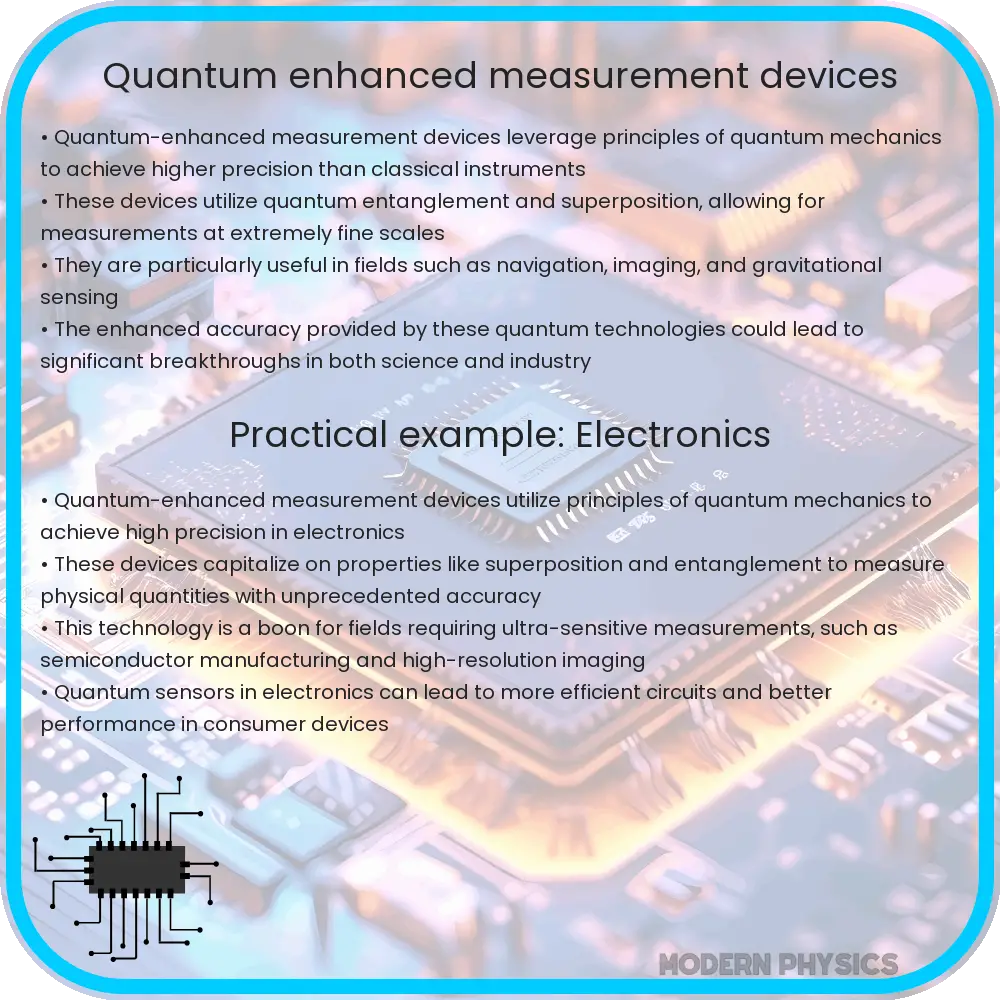
Quantum-enhanced Measurement Devices: Revolutionizing Precision, Speed, and Sensitivity
The realm of quantum mechanics has long intrigued scientists and engineers with its potential to revolutionize various technological fields. Among the most promising applications of quantum principles are quantum-enhanced measurement devices. These advanced tools leverage the peculiarities of quantum states to achieve unprecedented levels of precision, speed, and sensitivity in measurements, surpassing the capabilities of classical measurement devices.
The Quantum Advantage
At the heart of quantum-enhanced measurement devices is the principle of quantum superposition, where particles like photons, electrons, or atoms can exist in multiple states simultaneously. This property, along with entanglement — where particles remain connected, sharing their physical states no matter how far apart they are — provides a significant advantage in measurement technologies. For instance, quantum sensors use entangled particles to measure physical quantities such as magnetic fields, gravitational forces, or time with extraordinary precision.
Applications in Various Fields
- Quantum Metrology: Enhancing the accuracy of measurements at the atomic scale, quantum metrology promises to improve the standards of time, length, and electrical currents. This has profound implications for navigation systems, electronic devices, and the synchronization of global data networks.
- Quantum Imaging: By utilizing entangled photons, quantum imaging techniques can achieve higher resolution images under conditions where classical optics fail. This is crucial for medical imaging, astronomical observations, and even in the development of stealth technologies.
- Quantum Sensing: Quantum sensors detect changes in the quantum state of a system, offering unmatched sensitivity for environmental monitoring, mineral exploration, and security scanning. These sensors can detect the slightest changes in magnetic or electric fields, temperature, or pressure, providing critical data in real-time.
The integration of quantum mechanics into measurement devices not only enhances their performance but also opens up new possibilities for research and development across various scientific disciplines. The fusion of quantum mechanics and measurement technology heralds a new era of precision and sensitivity, promising significant advancements in science, medicine, and engineering.
Challenges and Future Prospects
Despite the promising advantages of quantum-enhanced measurement devices, several challenges remain. The complexity of quantum systems and the need for extreme conditions, such as ultra-low temperatures and high vacuum, pose significant obstacles. Furthermore, quantum devices are sensitive to environmental noise, which can disrupt the delicate quantum states essential for their operation. Researchers are actively developing techniques to stabilize quantum systems and protect them from decoherence, ensuring the reliability and robustness of quantum measurements.
Another area of intense research is the scalability of quantum technologies. For quantum-enhanced measurement devices to become widespread, they must be manufacturable at a scale and cost that make them accessible beyond specialized laboratories. Innovations in quantum computing and materials science are paving the way for more practical quantum devices, suggesting a future where quantum-enhanced measurements become a part of everyday technology.
Conclusion
Quantum-enhanced measurement devices represent a paradigm shift in the precision, speed, and sensitivity of measurements. By exploiting the unique properties of quantum mechanics, these devices offer significant improvements over traditional measurement technologies. From improving the accuracy of time standards to enabling new forms of imaging and sensing, the potential applications of quantum measurement devices are vast and varied. While challenges remain in terms of practical implementation and scalability, ongoing research and development are rapidly addressing these issues. As we stand on the cusp of a quantum revolution, the future of measurement and sensing technologies looks brighter than ever. The integration of quantum mechanics into measurement devices is not just an enhancement of existing technologies but a step towards unlocking new scientific discoveries and technological innovations that were once thought impossible.