
Quantum Electrodynamics (QED) is the quantum theory explaining the interaction between light and matter through photon and electron exchanges.
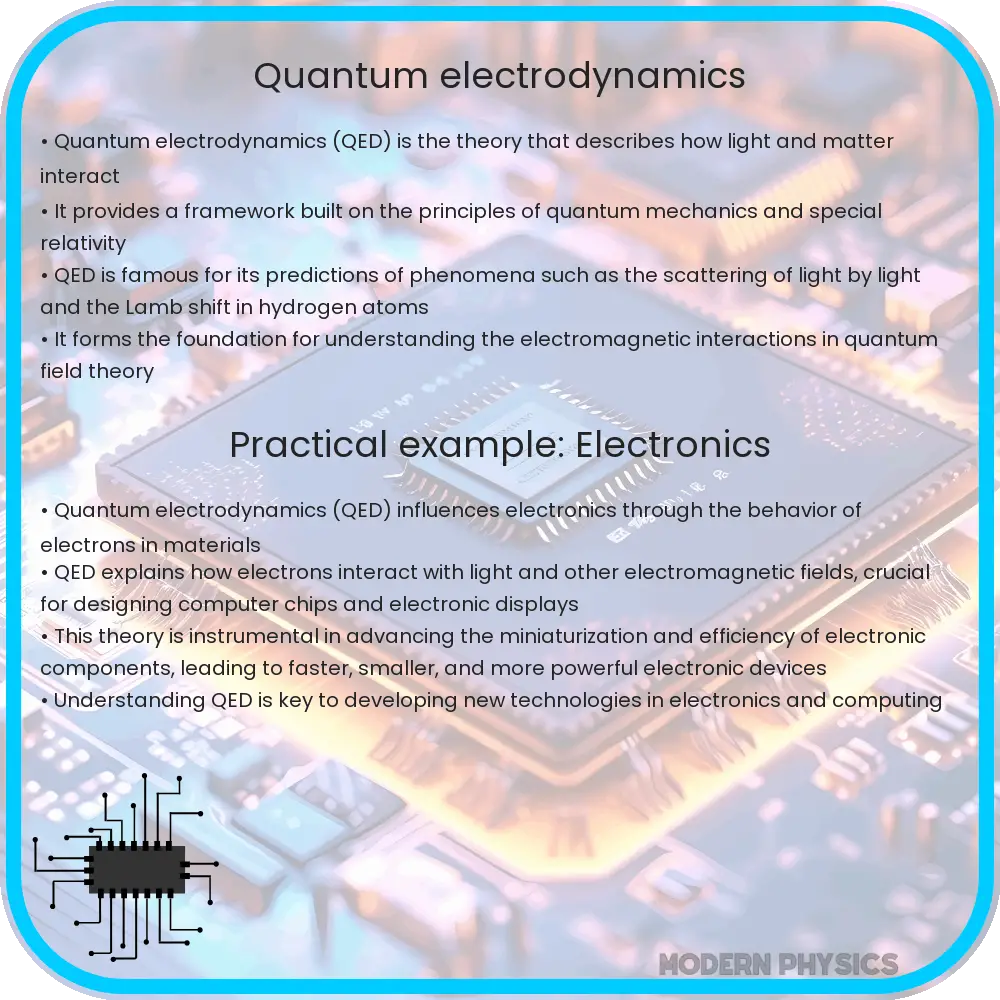
Introduction to Quantum Electrodynamics (QED)
Quantum Electrodynamics (QED) is a quantum theory of the interaction of light and matter, focusing on how photons and electrons interact. As a cornerstone of modern physics, QED interweaves the principles of quantum mechanics and the theory of relativity to explain the electromagnetism at the quantum level. This blending is crucial in developing our understanding of the fundamental particles and forces of nature.
The Basic Principles of QED
At its core, QED is built around the idea that charged particles, such as electrons and positrons, interact by exchanging photons, the quanta of light. These interactions are the fundamental processes behind electromagnetism. The beauty of QED lies in its ability to provide a framework that not only predicts but also quantifies the subtle nuances of interactions at very small scales.
The primary equation that governs QED is the Dirac equation for fermions (like electrons) and the Maxwell equations for bosons (like photons). In simpler terms, the Dirac equation describes how particles with spin-½, such as electrons, behave, taking into account both their quantum mechanical nature and relativistic effects, like traveling close to the speed of light.
Quantizing the Electromagnetic Field
In QED, the electromagnetic field itself is quantized. This quantization involves treating the electromagnetic field as a field of photons, which themselves can be thought of as discrete packets of energy. This concept is vital in understanding phenomena like the photoelectric effect, where light can eject electrons from a metal surface—the basis for solar panels and various types of sensors.
To visualize this, consider the photons as carriers of electromagnetic force, transferring momentum between charged particles. This exchange can be expressed using what physicists call ‘Feynman diagrams,’ named after Richard Feynman, one of the pioneers of QED. These diagrams use lines to represent the paths of particles and wavy lines to represent the exchange of photons.
Applications and Impacts of QED
Quantum Electrodynamics has paved the way for numerous technological advancements. Its applications range from the laser technology used in medical procedures and everyday appliances to the development of quantum computing. Furthermore, the precise predictions of QED regarding the interactions of light and matter have been crucial in the advancement of spectroscopy, which in turn has impacts ranging from chemistry and pharmacology to astronomy.
Moreover, QED plays a significant role in the burgeoning fields of nanotechnology and materials science, by helping scientists understand and manipulate electromagnetic interactions at the atomic and subatomic levels. This understanding is crucial for innovating new materials with tailored properties, potentially revolutionizing industries and leading to the development of new technologies.
- Technological Innovations: Lasers, semiconductors, and quantum computing owe much of their development to the principles of QED.
- Scientific Advancements: Improved models in physics that extend beyond classical electromagnetism to accommodate quantum mechanical effects.
- Improved Precision in Measurements: Extremely accurate measurements of electromagnetic properties enhance various scientific and engineering tasks.
Challenges and Future Prospects
Despite its successes, Quantum Electrodynamics also faces several challenges that remain areas of active research. One of the key issues is the integration of QED with the gravitational force, a fundamental interaction still not completely understood within the framework of quantum mechanics. Additionally, as we push the boundaries of precision in experiments, the infinitesimal discrepancies between theory and experimental results become significant, driving further refinement of the theory.
Looking to the future, the exploration of QED in conjunction with other quantum field theories offers exciting possibilities. For instance, researchers are increasingly focusing on the unification of forces within a single framework, aiming to bridge QED with strong and weak nuclear forces. This pursuit, often referred to as ‘Grand Unified Theory’, could revolutionize our understanding of the universe.
Educational Implications of QED
Quantum Electrodynamics is not only a subject of intricate research but also an essential part of physics education, inspiring the next generation of physicists. Its complex concepts are taught in advanced physics courses, often accompanied by experiments that illustrate the quantum mechanical phenomena underlying electromagnetic interactions. As educational tools evolve, simulations and visualizations are becoming crucial in making such abstract concepts more accessible and engaging for students.
- Critical Thinking: Engaging with QED encourages the development of analytical skills and a deep understanding of nature’s fundamental aspects.
- Innovation in Teaching: Modern educational technologies enable more interactive and engaging ways to teach and learn these complex concepts.
- Broader Perspectives: Understanding QED opens up various career opportunities in research, technology, and academia, fostering a broader scientific worldview.
Conclusion
Quantum Electrodynamics represents one of the most precise and profound theories in physics. It elegantly combines quantum mechanics and special relativity to explain how light and matter interact at the most fundamental levels. Through its challenging concepts and extensive applications, QED not only advances our technological frontiers but also enriches our theoretical understanding of the universe. As research progresses and educational methods evolve, QED will continue to inspire awe and curiosity, driving further innovations and deeper insights into the fabric of reality.