
Explore the role of quantum coherence in solid-state devices, including its applications in technology and how it shapes the future of electronics.
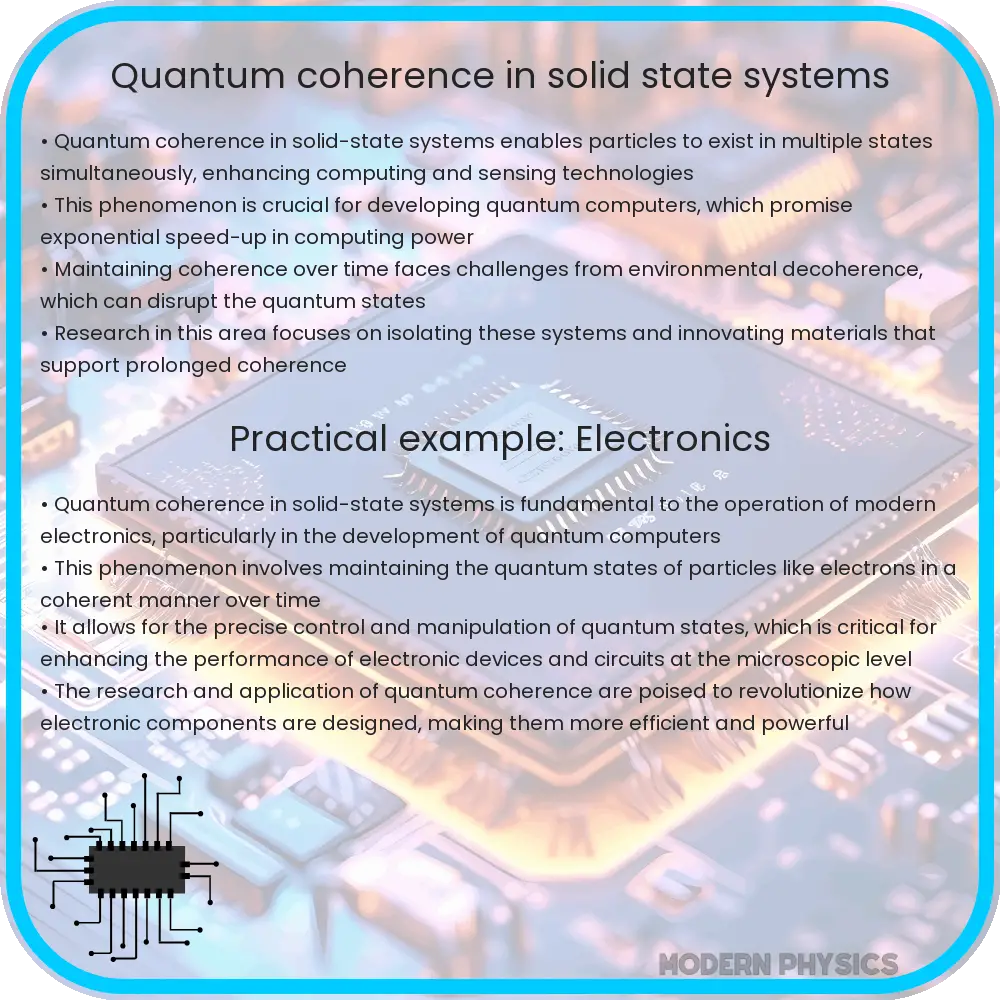
Understanding Quantum Coherence in Solid-State Devices
Quantum coherence is a fundamental principle that plays a pivotal role in the realm of quantum mechanics, underpinning the behavior and interaction of particles at microscopic scales. This phenomenon is essential for the development and functioning of solid-state devices, which are at the heart of modern electronics, including computers, smartphones, and various sensing and imaging technologies.
At its core, quantum coherence refers to the property of particles to exist in multiple states simultaneously, a condition known as superposition. This capability allows for the encoding and manipulation of information in ways that classical physics cannot accommodate, opening up new avenues for computing and data storage.
Applications in Solid-State Devices
Solid-state devices, such as transistors and semiconductors, rely on the manipulation of electrons to perform their functions. The incorporation of quantum coherence into these devices has led to the development of quantum computers, which promise to surpass the computational power of classical computers by performing complex calculations at unprecedented speeds.
Beyond computing, quantum coherence has significant implications for the field of cryptography, enabling secure communication methods that are theoretically immune to hacking. Furthermore, the principle is instrumental in the advancement of quantum sensing and imaging technologies, offering sensitivity and resolution that could revolutionize medical diagnostics, environmental monitoring, and navigation systems.
Challenges and Future Prospects
Despite its potential, harnessing quantum coherence in solid-state devices presents considerable challenges. One of the main obstacles is maintaining coherence over practical time scales, as interactions with the environment tend to destroy this delicate state, a phenomenon known as decoherence. Researchers are actively exploring materials and designs that minimize decoherence, including the use of superconducting circuits and the isolation of qubits in vacuum environments.
The integration of quantum coherence into solid-state devices is at the forefront of technological innovation, with ongoing research pushing the boundaries of what is possible. As scientists and engineers continue to overcome the challenges associated with quantum coherence, the next generation of solid-state devices promises to bring about a new era of computing, communication, and sensing capabilities.
Quantum Coherence in Solid-State Devices: Revolutionizing Technology
Quantum coherence represents a pivotal principle in quantum mechanics, denoting the property of particles to exist in multiple states simultaneously. This principle underlies the phenomena of superposition and entanglement, which are fundamental to quantum computing and various solid-state devices. In the realm of solid-state physics, the application of quantum coherence has opened up revolutionary pathways for the development of highly efficient and powerful technologies, including quantum computers, sensors, and novel materials.
Applications of Quantum Coherence in Solid-State Devices
One of the most significant applications of quantum coherence lies in the development of quantum computers. These devices leverage the superposition principle to perform complex calculations at speeds unattainable by classical computers. By manipulating qubits, which can represent both 0 and 1 simultaneously due to quantum coherence, quantum computers can solve problems in cryptography, drug discovery, and complex system simulation more efficiently.
Additionally, quantum coherence is instrumental in enhancing the sensitivity and accuracy of solid-state sensors. Quantum sensors exploit coherent quantum states to measure physical quantities such as magnetic fields, temperature, and pressure with unprecedented precision. This capability is crucial for advances in navigation, medical imaging, and environmental monitoring.
Moreover, the exploration of quantum coherence has led to the creation of new materials with exotic properties. Topological insulators, for instance, conduct electricity only on their surface, with their interior acting as an insulator. This unique behavior, rooted in quantum coherence, holds promise for developing low-power, high-efficiency electronic devices.
Challenges and Future Directions
Despite the promising applications, harnessing quantum coherence in solid-state devices is fraught with challenges. Maintaining coherence over practical time scales is difficult due to decoherence, a process where interaction with the environment causes quantum systems to lose their coherent properties. Researchers are actively seeking materials and design strategies that minimize decoherence, aiming to make quantum devices more robust and reliable.
Looking ahead, the ongoing advancements in quantum materials and engineering promise to overcome current limitations, paving the way for the widespread adoption of quantum technologies. The integration of quantum coherence into solid-state devices is expected to revolutionize various sectors, including computing, healthcare, and telecommunications, heralding a new era of technological innovation.
Conclusion
The exploration and application of quantum coherence in solid-state devices signify a transformative shift in technology, offering the potential for profound advancements across multiple fields. As scientists and engineers continue to unravel the complexities of quantum mechanics and develop new methods to maintain coherence, the future of quantum technologies shines brightly. The journey from theoretical concept to practical application underscores a collective ambition to harness the quantum realm, promising to unlock capabilities far beyond the reach of traditional technologies. In this era of rapid technological progress, the exploration of quantum coherence in solid-state devices remains a beacon of innovation, driving forward the boundaries of what is scientifically and technologically possible.