
Explore the Phonon Bottleneck Effect in solid state physics: its impact, optimization strategies, and innovative solutions for enhanced material performance.
Understanding the Phonon Bottleneck Effect in Solid State Physics
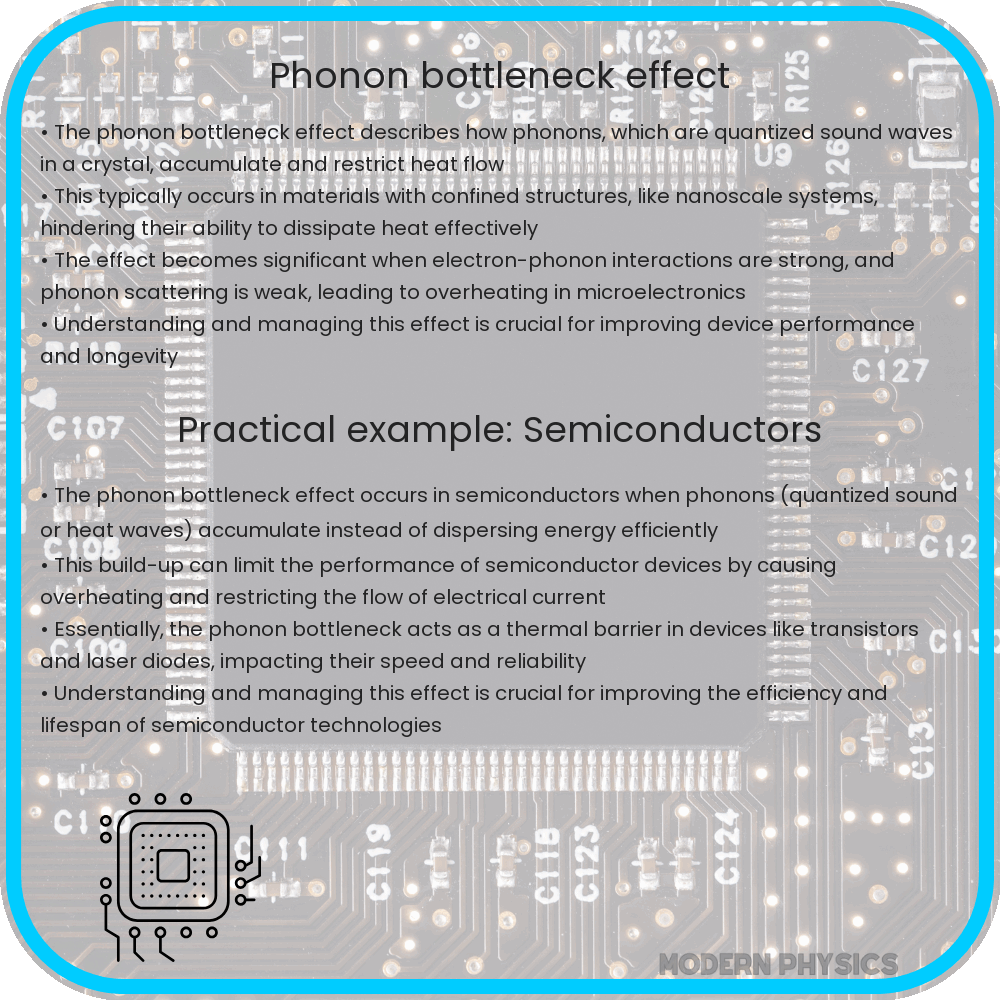
The Phonon Bottleneck Effect is a critical phenomenon in solid state physics that impacts the thermal conductivity and electronic properties of materials. This effect arises when there is a restriction in the flow of phonons, which are quasiparticles representing quantized modes of vibrations within a solid. These restrictions can lead to significant challenges in thermal management and energy conversion processes, especially in semiconductors and nanostructured materials.
Impact of Phonon Bottleneck on Material Properties
The Phonon Bottleneck Effect influences various material properties, including thermal conductivity, electronic mobility, and overall device efficiency. In semiconductors, for instance, an inhibited phonon flow can lead to overheating and reduced efficiency of electronic devices. This is particularly problematic in high-power applications where efficient heat dissipation is crucial. Additionally, the effect can alter the carrier relaxation dynamics in nanostructures, affecting their optical and electronic performance.
Optimization Strategies
- Material Engineering: Adjusting the composition and structure of materials to facilitate phonon flow. Incorporating materials with different lattice structures or mass variances can disrupt phonon scattering, mitigating the bottleneck effect.
- Nanostructuring: Designing materials with nano-scale features can help in managing phonon flow. Nanostructures, such as quantum dots and nanowires, can be engineered to have phonon spectra that minimize bottlenecks.
- Thermal Interfaces: Improving the quality of thermal interfaces in devices can enhance phonon transfer, reducing thermal resistance and improving heat dissipation.
Solutions and Technological Advancements
Research in solid state physics continues to develop solutions to overcome the Phonon Bottleneck Effect. Advanced computational models and experimental techniques are being employed to understand phonon dynamics better and design materials that can circumvent these limitations. Innovations such as phononic crystals and engineered superlattices show promise in directing and controlling phonon flow, opening new avenues for high-performance thermal and electronic devices.
Understanding and mitigating the Phonon Bottleneck Effect is crucial for the development of next-generation materials and devices. By optimizing phonon flow within solids, scientists and engineers can enhance the efficiency and reliability of a wide range of technologies, from semiconductor devices to thermoelectric materials.
Future Directions in Phonon Bottleneck Research
The ongoing research into the Phonon Bottleneck Effect holds the potential to revolutionize solid state physics and material science. As we delve deeper into quantum effects and nano-scale phenomena, the understanding of phonon interactions grows, paving the way for innovative solutions. The development of new materials with tailored phononic properties is at the forefront of this research, aiming to enhance energy conversion efficiency and thermal management in electronic devices.
Challenges and Opportunities
Despite the promising advances, significant challenges remain in fully overcoming the Phonon Bottleneck Effect. One of the main hurdles is the precise control and manipulation of phonon behavior at the nano-scale. Additionally, integrating these advanced materials into commercial devices requires scalable manufacturing techniques and compatibility with existing technologies. However, these challenges also present opportunities for interdisciplinary collaboration and innovation, merging insights from physics, chemistry, and engineering to create novel solutions.
Conclusion
The Phonon Bottleneck Effect represents a critical challenge and opportunity in solid state physics and materials science. By restricting phonon flow, it impacts thermal conductivity and electronic properties of materials, posing hurdles for device efficiency and reliability. However, through material engineering, nanostructuring, and the development of thermal interfaces, significant progress has been made in mitigating its effects. Future research is poised to further unlock the potential of materials and devices by overcoming these limitations, with a focus on understanding phonon dynamics, developing new materials, and integrating innovative solutions into practical applications. As we continue to explore the quantum and nano-scale world, the insights gained from addressing the Phonon Bottleneck Effect will undoubtedly contribute to the next wave of technological advancements, making it an exciting area of study for scientists and engineers alike.