
Explore the fascinating intersection of Quantum Chromodynamics and Statistical Thermodynamics, uncovering the universe’s fundamental mysteries.
Exploring the Intersection of Quantum Chromodynamics and Statistical Thermodynamics
The fascinating interplay between Quantum Chromodynamics (QCD) and Statistical Thermodynamics offers a deep insight into the fundamental aspects of matter and energy. Quantum Chromodynamics, a subset of quantum field theory, is primarily concerned with the study of the strong interaction – the force that binds quarks and gluons together in protons, neutrons, and other particles. On the other hand, Statistical Thermodynamics provides a framework for understanding the macroscopic properties of systems based on the statistical behavior of their microscopic constituents.
Quantum Chromodynamics: The Strong Force Unveiled
QCD delves into the interactions between quarks and gluons, governed by the strong force. This force, one of the four fundamental forces of nature, is responsible for holding the atomic nucleus together. In QCD, the concept of color charge is crucial, analogous to electric charge in electromagnetism. Quarks come in three ‘colors’ – red, green, and blue – and their interactions are mediated by gluons, which carry the color force. The unique property of QCD is confinement, which posits that quarks cannot exist independently but are always confined within larger particles like protons and neutrons.
Statistical Thermodynamics: Bridging Microscopic and Macroscopic Worlds
Statistical Thermodynamics links the microscopic quantum world to macroscopic observable properties. It uses statistical methods to relate the properties of individual atoms or particles, like their energy levels and quantum states, to the thermodynamic properties of the material as a whole. This includes concepts like temperature, pressure, and entropy. A key principle in statistical thermodynamics is the Boltzmann distribution, which describes the distribution of energy states among particles in a system.
The Convergence of QCD and Statistical Thermodynamics
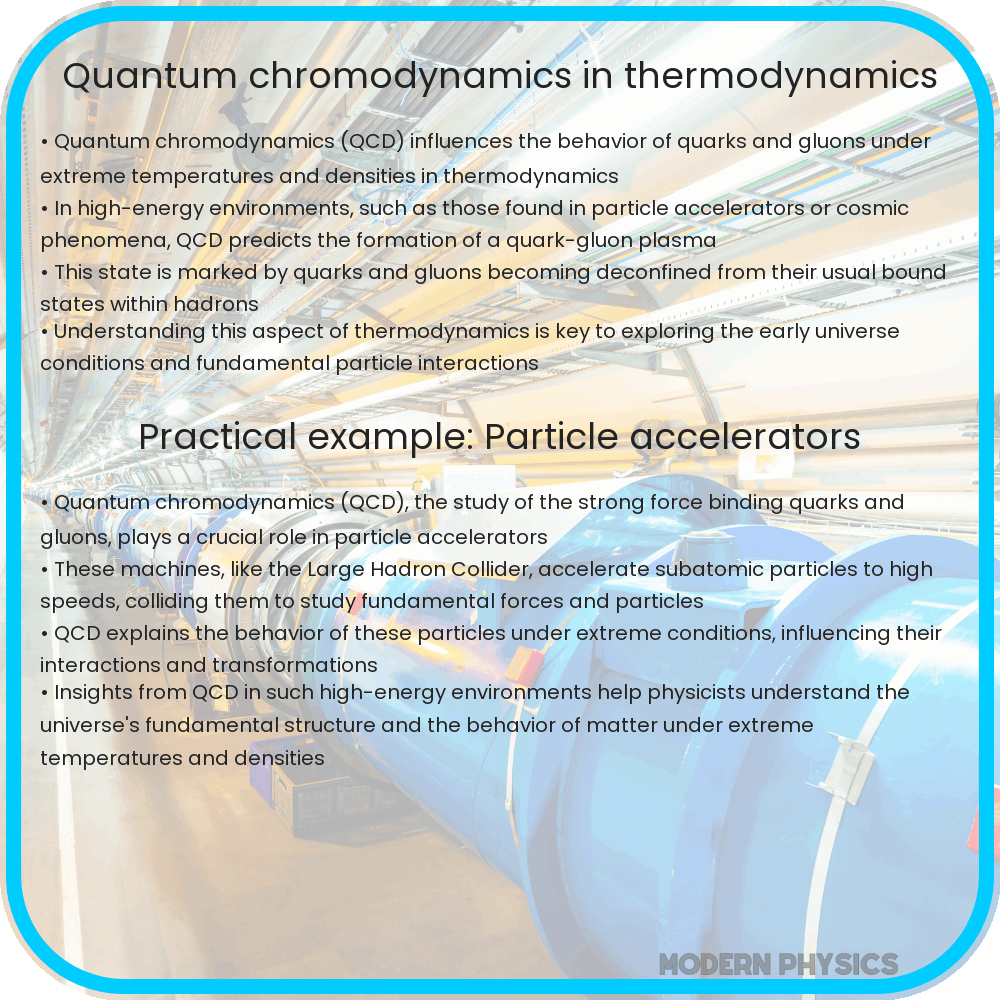
At high temperatures or densities, such as those found in the early universe or inside neutron stars, QCD and Statistical Thermodynamics intersect dramatically. Under these extreme conditions, quarks and gluons are no longer confined within protons and neutrons but form a new state of matter known as quark-gluon plasma (QGP). The study of QGP is a perfect example of how the principles of QCD and Statistical Thermodynamics come together to explain the behavior of matter under extreme conditions.
In summary, the integration of Quantum Chromodynamics and Statistical Thermodynamics is a potent combination for probing the most fundamental aspects of our universe. The next section will delve deeper into the applications and implications of this interdisciplinary approach.
Advanced Applications and Implications
The synergy between Quantum Chromodynamics and Statistical Thermodynamics extends far beyond theoretical curiosity. One significant application lies in the field of high-energy physics, particularly in particle accelerators like the Large Hadron Collider (LHC). Here, scientists recreate conditions similar to those just after the Big Bang, allowing them to study quark-gluon plasma and test predictions of QCD in a thermodynamic context.
Another application is in astrophysics, especially in understanding the internal dynamics of neutron stars. These dense celestial bodies, formed from collapsed stars, are thought to contain cores of quark matter. The principles of QCD and Statistical Thermodynamics help astrophysicists model these extreme environments, providing insights into the behavior of matter under immense pressure and density.
Challenges and Future Directions
Despite its significant achievements, the integration of QCD and Statistical Thermodynamics faces challenges, primarily due to the complex nature of strong interactions and the difficulty in creating and studying extreme states of matter. Future research aims to develop more sophisticated models and experimental techniques to explore this realm more deeply.
Emerging technologies like quantum computing offer promising avenues for solving complex QCD problems. By simulating quantum phenomena directly, quantum computers could provide unprecedented insights into the quark-gluon plasma and other exotic states of matter.
Conclusion: A Gateway to Unraveling Mysteries of the Universe
The intersection of Quantum Chromodynamics and Statistical Thermodynamics represents a frontier in our understanding of the universe. From unveiling the conditions of the early universe to probing the inner workings of neutron stars, this interdisciplinary approach is crucial for exploring some of the most fundamental and intriguing questions in physics. As technology advances and our theoretical understanding deepens, the convergence of these fields promises to shed light on the mysteries of the quantum world and its macroscopic manifestations, opening new horizons in both fundamental physics and practical applications.