
Learn how a Quadratic Residue Diffuser utilizes mathematical principles to enhance room acoustics by dispersing sound waves evenly.
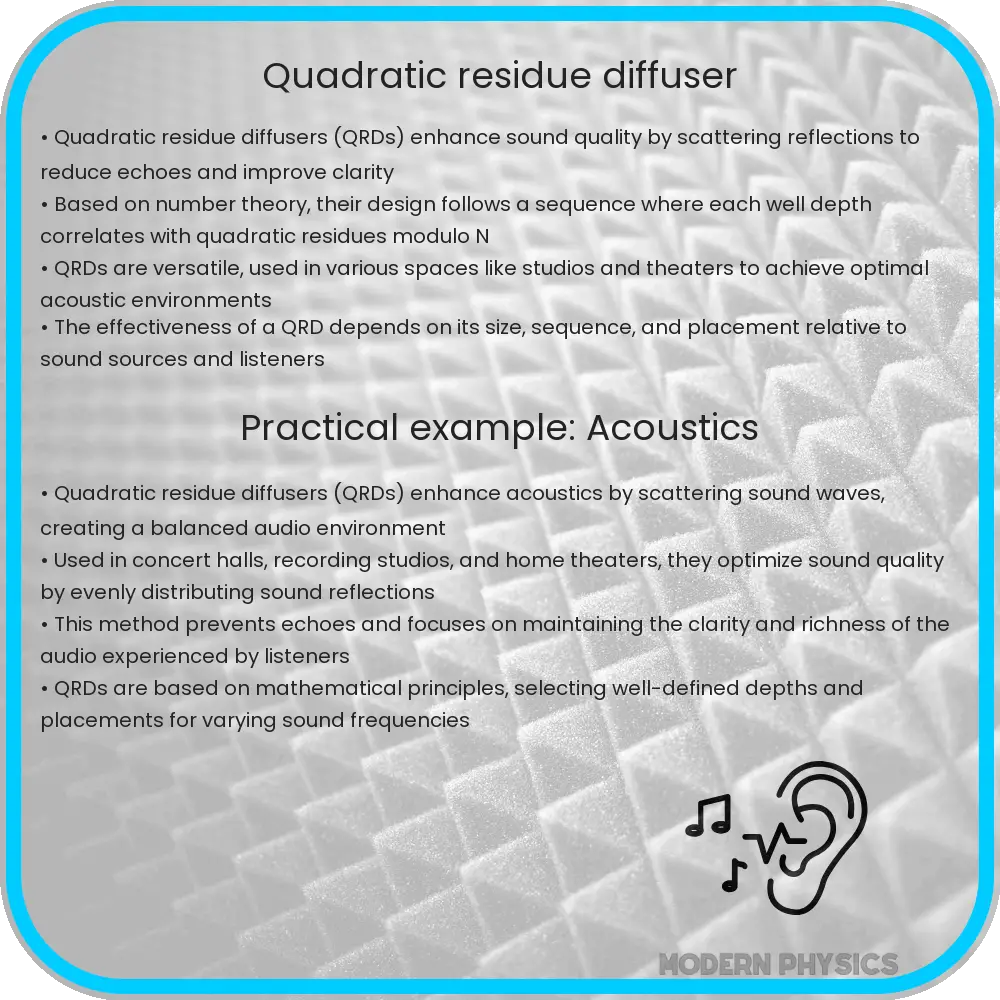
Quadratic Residue Diffuser: Optimize Sound, Enhance Acoustics
Sound quality is crucial in various settings, from professional music studios to home theaters. One effective way to improve acoustics is through the implementation of a Quadratic Residue Diffuser (QRD). By understanding the physics behind the QRD, we can see how it operates to not only disperse sound waves more uniformly but also reduce echoes and refine the overall sound experience in a room.
Basics of Sound Wave Diffusion
Sound waves propagate through air by creating pressure fluctuations, which our ears perceive as sound. In acoustically untreated spaces, these waves can bounce off hard surfaces, leading to excessive reverberations and echoes. To counteract this, acoustic treatments are used to absorb and diffuse sound. Diffusion is particularly significant as it scatters sound waves in many directions, promoting a more balanced acoustical environment.
What is a Quadratic Residue Diffuser?
A Quadratic Residue Diffuser makes use of the mathematical principle of quadratic residues. This device is meticulously designed to break up coherent sound waves into many smaller waves, scattering them widely throughout the space. The primary function of a QRD is to improve sound clarity and spatial decay without removing energy from the sound, which is often a side effect of sound absorption techniques.
The Mathematical Model Behind QRD
The effectiveness of a QRD is rooted in its mathematical conception, relying specifically on prime numbers and quadratic residue theory, which is an area of mathematics concerning the solvability of quadratic equations modulo ‘n’. More formally, a number ‘a’ is a quadratic residue modulo ‘n’ if it can be expressed as a^2 ≡ p (mod n), where ‘p’ is prime and ‘a’ is an integer. This characteristic influences the design and performance of diffusion panels.
The sequence of well depths in the panel corresponds to the values calculated from the quadratic residue of a set prime number, ultimately determining how sound is diffused. Typically, the depth sequence helps scatter specific frequency waves more effectively, enhancing the uniformity of sound distribution.
Design and Practical Application
The physical structure of a QRD involves a series of slots or wells with depths varying according to the quadratic residue sequence. These wells are usually constructed in aligned rows, their different depths programmed to target various frequencies of sound. When a sound wave strikes the uneven surface of the diffuser, the different well depths cause the waves to be reflected at different angles, thus achieving diffusion.
The effectiveness of a QRD can be adjusted by altering the depth and number of wells based on the desired acoustic results. These parameters depend heavily on the specific sound frequencies one wishes to manage and the acoustic characteristics of the room. The versatility in the design of these diffusers makes them suitable for use in a wide range of environments that demand high-quality acoustics.
Engineers and architects often incorporate QRDs into acoustic design strategies to optimize the way sound behaves in a space, whether it’s a lecture hall, a recording studio or a home cinema. The choice of where to place these diffusers within a room is also crucial for achieving the best sound dispersion, highlighting the integral role of good design and planning in acoustic treatments.
- Reduction of echo and reverberation
- Enhanced clarity for speech and music
- Uniform sound coverage in a space
Materials and Sustainability in QRD Manufacturing
The choice of materials used in constructing a Quadratic Residue Diffuser is essential not only for its acoustic performance but also for environmental sustainability. Common materials include wood, which is favored for its natural acoustic properties and aesthetic appeal. However, modern diffusers might also utilize recycled plastics or composite materials that offer durability and moisture resistance, which are crucial in varying climate conditions.
Sustainability in QRD manufacturing involves selecting materials that are locally sourced, recyclable, and have a low impact on the environment. Manufacturers are increasingly adopting eco-friendly practices, aiming to reduce carbon footprints and promote sustainability in acoustic engineering.
Future Trends in QRD Technology
As technology advances, so do the methodologies and materials used in the construction of QRDs. There is a growing trend toward integrating smart technology into diffusers, allowing for adjustable acoustic properties based on real-time sound analysis. This innovation could lead to more dynamic acoustic environments that can adapt to different events or times of day.
Moreover, research is continually being conducted to enhance the mathematical models that govern QRD design, providing even more precise control over sound diffusion. These developments promise to refine our understanding and implementation of sound diffusion principles further, leading to more effective and versatile acoustic solutions.
Conclusion
Understanding the principles and benefits of Quadratic Residue Diffusers is essential for anyone involved in enhancing acoustic environments. From their mathematical foundations to practical applications, QRDs play a pivotal role in managing sound diffusion in various settings. By effectively reducing reverberation and enhancing sound clarity, these diffusers make significant improvements in sound quality, benefiting spaces like studios, theaters, and residential areas.
The ongoing evolution of QRD technology, with a focus on sustainability and adaptability, highlights the dynamic nature of acoustic engineering. As new materials and technologies emerge, the potential for creating more efficient and environmentally friendly sound diffusion solutions continues to expand. Ultimately, the proper implementation and continual advancement of QRDs will lead to better soundscapes and enriched auditory experiences in our daily environments.