
Explore the physics of soda cans, uncovering the role of gas laws, equilibrium, and force balance in maintaining pressure and carbonation.
Understanding the Physics Behind the Pressure in a Soda Can
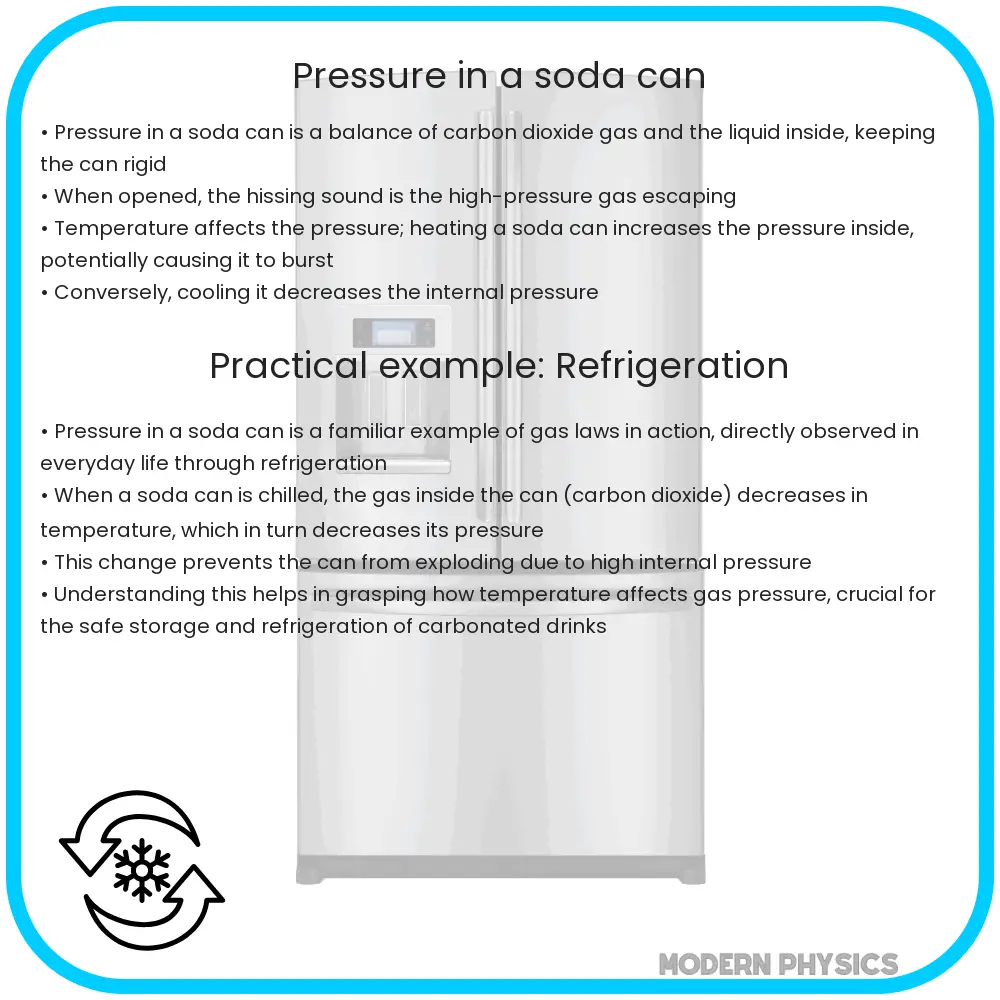
The science of a soda can is a fascinating interplay of physics, chemistry, and engineering. To understand how pressure maintains equilibrium in a soda can, we must explore concepts of force balance, gas laws, and fluid dynamics.
Force Balance and Equilibrium in a Soda Can
At its core, the concept of force balance governs the stability of a soda can. When a soda can is sealed, it contains a carbonated beverage, which is a mixture of water and dissolved carbon dioxide (CO2). The dissolution of CO2 in water is a reversible chemical reaction, forming carbonic acid (H2CO3). This equilibrium between CO2, water, and carbonic acid is crucial for maintaining the pressure inside the can.
Gas Laws and Pressure
Understanding the gas laws helps explain the pressure dynamics inside a soda can. According to Henry’s Law, the amount of dissolved gas in a liquid is proportional to its partial pressure above the liquid. Therefore, the high pressure inside a sealed soda can keeps a significant amount of CO2 dissolved. When the can is opened, the pressure is released, leading to the effervescence or bubbling we observe as CO2 escapes from the solution.
Boyle’s Law also plays a role. It states that the pressure of a gas is inversely proportional to its volume, at a constant temperature. In a sealed can, as the temperature increases, the pressure inside the can also increases, which can sometimes lead to the can bursting if the conditions are extreme.
The Role of Fluid Dynamics
Fluid dynamics contributes to the understanding of how liquids and gases behave inside the soda can. The interaction between the liquid and the pressurized gas above it, and the way they respond to changes in temperature and pressure, are essential aspects of fluid dynamics. This interaction ensures that the soda remains carbonated until the can is opened.
In summary, the pressure inside a soda can is a result of a delicate balance between chemical reactions, gas laws, and fluid dynamics. The equilibrium maintained by these factors is what keeps the soda carbonated and prevents the can from deforming under normal conditions.
Exploring Further: The Implications of Temperature and Altitude
Temperature and altitude are significant factors that affect the pressure inside a soda can. As mentioned earlier, an increase in temperature can lead to an increase in pressure inside the can due to the gas laws. This phenomenon is particularly evident in hot climates where stored soda cans are more prone to bursting. Conversely, in colder environments, the pressure inside the can decreases, which can affect the carbonation levels when the can is opened.
Altitude also plays a crucial role. At higher altitudes, the external atmospheric pressure is lower than at sea level. This reduced external pressure can cause an increase in the internal pressure differential, leading to cans bulging or even exploding if the difference is too significant. Conversely, when brought from a high altitude to a lower one, the reduced internal pressure compared to the external pressure can cause the can to implode slightly, appearing dented.
Material Science and Can Design
The design of soda cans is a direct response to the forces discussed. Aluminum is commonly used due to its strength-to-weight ratio, corrosion resistance, and ease of forming. The can’s structure, particularly its cylindrical shape and the concave bottom, is engineered to withstand the internal pressure. These design elements distribute the pressure evenly across the can’s walls and reduce the risk of deformation or failure under normal handling and temperature conditions.
Conclusion
The humble soda can is a marvel of modern science and engineering. It embodies principles of physics, chemistry, and material science. The equilibrium of pressure inside the can, governed by gas laws and chemical reactions, is a delicate balance that keeps the beverage carbonated. The impact of external factors like temperature and altitude further demonstrates the dynamic nature of this equilibrium. Additionally, the intelligent design and choice of materials for the can ensure its integrity under various conditions. This intricate interplay of science and engineering not only preserves the quality and fizz of the beverage but also ensures consumer safety. Thus, the next time you open a soda can, remember it’s not just a drink, but a testament to the fascinating world of physics and engineering.