
Explore Poincaré Symmetry’s vital role in Special Relativity, impacting particle physics, cosmology, and technological advancements.
Understanding Poincaré Symmetry in the Realm of Special Relativity
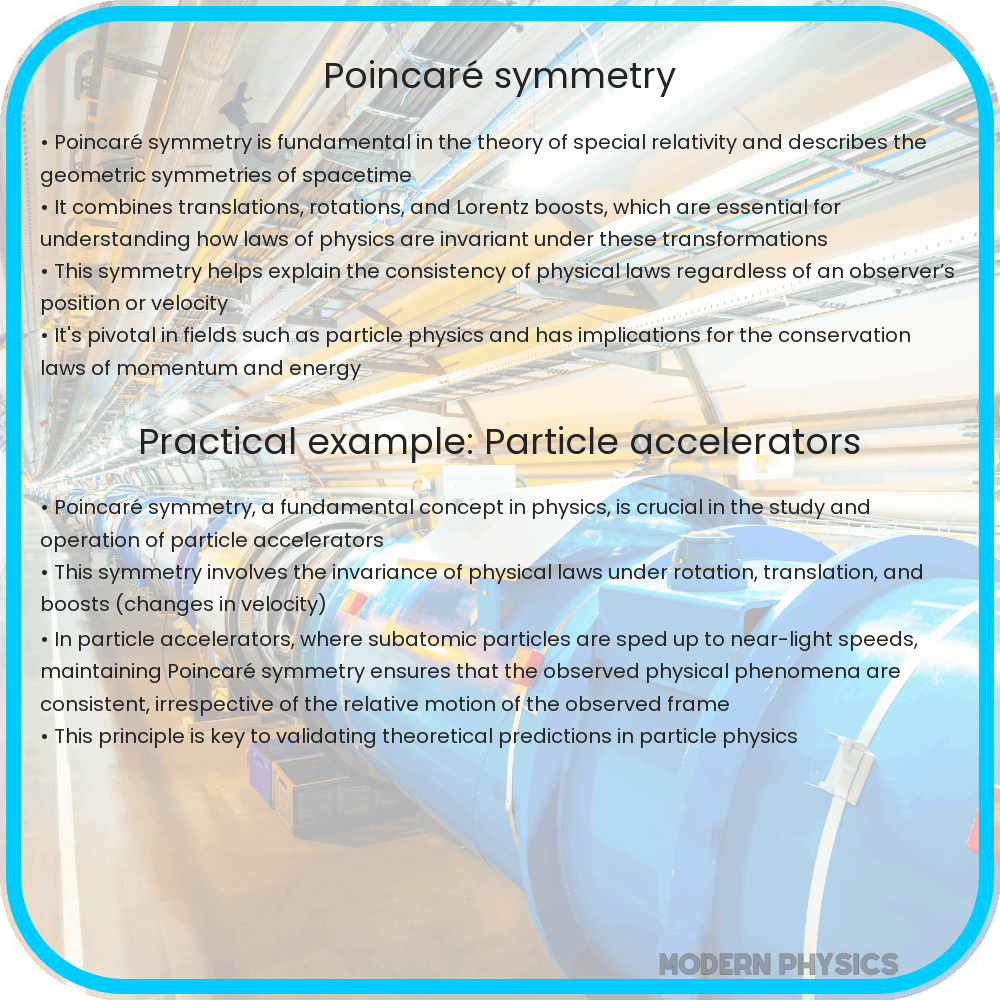
Poincaré Symmetry, named after the French mathematician Henri Poincaré, is a cornerstone concept in the field of theoretical physics, particularly within the framework of Special Relativity. This symmetry plays a crucial role in our understanding of space, time, and the fundamental interactions of particles.
Special Relativity, introduced by Albert Einstein in 1905, revolutionized our conception of the universe. It introduced the idea that the laws of physics are the same for all non-accelerating observers and that the speed of light within a vacuum is the same no matter the speed at which an observer travels. This theory led to the famous equation E=mc2, linking energy (E) with mass (m) and the speed of light (c).
Poincaré Symmetry extends these concepts by incorporating the notions of invariance and transformation in spacetime – a four-dimensional continuum comprising three spatial dimensions and one temporal dimension. It asserts that the fundamental laws of physics remain invariant (unchanged) not only under spatial translations and rotations (as per Galilean symmetry) but also under boosts (changes in velocity) and temporal translations. This unification of space and time transformations underlies the principle of relativity.
The implications of Poincaré Symmetry in Special Relativity are profound. It dictates that physical phenomena should appear identical to all observers, regardless of their relative motion or position in spacetime. This invariance underlies the conservation laws of physics, such as the conservation of energy, momentum, and angular momentum.
One of the key uses of Poincaré Symmetry in physics is in the realm of particle physics. It is fundamental to the Standard Model of particle physics, which describes how the basic building blocks of the universe interact. The symmetry constraints imposed by Poincaré Symmetry help physicists predict the properties of particles and their interactions. For instance, it has been instrumental in predicting the existence of particles like the Higgs boson before they were experimentally confirmed.
Moreover, Poincaré Symmetry has applications beyond particle physics. In cosmology, it aids in understanding the large-scale structure of the universe and the behavior of objects under extreme conditions, such as near black holes. It also has implications in the development of quantum field theory, a fundamental framework for modern theoretical physics.
Exploring the Depths of Poincaré Symmetry and Its Role in Special Relativity
The exploration of Poincaré Symmetry extends into the domain of quantum mechanics, where it influences the principles that govern the behavior of particles at the quantum level. This symmetry is integral to quantum field theory, which combines quantum mechanics with special relativity, providing a unified framework for understanding how fundamental particles and forces interact.
In this context, Poincaré Symmetry ensures that the equations governing these interactions remain consistent across different frames of reference. This is crucial for the formulation of theories like Quantum Electrodynamics (QED) and Quantum Chromodynamics (QCD), which describe the electromagnetic and strong nuclear forces, respectively. The symmetry’s influence is not just theoretical; it guides experimental physicists in designing experiments and interpreting data in particle accelerators like the Large Hadron Collider (LHC).
Furthermore, Poincaré Symmetry has profound implications in the development of advanced theories like string theory and loop quantum gravity. These theories attempt to reconcile general relativity with quantum mechanics, and Poincaré Symmetry provides a foundational principle that helps in formulating these theories. It offers a framework for understanding how space, time, and matter behave at the most fundamental level, potentially unlocking secrets of the universe that remain beyond our current understanding.
Moreover, the principles of Poincaré Symmetry have practical applications in technology. The understanding of relativistic effects is vital in the functioning of Global Positioning Systems (GPS). Without accounting for the effects predicted by Special Relativity and Poincaré Symmetry, the accuracy of GPS would be significantly compromised, impacting navigation and communication technologies worldwide.
Conclusion
In conclusion, Poincaré Symmetry is not just a theoretical construct but a fundamental aspect of the universe that permeates various fields of physics. From the microscopic world of particle physics to the cosmic scale of cosmology, its principles guide our understanding of the natural world. Its role in Special Relativity and subsequent theories underscores the interconnectedness of space, time, and matter. As our exploration of the universe continues, the insights provided by Poincaré Symmetry will undoubtedly play a pivotal role in unveiling new mysteries and advancing our quest for knowledge. This symmetry, a testament to the elegance and coherence of the physical laws, continues to be a guiding light in the ever-evolving landscape of theoretical physics.