
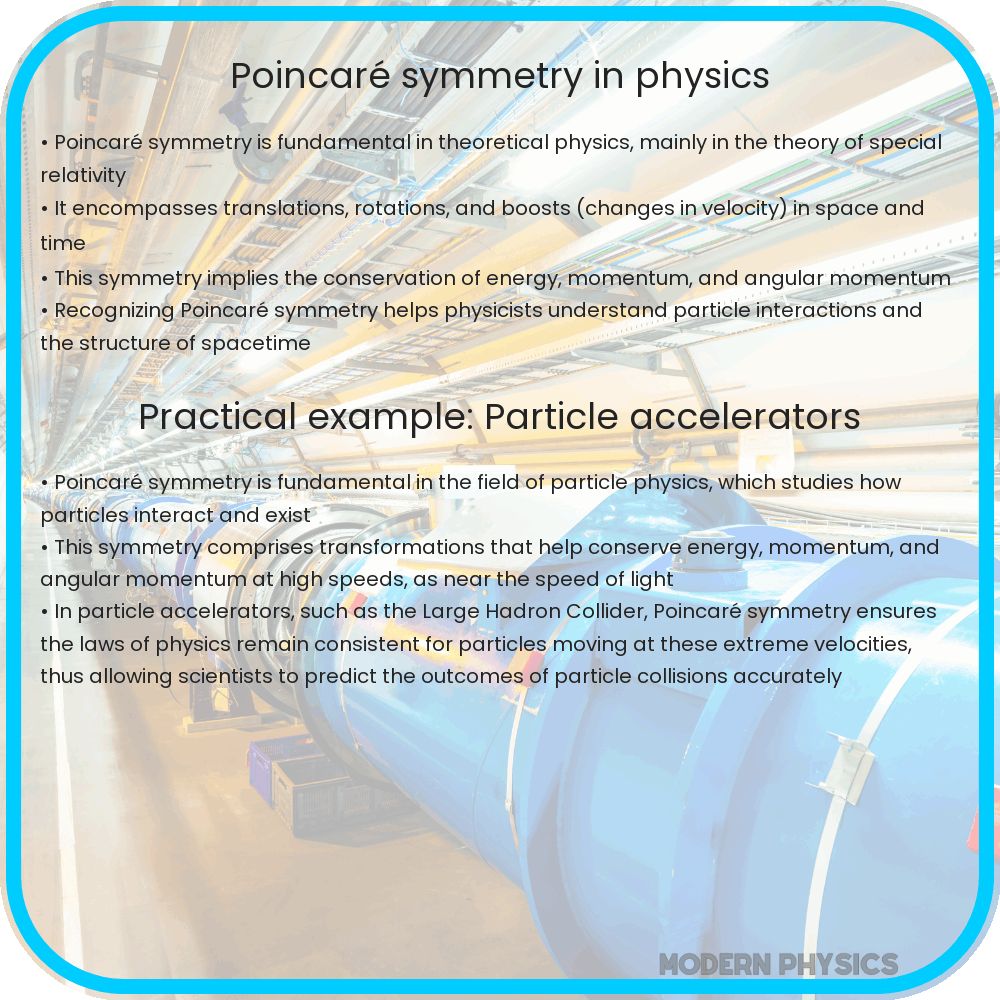
Poincaré symmetry underpins the invariance of physical laws across different frames, combining Lorentz invariance and spacetime translations.
Understanding Poincaré Symmetry: The Essence of Relativity, Space, and Time
Poincaré symmetry is a fundamental concept in the field of theoretical physics, particularly playing a crucial role in the theories of special and general relativity. Named after the French mathematician and physicist Henri Poincaré, this symmetry is a cornerstone in understanding how the laws of physics are invariant (i.e., remain the same) in different frames of reference, no matter their relative motion or position in space and time. Let’s delve into the basics of Poincaré symmetry and explore its implications in physics.
The Components of Poincaré Symmetry
Poincaré symmetry combines two key physical ideas: Lorentz invariance and translations in space and time. Here we break down these components:
- Lorentz Invariance: This part of Poincaré symmetry involves transformations that include rotations and boosts (changes in velocity without rotation). These transformations are crucial for understanding how observers moving at constant velocities relative to each other can describe the same physical phenomena differently yet equivalently.
- Translations in Space and Time: This refers to shifting the origin of the coordinate system to any point in space and time. The laws of physics must remain unchanged by such shifts, further emphasizing the uniformity and isotropy of space and time.
Together, these transformations form the Poincaré group, which mathematically describes the symmetries of space and time essential for the theory of relativity.
Poincaré Symmetry in Action
One of the fascinating applications of Poincaré symmetry is found in the field of particle physics, particularly in understanding the fundamental particles and their interactions. According to the principles of quantum field theory, particles can be classified based on their behavior under Poincaré transformations. These classifications are known as particles’ spin and mass.
- Spin: In quantum mechanics, spin is an intrinsic form of angular momentum carried by particles. Poincaré symmetry helps in understanding how spin values are conserved in particle interactions.
- Mass: Poincaré invariance implies that the mass of a particle is an invariant quantity – it remains constant regardless of the particle’s speed or the inertial reference frame in which it is measured.
The Mathematical Representation
The mathematical framework of Poincaré symmetry is captured using the language of group theory, which describes the symmetry transformations as elements of the Poincaré group. The Poincaré group can be expressed as follows:
Lorentz Group ⊗ Translations in Space and Time
The Lorentz group itself encompasses:
- Rotations in space (described by 3 parameters)
- Boosts (described by 3 parameters)
When combined with translations in space (3 parameters) and time (1 parameter), the full Poincaré group involves ten parameters, each corresponding to freedoms in manipulating the spacetime framework.
The algebra of these transformations, known as Poincaré algebra, is crucial for developing theories that adhere to relativity and provide consistent, invariant descriptions of physical phenomena across different frames of reference.
Experimental Verifications of Poincaré Symmetry
Experimental evidence supporting Poincaré symmetry is abundant in physics, highlighting its reliability and universal applicability. One of the most compelling pieces of evidence is the precision tests of the theory of relativity, which inherently relies on Poincaré invariance. Time dilation, length contraction, and the equivalence of mass and energy, as described by E = mc2, all spring from the principles of this symmetry. Experiments involving high-speed particles in particle accelerators confirm these phenomena, strongly supporting the foundational standing of Poincaré symmetry in physics.
Implications and Modern Applications
The principles of Poincaré symmetry extend far beyond the confines of theoretical physics and are essential in the fields of engineering and technology. For instance, the design of GPS systems crucially depends on corrections calculated using the principles of general relativity, which in turn are based on Poincaré invariance. Without these corrections, GPS accuracy would be significantly compromised, demonstrating the practical impact of these theoretical concepts.
Moreover, the exploration of quantum gravity, an area aimed at unifying general relativity with quantum mechanics, often references Poincaré symmetry to guide and assess theoretical frameworks. This ongoing research might one day provide us with a more profound understanding of the universe’s fundamental structure.
Conclusion
Poincaré symmetry, a deep-seated principle in the realm of physics, is fundamental to our understanding of space, time, and matter. It integrates complex concepts like Lorentz invariance and translations into a cohesive framework that supports and explains the universality of the laws of physics across different frames of reference. Its applications in theoretical explorations and real-world technologies underscore its crucial role in advancing both scientific inquiry and technological innovation. As we continue to probe the depths of the universe, Poincaré symmetry remains a pivotal guide, steering us toward greater discoveries and a better grasp of the very fabric of reality.