
Explore the fascinating world of plasma oscillations: their waves, stability, and diverse applications in technology, healthcare, and environmental monitoring.
Understanding Plasma Oscillation
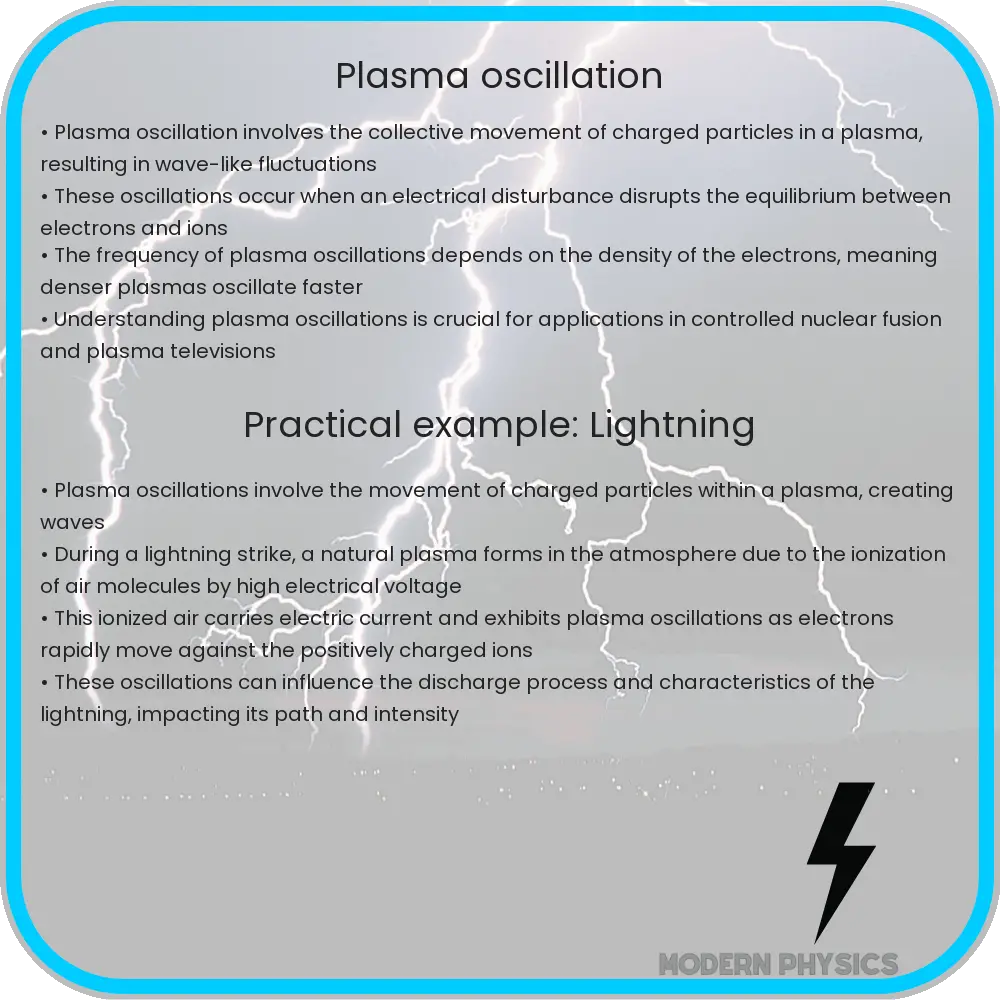
Plasma oscillation, or plasma frequency, refers to the collective and coherent motion of electron density in a plasma, which is a state of matter similar to gas but with a significant number of electrically charged particles, both positive ions and negative electrons. This phenomenon is critical in the field of plasma physics and has widespread implications in various technological applications.
Waves in Plasma
Within plasma, waves or oscillations occur when there is a disturbance in the equilibrium state. These disturbances can lead to collective movements of the charged particles. The unique aspect of plasma oscillations, compared to other types of waves, is that they are governed by the collective interactions among the plasma’s constituents rather than by the kinetic properties of individual particles. This results in a high-frequency oscillation, primarily of the plasma’s electron component, while the more massive ions remain relatively stationary due to their higher inertia.
Stability in Plasma Oscillations
The stability of plasma oscillations is a key area of study, as instabilities can lead to energy losses and are particularly relevant in controlled fusion research. Stability is influenced by several factors, including the density and temperature of the plasma, magnetic fields, and external forces. Understanding these factors is essential for managing plasma behavior in applications such as nuclear fusion reactors and space physics.
Applications of Plasma Oscillations
Plasma oscillations have a range of applications, including in the development of plasma TVs, fluorescent lamps, and semiconductor devices. In the field of telecommunications, they play a critical role in the operation of plasma antennas, which offer advantages over traditional metal antennas such as lower noise and greater reconfigurability. Additionally, in the area of space physics, understanding plasma oscillations is vital for interpreting the behavior of the ionosphere and for the development of technologies aimed at protecting Earth-bound communication networks from space weather effects.
Diagnostic and Therapeutic Uses of Plasma Oscillations
Plasma oscillations also find applications in medical diagnostics and therapy. In diagnostic equipment, such as plasma-enhanced spectroscopy, these oscillations help in the identification of various elements and compounds, which is crucial in chemical analysis and environmental monitoring. Therapeutically, plasma technology is being explored for its potential in killing harmful bacteria and treating wounds, showcasing the versatility and potential of plasma-based applications in healthcare.
Future Directions and Challenges
As research in plasma physics progresses, the understanding and utilization of plasma oscillations continue to expand. Future advancements may lead to more efficient energy sources, improved environmental monitoring techniques, and innovative medical treatments. However, challenges remain, particularly in terms of stability control, energy consumption, and the translation of laboratory-based plasma technologies into practical applications. Addressing these challenges requires interdisciplinary collaboration and sustained investment in research and development.
Conclusion
Plasma oscillations represent a fundamental and highly dynamic aspect of plasma physics with far-reaching implications across various scientific and technological fields. From improving communication technologies to advancing medical treatments, the applications of plasma oscillations are vast and diverse. Despite the challenges, the potential benefits of harnessing and understanding these oscillations are significant. Continued research and development in this area promise to unlock new possibilities and innovations, contributing to the advancement of technology and improvement of human life. As we delve deeper into the mysteries of plasma, the horizon of what is possible continues to expand, driven by the undulating waves of plasma oscillations.