
Explore the potential of magnetic confinement in nuclear fusion, a clean energy future with efficient, stable energy generation and significant environmental benefits.
Magnetic Confinement: Paving the Way for Efficient and Stable Energy Generation
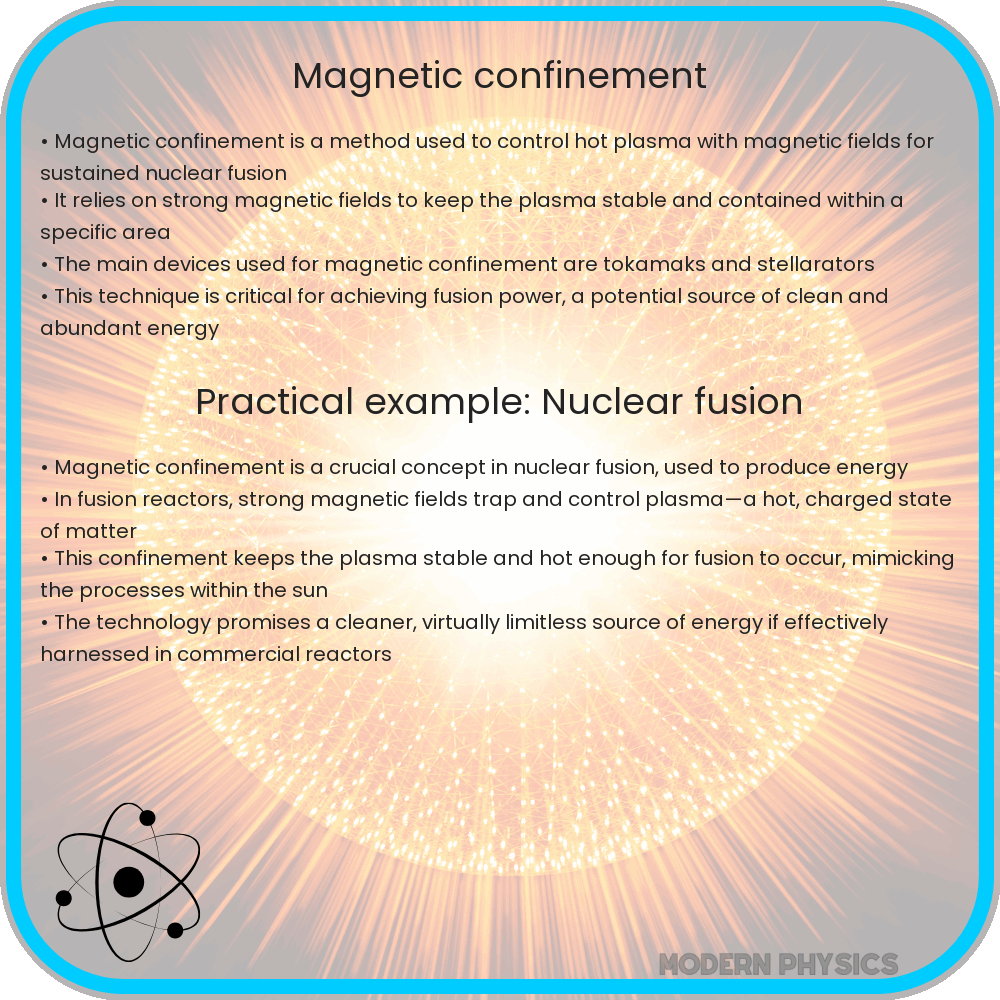
Magnetic confinement is a groundbreaking method in the field of plasma physics and controlled nuclear fusion, offering a path toward generating energy more efficiently, stably, and advanced than ever before. This technique involves the use of powerful magnetic fields to confine plasma—a hot, ionized gas consisting of positive ions and free electrons—in a defined space. The primary goal of magnetic confinement is to achieve a controlled fusion reaction, a process where light atomic nuclei combine to form heavier nuclei, releasing enormous amounts of energy in the process.
Understanding the Basics of Magnetic Confinement
At the core of magnetic confinement technology are devices like the tokamak and the stellarator. The tokamak, a toroidal (doughnut-shaped) apparatus, is the most extensively studied and utilized configuration. It employs magnetic fields to both confine the plasma and shape the flow of particles and energy within the confinement area. Stellarators, another type of confinement device, use a complex arrangement of magnetic coils to create twisted magnetic fields that effectively trap plasma.
The Role of Magnetic Fields in Plasma Confinement
Magnetic fields play a crucial role in maintaining the stability and efficiency of the confinement process. By preventing the plasma from coming into contact with the reactor walls, these fields allow the plasma to reach the high temperatures and densities necessary for fusion reactions to occur. The temperatures within the confinement area can exceed 100 million degrees Celsius, at which point the hydrogen isotopes deuterium (D) and tritium (T) can undergo fusion to form helium (He) and a neutron (n), releasing significant energy as described by the reaction:
21H + 31H → 42He + 10n
Advancements in Magnetic Confinement
Recent years have seen significant advancements in magnetic confinement technology, including improvements in magnetic field strength and stability, plasma heating methods, and diagnostics. These developments have led to longer confinement times, higher plasma densities, and increased efficiency of the fusion process. As research continues, the goal of achieving a sustainable, controlled fusion reaction, which could provide a virtually limitless source of clean energy, becomes increasingly attainable.
Challenges and Solutions in Magnetic Confinement Fusion
Despite its promising potential, magnetic confinement fusion faces several challenges. One of the main hurdles is achieving and maintaining the precise conditions needed for efficient fusion over a long period. This includes sustaining extremely high temperatures and plasma densities, while ensuring stability against various plasma instabilities. Engineers and scientists have been developing innovative solutions, such as advanced magnetic field configurations and real-time plasma control systems, to overcome these obstacles.
Environmental Impact and Future Prospects
The environmental benefits of magnetic confinement fusion are significant. Unlike fossil fuels, fusion does not produce greenhouse gases or long-lived radioactive waste, making it a clean and sustainable energy source. The only major by-product, helium, is non-toxic and has various industrial applications. As research progresses, the integration of fusion energy into the global energy mix could drastically reduce our dependence on non-renewable energy sources and help combat climate change.
Looking forward, the international fusion research community is highly focused on projects like ITER (International Thermonuclear Experimental Reactor), which aims to demonstrate the feasibility of fusion as a large-scale and carbon-neutral source of energy. ITER embodies the collective effort and expertise from countries around the world, showcasing the global commitment to advancing fusion technology. Success in these endeavors will pave the way for the construction of commercial fusion power plants, marking a new era in energy production.
Conclusion
Magnetic confinement fusion stands at the forefront of revolutionary energy solutions, offering a glimpse into a future powered by clean, efficient, and sustainable energy. While challenges remain, the progress in magnetic confinement technologies and the ongoing international collaboration underscore the potential of fusion energy to transform our world. By harnessing the power of the stars here on Earth, we are on the cusp of unlocking an inexhaustible source of energy that could secure a bright and sustainable future for generations to come.