
Explore the cutting-edge world of plasma mirrors, offering unmatched precision and durability for high-intensity laser applications in research, industry, and medicine.
Introduction to Plasma Mirrors
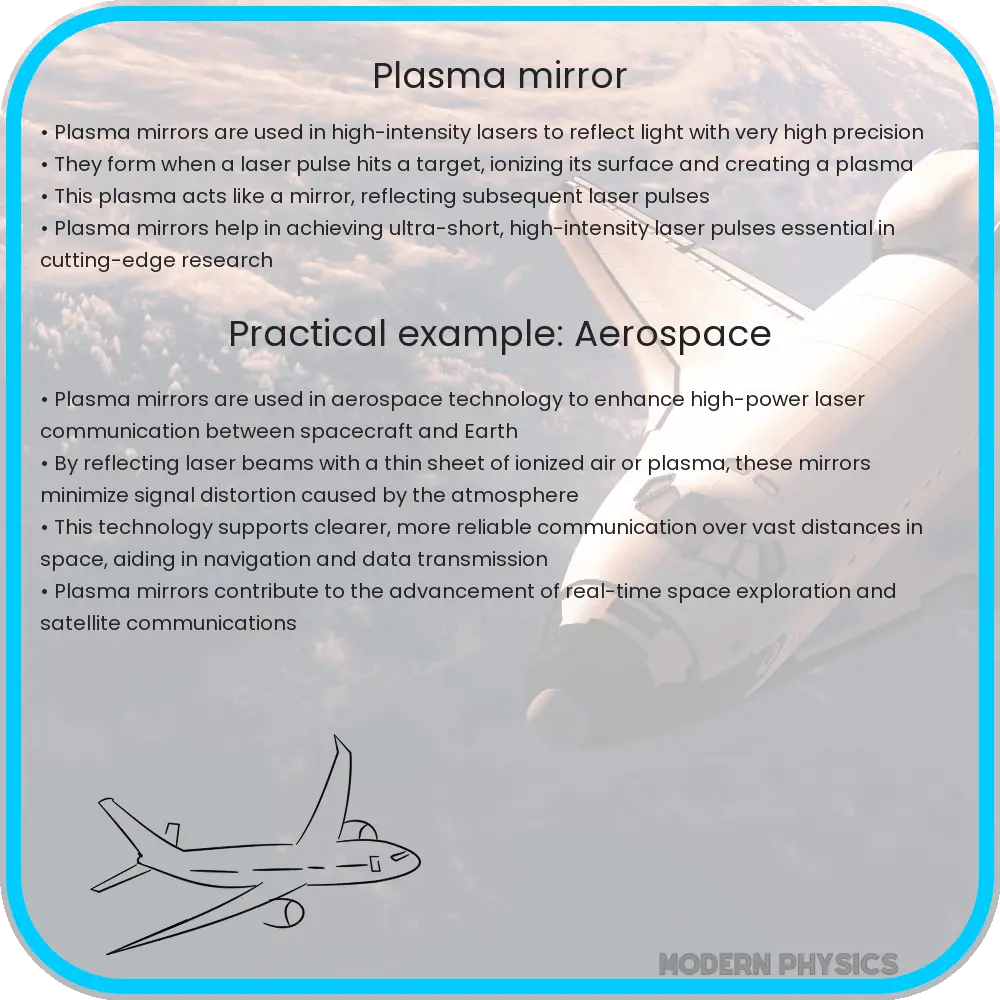
Plasma mirrors represent a groundbreaking advancement in the realm of optical technology, offering unparalleled precision and reflectivity. These mirrors, by harnessing the unique properties of plasma states, have opened new vistas for high-intensity laser applications, including in the fields of physics research, materials science, and even medical diagnostics.
Understanding Plasma Mirrors
At the heart of a plasma mirror is the concept of turning a material into a plasma state – where electrons are separated from atoms – to reflect incoming laser beams with extreme accuracy. This is achieved by focusing a high-power laser pulse onto a small spot on a target material, ionizing it instantly and creating a plasma surface that acts as a mirror.
Advantages of Plasma Mirrors
- High Reflectivity: Plasma mirrors can reflect laser beams with efficiencies close to 100%, significantly higher than traditional metallic or dielectric mirrors.
- Damage Resistance: Unlike conventional mirrors that can easily be damaged by high-intensity lasers, plasma mirrors can withstand extremely high powers, making them ideal for cutting-edge laser applications.
- Precision Control: The properties of the plasma mirror can be finely tuned by adjusting the laser pulse’s intensity, duration, and focal spot size, offering unparalleled control over the reflection process.
Applications of Plasma Mirrors
Plasma mirrors are not just a theoretical marvel but have practical applications that are transforming industries. In physics research, they are used to study high-intensity light-matter interactions, paving the way for advancements in quantum computing and nuclear fusion. In materials science, their precision and power are harnessed for ultra-precise cutting and engraving processes. Moreover, in the medical field, plasma mirrors contribute to the development of new diagnostic tools and treatments, offering hope for breakthroughs in non-invasive surgeries and therapy techniques.
The Science Behind Plasma Mirrors
The efficiency and functionality of plasma mirrors depend significantly on the plasma’s density and the incident laser’s characteristics. When the laser pulse hits the target material, it ionizes the surface atoms, creating a plasma layer. The critical density of the plasma, where the plasma frequency equals the laser frequency, is crucial for achieving optimal reflection. This balance ensures that the laser beam is reflected rather than absorbed or transmitted, maximizing the mirror’s efficiency.
Challenges and Future Directions
Despite their impressive capabilities, plasma mirrors face challenges that must be addressed to unlock their full potential. One of the primary hurdles is the requirement for high-quality, ultra-short laser pulses to initiate the plasma state, necessitating sophisticated and expensive laser systems. Additionally, the process of creating and maintaining a stable plasma state is highly sensitive to environmental conditions and requires precise control over many parameters, posing operational challenges.
Future research in plasma mirror technology is aimed at overcoming these challenges by developing more robust and flexible systems. Efforts are underway to reduce the dependence on high-cost laser equipment and to enhance the stability and durability of the plasma state under a wider range of conditions. Innovations in materials science and laser technology are expected to play a crucial role in these developments, potentially leading to more accessible and versatile plasma mirror applications.
Conclusion
Plasma mirrors stand at the forefront of optical technology, offering a combination of high precision, reflectivity, and resistance to damage that traditional mirrors cannot match. Their ability to handle extreme laser intensities opens up new possibilities in scientific research, manufacturing, and medicine, among other fields. While challenges remain in terms of cost and operational complexity, ongoing research and technological advancements are paving the way for wider adoption and innovative applications. As we continue to explore the limits of light-matter interactions, plasma mirrors will undoubtedly play a pivotal role in shaping the future of laser technology and its applications across various disciplines.