
Understanding the process of gas exchange in plant canopies, involving the absorption of CO2 and release of O2 through photosynthesis, crucial for agricultural productivity and ecosystem health.
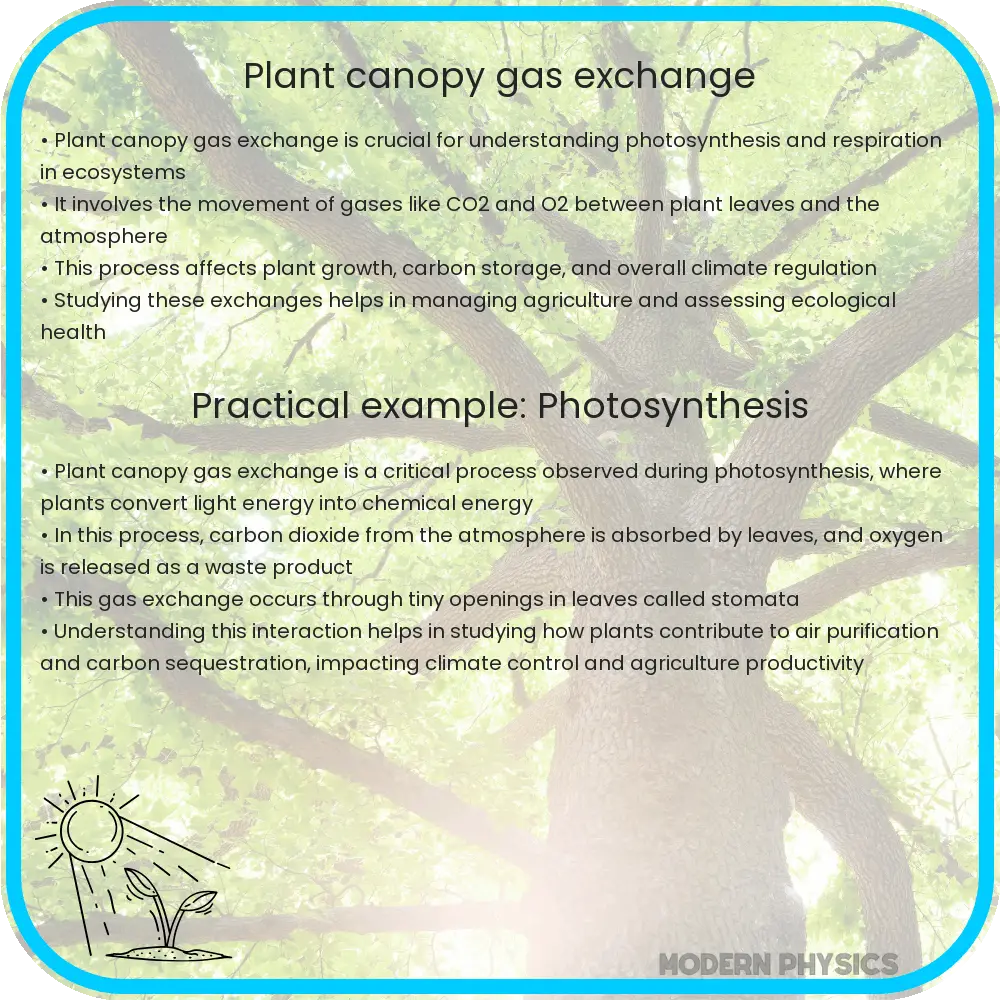
Understanding Plant Canopy Gas Exchange: Efficiency, Control, and Impact in Agricultural Physics
Plant canopies, the upper layer of vegetation dominated by the leaves and branches of trees or shrubs, play a critical role in the Earth’s ecosystem. Among their most vital functions is gas exchange, a process integral to plant growth, environmental interaction, and agricultural productivity. Comprehending the mechanics of this process not only deepens our understanding of plant physiology but also enhances our ability to manage crops effectively in agricultural settings.
What is Plant Canopy Gas Exchange?
Gas exchange in plant canopies involves primarily the absorption of carbon dioxide (CO2) from the atmosphere and the release of oxygen (O2) as a byproduct of photosynthesis. Another important aspect of this exchange is the transpiration of water vapor, which aids in nutrient uptake and temperature regulation within the plant system.
The Mechanics of Gas Exchange
The process primarily occurs through stomata, small openings on the leaf surfaces that regulate gas exchange based on environmental conditions and plant needs. The following equation represents the general photosynthesis process where these gases are exchanged:
\[ \text{6CO}_2 + 6\text{H}_2\text{O} \rightarrow \text{C}_6\text{H}_12\text{O}_6 + 6\text{O}_2 \]
Efficiency in this context refers to how effectively a canopy can exchange gases to maximize photosynthesis while minimizing water loss – a balance critical in agriculture, especially in water-scarce regions.
Control of Gas Exchange in Plant Canopies
Several factors influence the rate and efficiency of gas exchange in plant canopies. Environmental variables such as light intensity, temperature, humidity, and CO2 concentration play significant roles. Plants have evolved various physiological mechanisms to optimize their gas exchange processes. The opening and closing of stomata are controlled by both external stimuli and internal chemical signals, which help the plants adapt to environmental changes effectively.
- Light Intensity: More light generally encourages stomata to open, increasing CO2 uptake for photosynthesis.
- Humidity: Lower humidity can trigger more transpiration, leading to greater water loss but also enhanced nutrient uptake and temperature regulation.
- Temperature: Heat can increase the rate of photosynthesis, but extreme temperatures might lead to stomatal closure to conserve water, impacting gas exchange.
Impact of Efficient Gas Exchange on Agriculture
Understanding and managing gas exchange within plant canopies has substantial implications for agriculture. By optimizing the conditions under which plants exchange gases, farmers can enhance crop yield, improve water use efficiency, and even manipulate plant growth patterns to better suit agricultural goals. Innovative agricultural practices, like regulated deficit irrigation and precision farming, integrate knowledge of canopy gas exchange dynamics to sustainably increase food production.
Advanced technologies such as drones and sensors help in monitoring canopy health and environmental conditions, providing data essential for informed decision-making in crop management. This integration of technology and plant physiology is pivotal in addressing the global challenges of food security and sustainable agricultural practices.
Research and Advancements
The ongoing research in plant canopy gas exchange not only focuses on understanding the physiological aspects but also on how anthropogenic factors like pollution and climate change affect these processes. Insights gained from this research could lead to breakthroughs in genetic engineering, where plants are designed to thrive in suboptimal conditions with enhanced gas exchange capabilities.
Moreover, ecological models that predict how plant communities respond to various environmental changes are continually refined through better understanding of gas exchange processes. These models serve as crucial tools in forecasting and mitigating the impacts of environmental stressors on agricultural systems and natural ecosystems.
Challenges in Optimizing Canopy Gas Exchange
Despite advances, the optimization of gas exchange in plant canopies presents challenges. Variabilities in environmental conditions, such as unpredictable weather patterns and climate change, complicate the adaptive responses of plants. Additionally, the physiological diversity among plant species means that techniques effective for one crop may not be suitable for another.
- Genetic Variability: Different plant species and even varieties within a species can show significant differences in how their stomata react to environmental stimuli.
- Pest and Disease Influence: Infestations and diseases can impair the plant’s ability to perform gas exchange efficiently by damaging the stomata or other parts of the leaf structure.
- Soil Health: The quality of soil affects the plant’s overall health and its ability to absorb necessary nutrients, impacting its gas exchange capabilities.
Conclusion
The study and management of plant canopy gas exchange are pivotal for sustainable agriculture and environmental preservation. By delving into the intricacies of this process, scientists and farmers can devise strategies that improve plant growth, enhance crop yields, and conserve natural resources. With ongoing research, technological advancements, and a better understanding of environmental impacts, agricultural methods will continue to evolve, becoming more efficient and responsive to the challenges posed by a changing world. Ultimately, the mastery of canopy gas exchange holds a key to unlocking the full potential of our agricultural systems in harmony with the Earth’s ecological balance.