
Planform area is assessed for its impact on hydrodynamic efficiency by influencing drag and stability in watercraft designs.
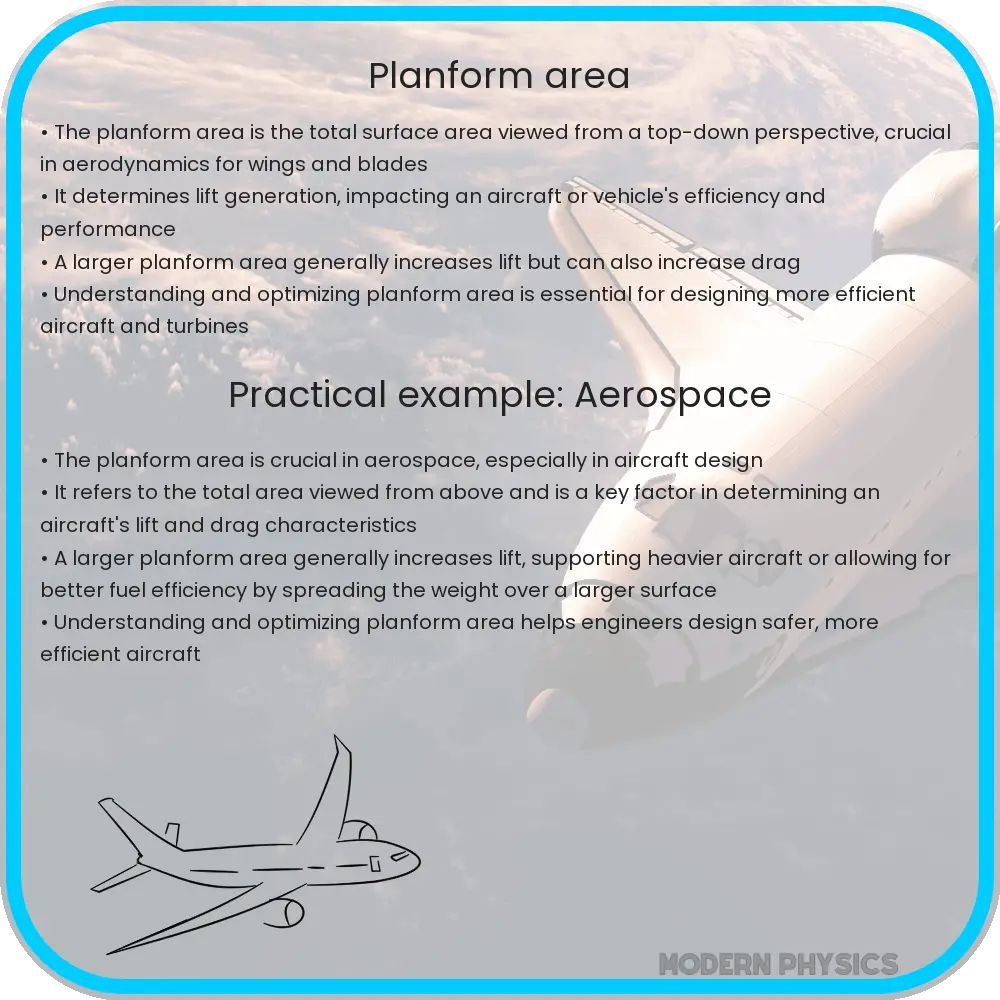
Introduction to Planform Area and Its Importance in Hydrodynamic Efficiency
Planform area is a critical concept in both aerodynamics and hydrodynamics, relating to the shape and area of a structure as projected onto a plane perpendicular to the flow of fluid around it. This concept is particularly crucial in the design of objects that move through water, such as boats, submarines, and different types of underwater vehicles. Understanding the planform area helps engineers enhance the hydrodynamic efficiency, which is essential for reducing drag, improving stability, and conserving energy in fluid environments.
Understanding Planform Area
The planform area can be defined as the total area seen when viewing the structure from a direction perpendicular to the flow direction. In the context of hydrodynamic designs, the planform directly influences the lift and drag forces applied by the fluid on the object. The shape and size of this area determine how smoothly an object can move through water, which in turn affects speed and fuel efficiency.
- Rectangular Planform: Common in simpler designs; offers good stability but generally experiences higher drag.
- Elliptical Planform: Known for its advantageous properties in reducing drag at the tips and providing even pressure distribution.
- Swept Planform: Often used in high-speed applications to reduce the effects of shock waves at high velocities.
Hydrodynamic Efficiency
Hydrodynamic efficiency refers to the effectiveness with which a vessel moves through water. A key factor in hydrodynamic efficiency is the minimization of resistance or drag, which is affected by the object’s planform area. The shape and orientation of the planform determine the flow pattern around the body, influencing the drag force experienced by it.
Equations Governing Flow Design
In assessing the hydrodynamic performance of a structure, several equations and principles come into play. One primary equation is the drag equation:
FD = 0.5 * ρ * v2 * CD * A
Where:
- FD is the drag force
- ρ (rho) represents the fluid density
- v is the velocity of the object relative to the fluid
- CD is the drag coefficient, which depends on the shape and roughness of the object
- A is the planform area perpendicular to the flow
This equation reveals that the larger the planform area, the higher the drag force, assuming all other factors remain constant. Thus, optimizing the shape and size of the planform area is crucial for improving hydrodynamic performance.
Application in Real-World Design
The principles of planform area and hydrodynamic efficiency are not limited to theoretical analysis but play a vital role in real-world applications. Designers and engineers often use computational fluid dynamics (CFD) software to simulate how changes in planform affect an object’s performance in a fluid environment. This allows for the optimization of designs before physical prototypes are built, saving both time and resources.
- Ship Design: Optimizing the hull shape to reduce drag and improve fuel efficiency.
- Submarine Contours: Refining the shape for stealth and speed capabilities in marine military applications.
- Water Sports Equipment: Designing surfboards, kayaks, and other equipment to enhance performance and maneuverability.
The Role of Planform Area in Environmental Sustainability
Enhancing hydrodynamic efficiency not only improves performance and reduces operational costs but also plays a significant role in environmental sustainability. By designing vessels that require less power for propulsion, engineers contribute to reducing the carbon footprints of marine operations. This is increasingly important as global awareness and regulations towards environmental impact continue to grow.
- Reduction in Emissions: More efficient designs lead to lower fuel consumption and lower emissions of greenhouse gases.
- Eco-friendly Materials: Coupling efficient planform designs with the use of sustainable materials improves overall environmental performance.
- Energy Efficiency Projects: Initiatives like the use of wind or solar power assist in further reducing the dependency on non-renewable energy resources.
Conclusion
The concept of planform area is crucial in the field of hydrodynamics, affecting everything from the basic functionality and efficiency of marine vessels to their environmental impact. By understanding and applying the principles of planform area and hydrodynamic efficiency, engineers can significantly influence the performance, cost-effectiveness, and sustainability of marine operations. The continuous advancement in computational and experimental methods will further enhance our ability to design more efficient and environmentally friendly waterborne vessels. By integrating these designs with sustainable practices, we take a step forward in preserving our oceans and waterways for future generations.