
Explore the Photonic Spin Hall Effect’s discovery, impact, and applications in optics, from enhancing communication to revolutionizing quantum computing.
Exploring the Photonic Spin Hall Effect: Discovery and Impact
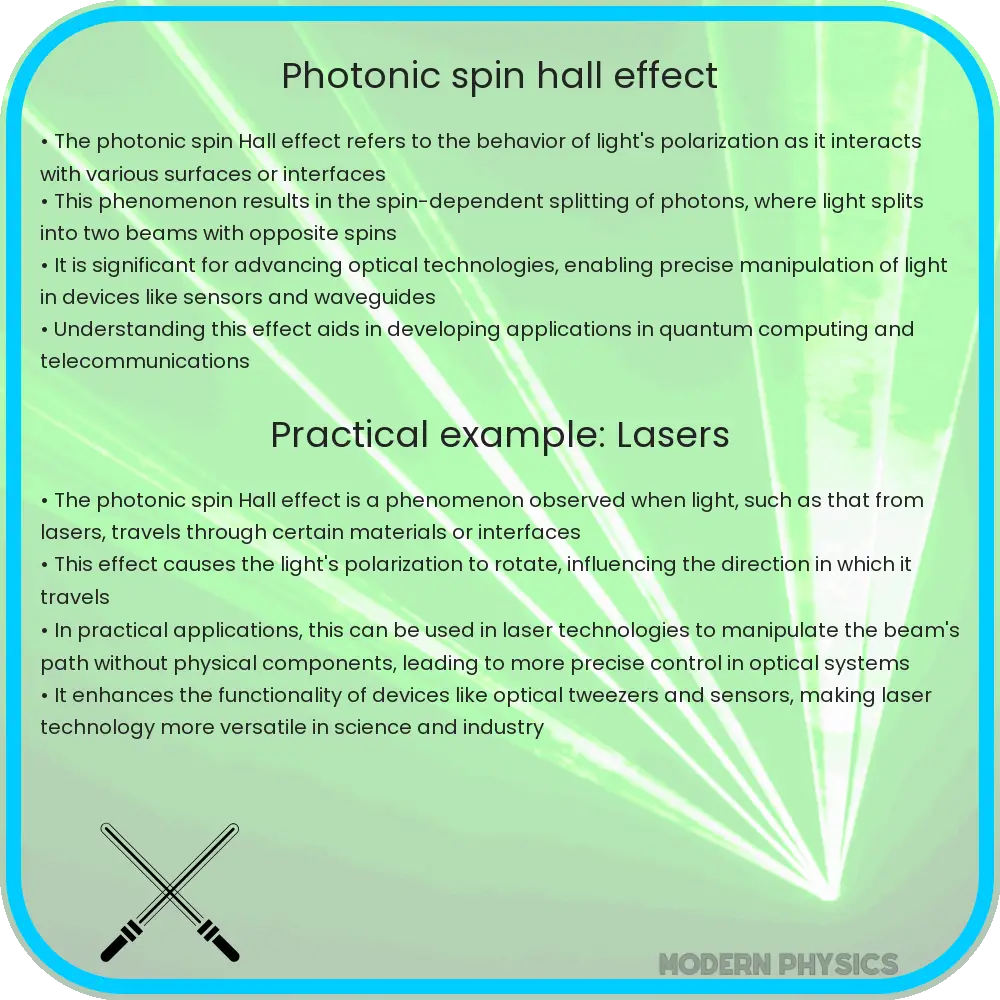
The Photonic Spin Hall Effect (PSHE) represents a groundbreaking advancement in the field of optics and photonics, fundamentally altering our understanding of light propagation and its interaction with matter. Discovered as a manifestation of the spin-orbit interaction of light, PSHE elucidates how a photon’s spin (its intrinsic angular momentum) can influence its trajectory through anisotropic or structured media. This phenomenon echoes the well-known Spin Hall Effect in electronic systems, showcasing a parallel wherein photons experience a transverse shift due to their spin state.
The discovery of PSHE has had profound implications for optical research and technology. Initially observed in the early 21st century, the effect has been extensively studied for its potential to revolutionize the manipulation and control of light at the micro and nano scale. By enabling the separation of light beams based on their spin state, PSHE paves the way for innovative applications in areas such as optical communications, quantum computing, and microscopy.
Key Applications and Technologies Enabled by PSHE
The applications of the Photonic Spin Hall Effect are as diverse as they are impactful. One of the most promising areas is in the development of spin-based optical devices, such as spin-dependent optical isolators and circulators, which are crucial for optical information processing. These devices exploit the PSHE to control light flow in integrated photonic circuits, enhancing performance and efficiency.
Another significant application is in the realm of quantum information science. PSHE facilitates the generation and manipulation of entangled photon pairs, serving as a cornerstone for quantum encryption and quantum computing technologies. By leveraging the spin states of photons, researchers can encode and transmit information with unprecedented security and efficiency.
In the field of optical sensing and metrology, the Photonic Spin Hall Effect offers new avenues for precision measurements. The ability to detect minute spin-dependent shifts in light beams enables the development of highly sensitive detectors for biological, chemical, and physical parameters. This capability is especially beneficial in microscopy and imaging techniques, where PSHE can enhance resolution and contrast by distinguishing between different spin states of light.
The exploration of PSHE also contributes to advancements in topological photonics, where researchers aim to create robust and error-resistant photonic systems. By harnessing the topological properties of light, devices based on PSHE can maintain operational integrity even in the presence of defects or disorder, offering a new paradigm for designing resilient optical networks.
Is this conversation helpful so far?
Enhancing Optical Manipulation and Future Prospects
Moreover, the Photonic Spin Hall Effect enables unprecedented control over the angular momentum of light, facilitating the development of optical tweezers and manipulators capable of exerting forces on microscopic particles. This aspect of PSHE is particularly beneficial for the fields of biophysics and nanotechnology, where it enables the manipulation of single cells, DNA molecules, and nanoparticles with high precision and minimal invasiveness. The ability to sort, move, and organize microscopic entities using light opens up new frontiers in medical research, drug delivery systems, and materials science.
Another groundbreaking application of PSHE lies in the enhancement of spatial light modulators and holographic technologies. By modulating the spin state of incoming light, these devices can create complex light patterns and holograms with improved efficiency and lower power consumption. This advancement is crucial for developing next-generation displays, augmented reality (AR) systems, and holographic storage devices, offering richer user experiences and higher data storage capacities.
The integration of PSHE with plasmonic and metamaterial structures also stands out as a significant achievement. These materials, designed to manipulate electromagnetic waves beyond the limits of traditional optics, gain added functionality through PSHE. By incorporating spin-dependent effects, researchers can design ultra-compact, highly efficient optical components that could revolutionize photonic circuits, sensors, and metamaterials, pushing the boundaries of what is possible in optical engineering and design.
Conclusion
The discovery and exploration of the Photonic Spin Hall Effect mark a pivotal chapter in the science of light. As researchers continue to unravel the complexities and potentials of PSHE, its applications across various domains of science and technology grow ever more promising. From revolutionizing optical communication and computing to enabling new paradigms in sensing, imaging, and material manipulation, PSHE stands at the forefront of optical innovation. The continued study and integration of this phenomenon into practical technologies promise to unlock new capabilities in photonics, heralding a future where the manipulation of light is limited only by our imagination. As we delve deeper into the quantum and classical realms of light, the Photonic Spin Hall Effect will undoubtedly play a critical role in shaping the next generation of optical technologies, making it a cornerstone of modern photonics research and application.