
Photoelectron Spectroscopy (PES) is a technique for studying electronic properties, chemical bonding, and elemental composition of materials.
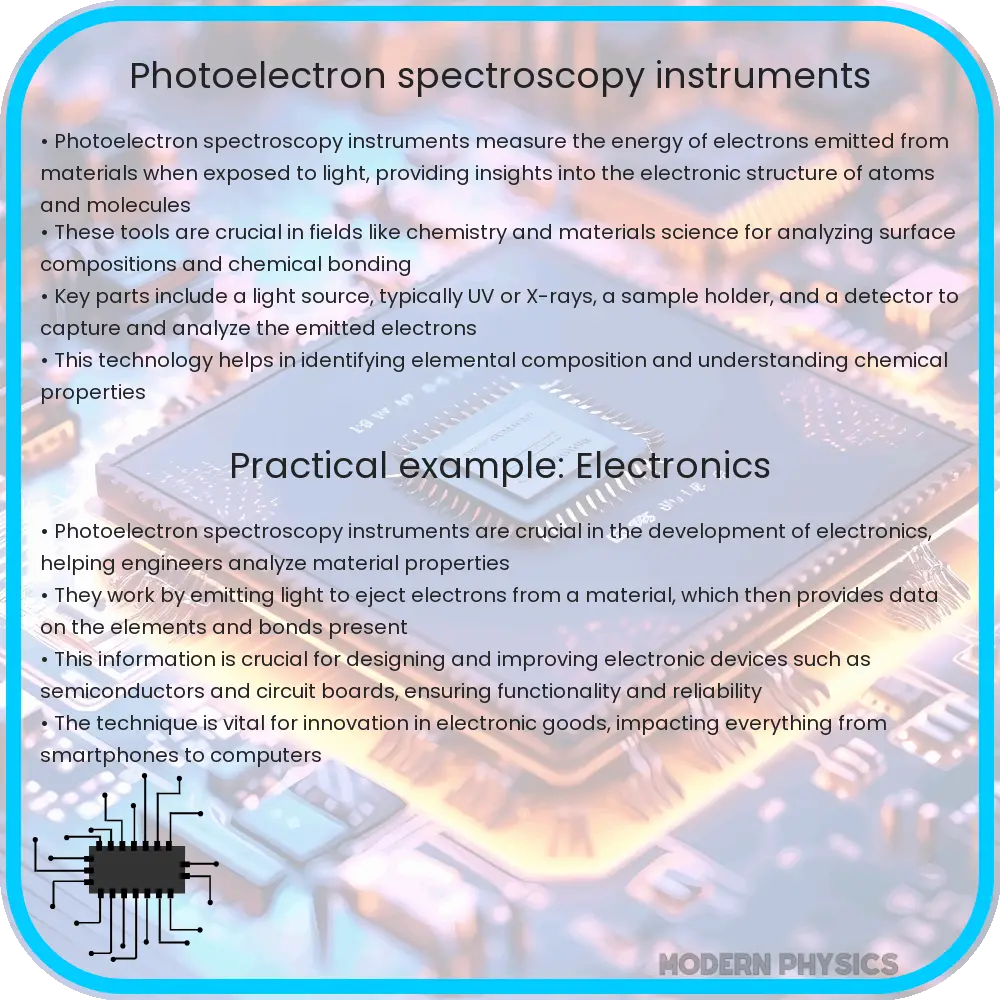
Introduction to Photoelectron Spectroscopy Instruments
Photoelectron Spectroscopy (PES) is a crucial technique in modern physical chemistry and materials science, used to study the electronic properties of atoms, molecules, and surfaces. This analytic method provides insights into chemical bonding, elemental composition, and electronic structure by measuring the kinetic energy of electrons ejected from a material when it is irradiated with ultraviolet or X-ray photons. As technology advances, the instruments used for PES have evolved, offering greater accuracy, efficiency, and innovative features that enhance research capabilities.
Accuracy in Photoelectron Spectroscopy
The accuracy of a PES instrument is paramount, as it determines the reliability of data for scientific analysis. High accuracy in PES is achieved through precise calibration of the photon source and electron detection systems. Typical aspects that impact accuracy include the energy resolution of the spectrometer and the stability of the photon source. Modern instruments use monochromatic X-ray sources and hemispherical energy analyzers to enhance resolution and accuracy. This setup minimizes the broadening of spectral features and allows for the detailed examination of electron binding energies, which are critical for identifying elemental compositions and oxidation states.
Efficiency of PES Instruments
Efficiency in Photoelectron Spectroscopy reflects the instrument’s ability to conduct rapid measurements without compromising data quality. This is particularly important in research environments where time and resource constraints are prevalent. Advances in detector technology have significantly contributed to improving the efficiency of PES instruments. Fast detectors, such as delay line detectors (DLD) and microchannel plate (MCP) detectors, coupled with sophisticated software, allow for quick data acquisition and real-time analysis. Additionally, newer models incorporate automated sample handling and multi-angle analysis capabilities, further speeding up the experimental process and increasing throughput.
Innovative Features in Current PES Instruments
Today’s photoelectron spectroscopy instruments boast numerous innovative features that expand their usability and application range. For example, ambient pressure PES (AP-PES) systems allow researchers to perform experiments at pressures closer to natural conditions, which is crucial for the study of biological samples and catalytic processes. Another significant innovation is the development of spin-resolved PES, which provides insights into the spin characteristics of electrons, thus opening new avenues for research in magnetic materials and quantum computing.
Additionally, integration with other spectroscopic methods, like infrared spectroscopy and mass spectrometry, provides a comprehensive analysis platform that yields a multifaceted view of the sample under study. This integration is vital for complex analyses, such as those required in the study of heterogeneous catalysts and complex organic compounds.
Future Directions in Photoelectron Spectroscopy
The future of Photoelectron Spectroscopy looks promising with ongoing advancements in technology and software. Developers are continuously working on enhancing the sensitivity and selectivity of PES instruments. One anticipated improvement is the use of higher energy resolution systems which will permit even finer details of electron behavior and interactions to be observed. Moreover, the push towards more compact and user-friendly designs will make PES more accessible to a wider range of scientific communities and industries.
Another area of future development is the application of machine learning algorithms to interpret PES data more efficiently. These algorithms can assist in the recognition and analysis of complex patterns within the data, potentially reducing the time needed for data processing and increasing the accuracy of the outcomes. This integration of artificial intelligence could revolutionize the capabilities of PES in identifying new materials and understanding intricate chemical reactions.
Conclusion
Photoelectron Spectroscopy has evolved significantly over the past decades, driven by technological innovations that enhance its accuracy, efficiency, and application scope. The instruments used in PES now not only offer high-resolution and rapid data processing capabilities but also allow for experiments under varying environmental conditions and the analysis of electron spin properties. Looking forward, the incorporation of advanced computational tools and further technological enhancements promises to broaden the horizons of PES applications. This progress will undoubtedly propel further breakthroughs in materials science, chemistry, and many other fields, making PES an indispensable tool in scientific research and industry.