
Learn how photoacoustic imaging combines optical imaging and ultrasound for deep tissue analysis in medical diagnostics and research.
Understanding Photoacoustic Imaging
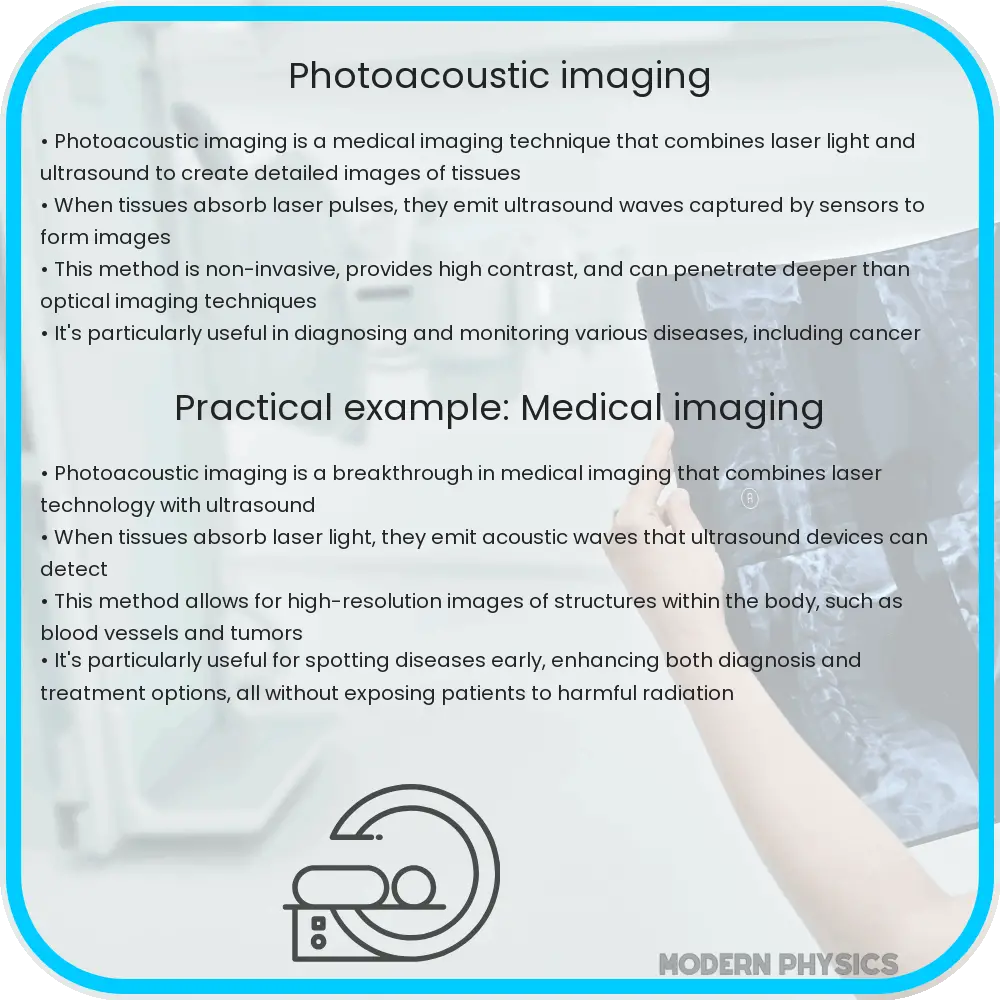
Photoacoustic imaging, a rapidly evolving biomedical imaging technique, combines the advantages of optical imaging and ultrasound to generate detailed images deep within biological tissues. This innovative method offers an exceptional balance of depth, resolution, and safety, making it a promising tool in medical diagnostics and research.
How Photoacoustic Imaging Works
The fundamental principle behind photoacoustic imaging revolves around the photoacoustic effect. When short pulses of light (usually from a laser) penetrate biological tissue, some of the light energy is absorbed by the tissue components, leading to a slight rise in temperature. This sudden thermal expansion creates acoustic waves, which are essentially small pressure waves.
These generated waves are then detected by ultrasound sensors placed on the surface of the tissue. The data collected from these sensors is processed to recreate images that represent the tissue’s optical absorption properties. Since different tissue types and pathological conditions exhibit unique optical absorption spectra, photoacoustic imaging can provide significant insights into tissue structure and health.
Advantages Over Traditional Methods
- Depth: Unlike purely optical imaging techniques, photoacoustic imaging allows for deeper tissue penetration—up to several centimeters—while maintaining high resolution. This is because sound waves, unlike light waves, do not scatter as much in tissue.
- Resolution: The spatial resolution of photoacoustic imaging is superior to that of traditional ultrasound because it combines the high contrast of optical imaging with the penetration power of ultrasound.
- Safety: Photoacoustic imaging uses non-ionizing laser pulses, which are considered safe for biological tissues. The energy levels and exposure durations are controlled to avoid any damage or harmful effects, making it safer than techniques involving ionizing radiation like X-rays.
Applications of Photoacoustic Imaging
Photoacoustic imaging has a wide range of applications in medical science, particularly in areas where traditional imaging methods fall short:
- Cancer Detection: The technology is highly effective in identifying the oxygenation state and the angiogenesis in tumors, which are crucial markers in cancer progression.
- Vascular Imaging: It provides detailed images of the vasculature, allowing researchers to study diseases related to the blood vessels such as atherosclerosis.
- Functional Brain Imaging: Researchers are exploring the use of photoacoustic imaging in studying brain function, by observing blood distribution changes related to neural activity.
Future Developments and Challenges
As photoacoustic imaging continues to advance, researchers are focusing on enhancing the technology to achieve even greater depths and resolutions. Future innovations may include the integration of more sophisticated laser systems and the development of advanced ultrasound detectors that can capture finer acoustic signals. However, there are challenges to be addressed, such as the need for better image reconstruction algorithms and the potential for increased complexity in interpreting the more detailed images produced.
Additionally, translating these advancements from the laboratory to the clinical setting poses its challenges. Ensuring the technology is cost-effective, user-friendly, and capable of providing rapid diagnostics are crucial steps for widespread adoption.
Conclusion
Photoacoustic imaging represents a significant leap forward in biomedical imaging, providing a non-invasive and safe method to observe deep biological tissues with remarkable clarity. By melding the best features of optical and ultrasound imaging, it offers a unique window into the body that other imaging modalities cannot match. As this technology evolves, it holds the promise not just for better disease detection and monitoring, but also for a deeper understanding of complex biological processes. Through ongoing research and development, photoacoustic imaging is set to revolutionize the field of medical diagnostics and expand our capabilities in medical science.
In an era where precision and safety in medical imaging are more critical than ever, photoacoustic imaging stands out as a vital tool in the medical community’s arsenal. It exemplifies how innovative engineering and a thorough understanding of physical principles can yield tools that substantially improve our lives. As we continue to explore and refine this technology, the potential impacts on healthcare and patient outcomes seem boundlessly promising.