
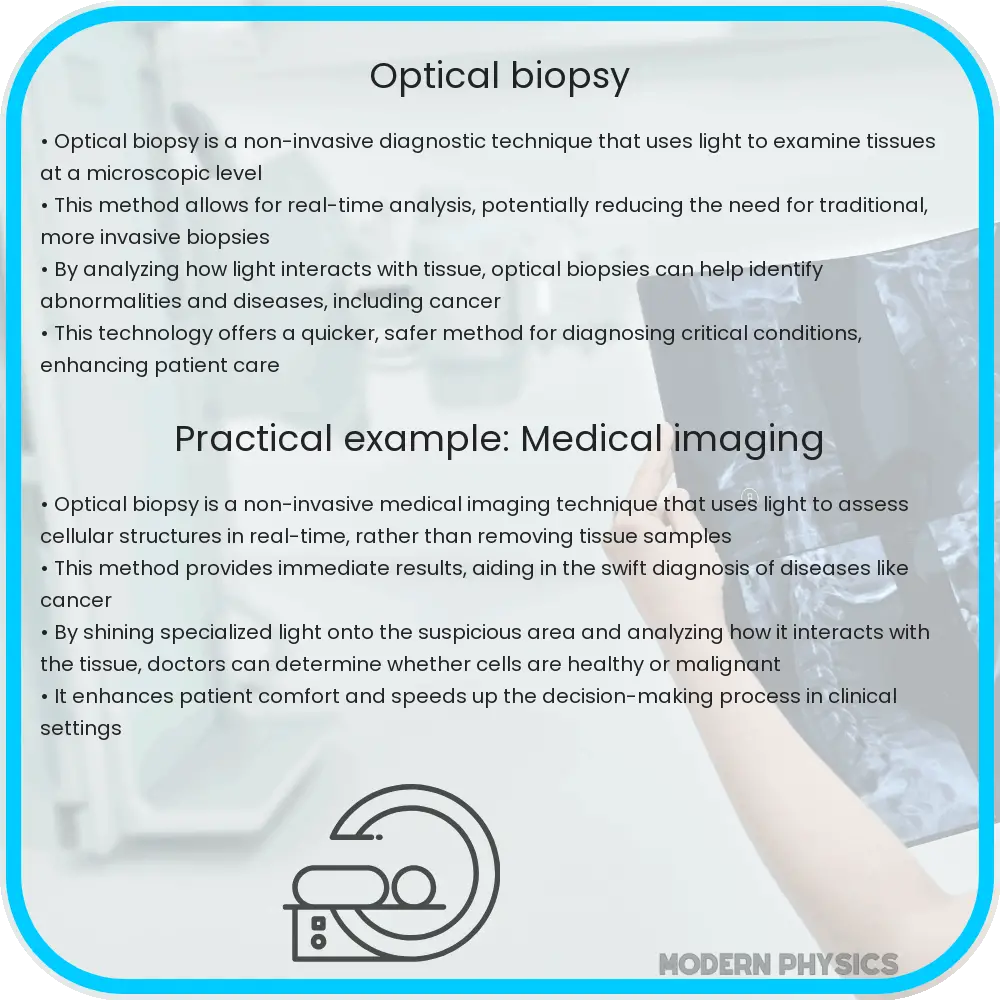
Optical biopsy is a non-invasive medical imaging technique that uses light to capture real-time, high-resolution images of tissues for immediate analysis.
Understanding Optical Biopsy
Optical biopsy is a groundbreaking technique in medical imaging that allows doctors to view real-time cellular and tissue structures without the need for traditional, invasive biopsy procedures. This innovative method leverages the power of light to capture high-resolution images of tissue, enabling precise and immediate analysis.
How Optical Biopsy Works
The principle behind optical biopsy involves using specialized optical systems — such as confocal microscopy, optical coherence tomography (OCT), and fluorescence microscopy — to scan tissues in real time. These systems emit light towards the tissue and measure the amount of light that is either reflected back or the fluorescence emitted from the tissue cells. By analyzing this light, detailed images of the tissue architecture and cellular morphology are produced, providing insights that are crucial for accurate diagnosis.
- Confocal Microscopy: This technique utilizes a laser to illuminate a single point in the specimen with focused light. By adjusting the focal point across the sample, it builds a three-dimensional image of the tissue structure.
- Optical Coherence Tomography (OCT): OCT works similarly to ultrasound imaging, but instead of sound, it uses light waves. It provides high-resolution cross-sectional images, enabling detailed visualization of tissue microstructures.
- Fluorescence Microscopy: This method relies on the emission of light by certain substances when exposed to specific wavelengths of light, typically from a laser. The emitted light is then captured to form an image that highlights specific features of the tissue.
The Advantages of Optical Biopsy
Optical biopsy offers several significant advantages over traditional biopsy methods:
- Non-invasive: As a non-invasive technique, optical biopsy eliminates the need for cutting into the tissue, thus reducing the risk of infection and complications associated with standard biopsy procedures.
- Real-time analysis: This method provides immediate results, which is crucial in surgical settings or when rapid diagnosis can significantly impact treatment decisions and outcomes.
- Preservation of tissue integrity: Since no tissue is removed, optical biopsy allows for repeated assessments over time, which is particularly valuable for monitoring chronic conditions or the effectiveness of treatment.
These advantages make optical biopsy a powerful tool in the field of medical diagnostics, opening new avenues for non-invasive and accurate assessments of pathological tissues. However, despite these benefits, there are challenges and limitations that need to be addressed to enhance its effectiveness and wider adoption.
Challenges and Future Prospects of Optical Biopsy
While optical biopsy represents a significant advance in medical imaging, it also faces certain challenges that impact its widespread adoption. Some of these include:
- Depth limitation: Optical techniques typically penetrate only a few millimeters into tissue, which may not suffice for diagnosing conditions involving deeper tissue structures.
- Specificity and Sensitivity: Differentiating between similar types of cells and identifying malignancy with high accuracy can be challenging and may still require traditional histological analysis for confirmation.
- Cost and accessibility: The high cost of advanced optical equipment and the need for specialized training to interpret the images can limit accessibility, particularly in low-resource settings.
Despite these challenges, the future of optical biopsy looks promising. Ongoing advancements in optical technology and imaging software are continuously improving the depth, resolution, and analytical capabilities of these techniques. Additionally, combining optical biopsy methods with artificial intelligence can potentially enhance the specificity and sensitivity of diagnoses, making them more reliable and efficient.
Conclusion
Optical biopsy stands out as an exemplary innovation in the realm of medical diagnostics, providing a less invasive, faster, and potentially safer alternative to traditional biopsy methods. With its ability to deliver real-time, high-resolution images of living tissues, this technique supports immediate and informed medical decisions, which are crucial in critical care and surgery settings.
The technique’s capabilities in preserving tissue integrity and enabling continuous monitoring are particularly valuable for managing chronic diseases or assessing treatment efficacy, creating a shift towards more patient-friendly and efficient healthcare processes. However, to realize its full potential, the medical community must address its present limitations related to depth penetration, diagnostic precision, and accessibility.
As we move forward, continuous improvements and innovations in optical biopsy are likely to broaden its application and utility, making it an indispensable tool in modern diagnostic medicine. Its integration with emerging technologies such as AI underscores a transformative future where non-invasive diagnostics converge with precision medicine to enhance patient care and treatment strategies.