
Explore the multifaceted roles of periscopes in enhancing visibility, influencing design innovations, and shaping naval strategy in modern warfare.
Understanding Periscope Uses: A Dive into Visibility, Design, and Naval Strategy
The periscope, a device that is often synonymous with submarines and naval warfare, has a rich history and a plethora of uses beyond its military applications. This instrument, designed for observation from a concealed position, plays a critical role in enhancing visibility, influencing design innovations, and shaping naval strategy. By exploring these facets, we can appreciate the periscope’s significance in both historical and contemporary contexts.
Enhancing Visibility through Periscopic Technology
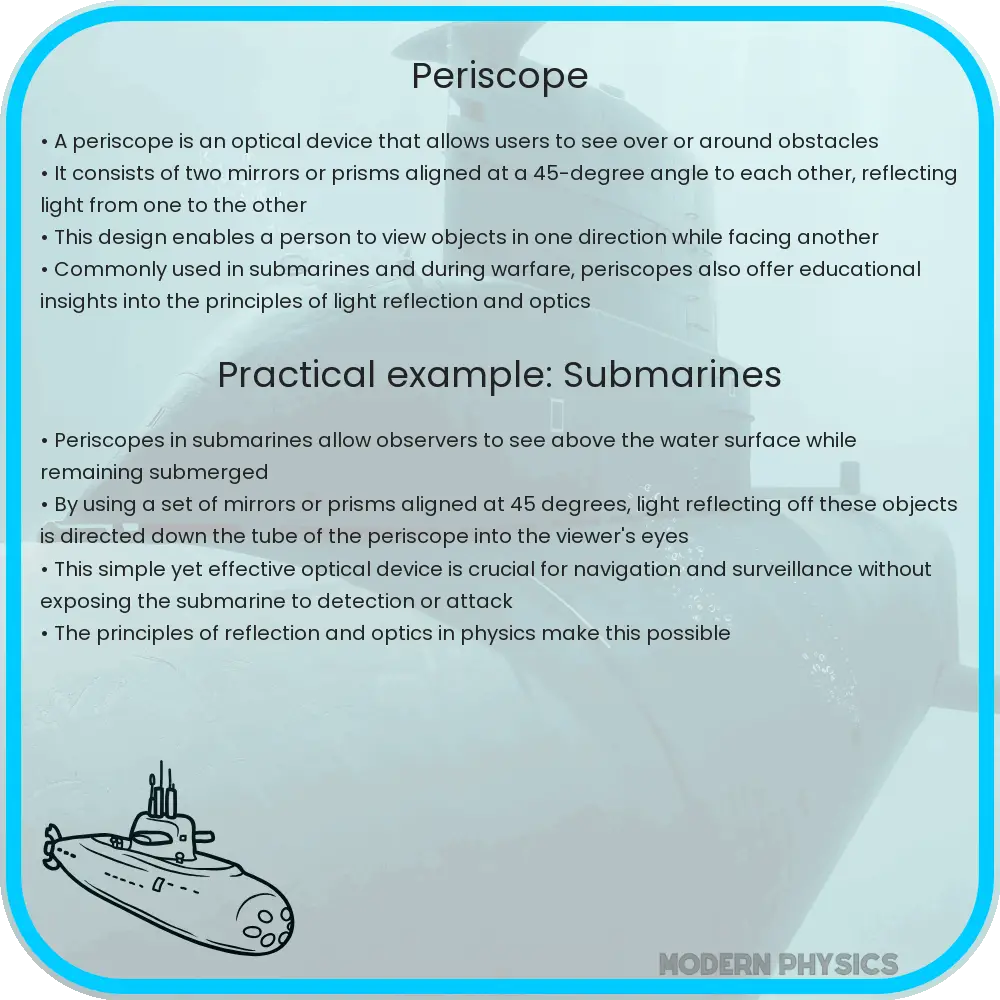
At its core, the periscope allows operators to see objects or areas that are not directly in their line of sight. This is achieved through a system of lenses and mirrors arranged in such a manner that it projects the image of the surroundings to the viewer. Initially developed for military use, particularly in submarines, to observe the surface of the water without emerging, its application has extended to various fields including surveillance, security, and even wildlife observation. The ability to remain concealed while maintaining awareness of the environment has been invaluable in numerous scenarios.
Innovations in Design for Diverse Applications
The design of periscopes has evolved significantly from simple tube-like structures to sophisticated systems incorporating digital technology. Modern periscopes, equipped with cameras, offer digital imaging, night vision, and thermal imaging capabilities. This evolution reflects the adaptation of periscope technology to meet the demands of modern warfare and civilian uses. For instance, in urban environments, periscopes have been used by law enforcement for surveillance purposes, demonstrating their versatility and adaptability.
Shaping Naval Strategy with Periscopic Insight
In naval warfare, the strategic importance of periscopes cannot be overstated. Submarines, equipped with periscopes, have the advantage of stealth, allowing them to observe enemy movements undetected. This capability has led to the development of strategies that leverage the element of surprise and information gathering to gain an upper hand in naval conflicts. The periscope’s ability to provide a visual assessment of threats and opportunities without exposing the vessel has been a game-changer in naval tactics and strategy.
The periscope’s journey from a basic observational tool to a complex system integrated into various fields illustrates its importance in enhancing visibility, driving design innovation, and influencing naval strategy. As we delve further into its applications, it’s clear that the periscope’s impact extends far beyond the confines of submarine warfare, embedding itself into the fabric of various industries and practices.
Exploring the Multifaceted Uses of Periscopes: From Visibility to Design and Naval Strategy
Periscopes, a device that is perhaps most commonly associated with submarines, serve a multitude of purposes beyond the deep blue sea. These ingenious optical tools are designed to allow an observer to see objects that are otherwise out of direct line of sight, employing a combination of lenses and mirrors to project a distant view to the user. Their applications span various fields, including visibility enhancement, design considerations, and strategic implementations in naval operations.
Enhancing Visibility
At its core, the periscope offers an invaluable solution to visibility challenges. In the naval context, it enables submariners to observe the surface of the water from a submerged position, a critical function for navigation and safety. However, its utility extends beyond military use. Periscopes are also employed in various civilian applications where direct line of sight is obstructed, such as viewing over a crowd at a concert or event, or in architectural designs to bring natural light into otherwise dark spaces.
Design and Innovation
The design of periscopes has evolved significantly since their inception. Early models were simple, featuring two mirrors aligned at a 45-degree angle. Modern iterations, however, incorporate sophisticated optics, including prisms and telescopic lenses, to enhance image quality and extend viewing range. This evolution in design not only improves functionality but also expands the scope of periscope applications, from surveillance and security systems to educational tools that offer a new perspective on the world around us.
Strategic Tool in Naval Warfare
In naval strategy, the periscope is an indispensable tool. Submarines use it for reconnaissance, allowing them to gather intelligence without revealing their position. The stealth and observational capabilities provided by periscopes give naval forces a tactical advantage, enabling them to make informed decisions based on real-time data. Moreover, the periscope’s design and functionality have influenced naval tactics and submarine design, emphasizing stealth, agility, and the element of surprise.
Conclusion
The periscope, with its simple yet powerful design, has proven to be a versatile and indispensable tool across various domains. From enhancing visibility in challenging environments to playing a pivotal role in naval strategy, its contributions are far-reaching. The ongoing evolution of periscope technology continues to open new avenues for innovation, demonstrating that this age-old device still holds significant potential for future applications. As we delve deeper into the realms of optical engineering and design, the periscope stands as a testament to human ingenuity and the endless quest for advancement.