
Oscillating foil propulsion is an innovative propulsion method inspired by the undulatory movements of marine life, designed to be efficient and environmentally friendly.
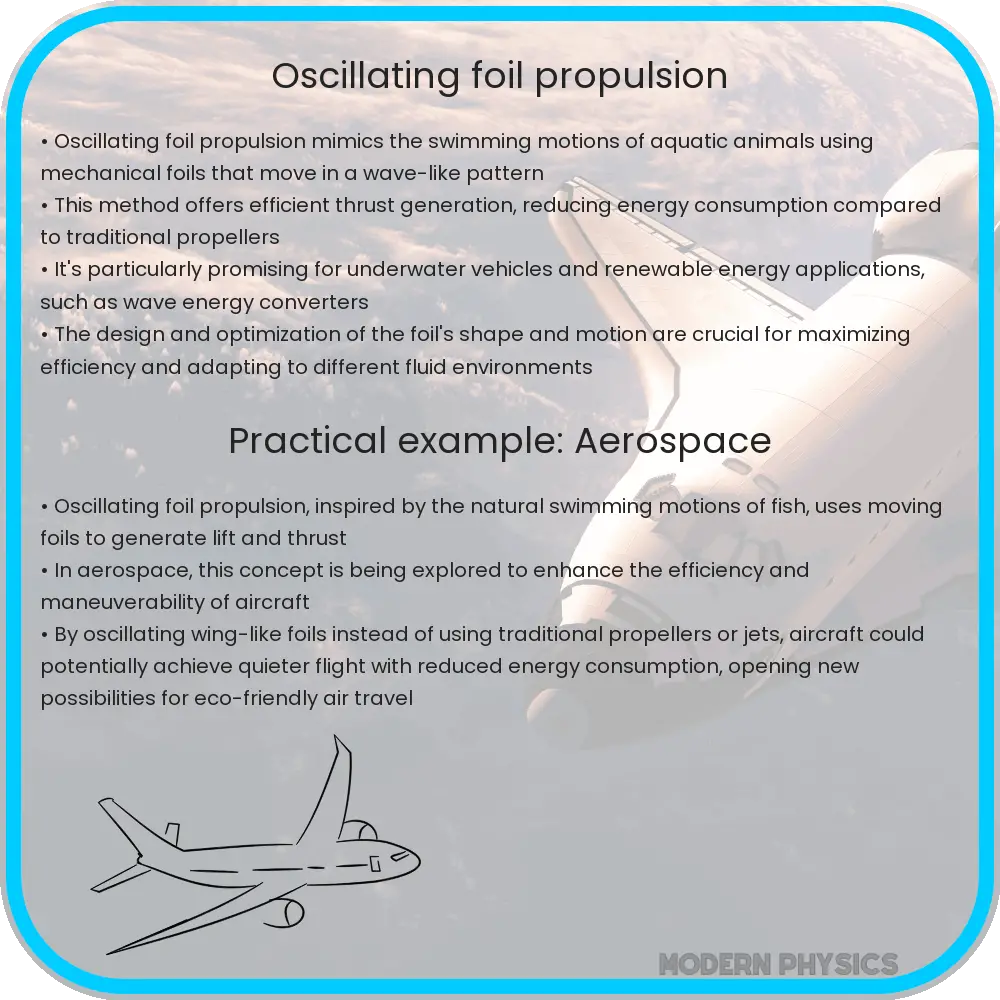
Oscillating Foil Propulsion: A Leap into Efficient Hydrodynamic Movement
Oscillating foil propulsion is a cutting-edge technique inspired by the natural undulatory movements of marine life such as fish and whales. This method represents a significant advancement in propulsion technology, particularly within aquatic environments, marrying the principles of physics with innovative engineering to create a system that is not only efficient but also environmentally friendly.
Understanding the Basics: What Is Oscillating Foil Propulsion?
At its core, oscillating foil propulsion involves the use of foils or fins that move in a wave-like motion, mimicking the natural movements found in sea creatures. This motion generates thrust and propels the vehicle forward through water. The primary components of this system are a foil shape, a mechanism to oscillate the foil, and a control system to optimize the movement pattern for maximum efficiency.
The Physics Behind the Propulsion
The efficiency of oscillating foil propulsion hinges on the hydrodynamic principles of lift and drag, crucial elements also seen in aircraft wings. As the foil moves through water, it alternates its angle of attack with each oscillation. This action generates a lift force perpendicular to the oncoming water flow, similar to how a wing generates lift in air. The key equations involved include:
- Lift (L): L = 0.5 * ρ * V2 * A * CL, where ρ is the water density, V is the velocity of the foil relative to the water, A is the area of the foil, and CL is the lift coefficient.
- Drag (D): D = 0.5 * ρ * V2 * A * CD, where CD is the drag coefficient.
The interplay between lift and drag facilitates the generation of thrust parallel to the flow of water, propelling the vehicle forward. The wave-like movement also contributes to reducing the overall energy consumption compared to traditional propellers that often face issues with drag at higher speeds.
Engineering Applications: From Submarines to Swimmers
Oscillating foil propulsion is not just a theoretical concept but has practical applications ranging from underwater drones and submarines to competitive swimming aids. In submarines, this technology offers a stealth advantage, significantly reducing the noise and mechanical vibrations compared to conventional propeller-driven systems. For swimmers, specially designed suits with small oscillating foils can help in achieving greater speeds and reducing fatigue.
The potential for energy efficiency and reduced environmental impact makes oscillating foil propulsion a promising alternative in various aquatic systems. Innovators and engineers continue to refine the designs, aiming to harness this technology for wider applications, including renewable energy generation from tidal and wave energy.
The Computational and Experimental Advances
Advancements in computational fluid dynamics (CFD) have played a pivotal role in the development and optimization of oscillating foil propulsion systems. Through CFD, engineers can simulate different flow conditions, foil shapes, and oscillation patterns to identify the most efficient configurations. Experimental testing in water channels and using scaled models allows for validation of computational predictions and further refinement of the systems.
Researchers are also exploring the scaling effects, which involve studying how changes in size and speed of the foil affect performance. This research is crucial for translating small-scale experiments to larger, practical applications that can be commercially viable.
Challenges and Future Prospects
Despite the benefits, oscillating foil propulsion systems face several challenges that must be overcome to enhance their utility. A significant issue is the durability and maintenance of the mechanical parts involved in the oscillating motion, which are susceptible to wear and tear due to continuous movement in harsh aquatic environments. Addressing these challenges requires innovative materials and engineering solutions to increase the longevity and reliability of these systems.
Furthermore, there is a need to improve the control systems that dictate the motion of the foils. Advanced sensors and feedback mechanisms could lead to smarter systems that adaptively modify foil movements in response to real-time environmental changes, such as water current shifts or obstacles.
Environmental Impact and Regulatory Considerations
The adoption of oscillating foil propulsion also brings up considerations related to environmental impact. While these systems are designed to be more environmentally friendly, the full ecological implications of widespread use are still being studied. Potential impacts on marine life, especially from noise and vibrations, need careful assessment.
Regulatory standards will also play a crucial role in the integration of oscillating foil propulsion into mainstream applications. Guidelines and certifications that ensure the safety, efficiency, and environmental compatibility of these systems are essential for fostering public and commercial acceptance.
Conclusion
Oscillating foil propulsion represents a fascinating intersection of nature-inspired design and advanced engineering. By mimicking the efficient movements of marine animals, this technology offers a superior alternative to conventional propulsion systems, with benefits including energy efficiency, reduced environmental impact, and potential applications in various aquatic environments. Although challenges remain in material durability and control system sophistication, ongoing research and technological advancements promise to address these issues, paving the way for broader adoption and innovative applications. As we continue to explore and refine oscillating foil propulsion, it opens up exciting possibilities for transforming how we interact with and navigate through aquatic environments.