
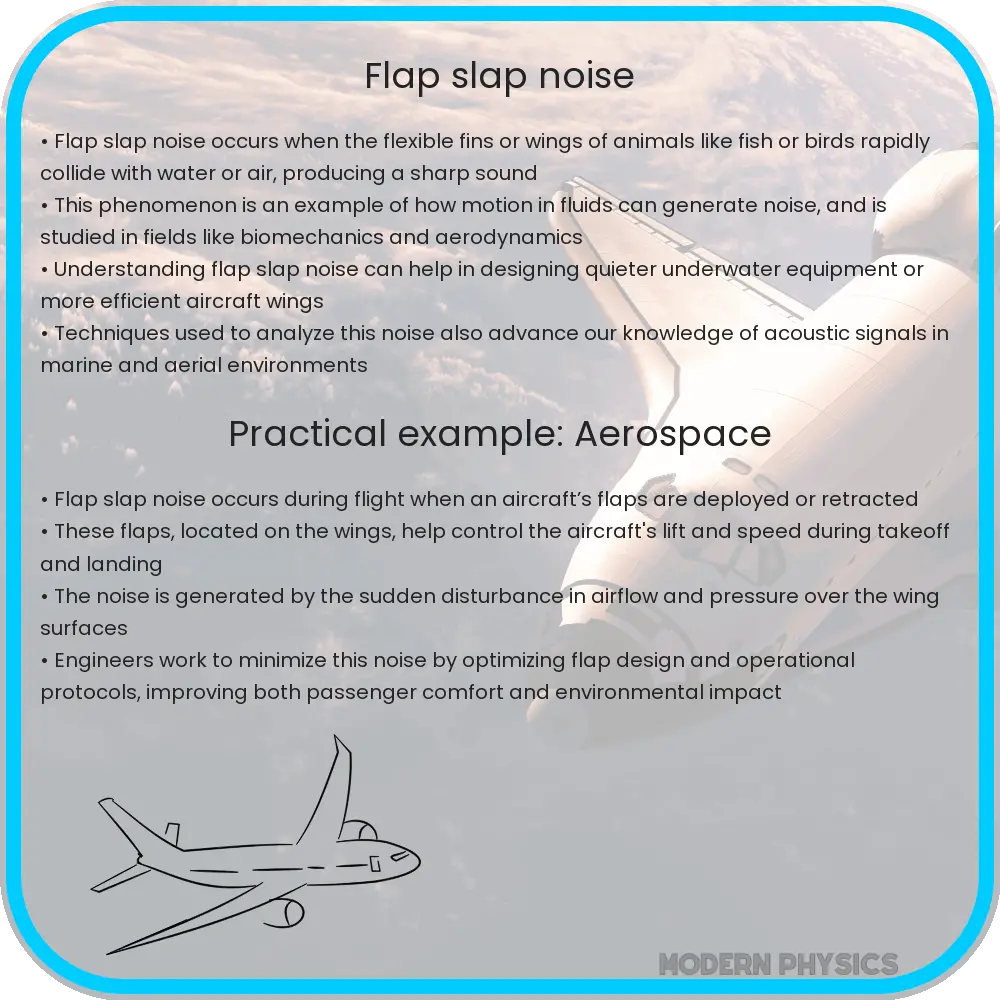
This article explores flap slap noise, a phenomenon caused by rapid fish fin movements in water, examining its hydrodynamic principles and implications for aquatic life and bio-inspired engineering.
Understanding Flap Slap Noise: Causes and Hydrodynamic Implications
Flap slap noise, though not commonly discussed outside specific scientific circles, is an intriguing phenomenon observed mainly in aquatic environments. This type of noise is predominantly associated with the rapid movements of fish fins and flippers, particularly during high-speed maneuvers. Understanding the causes and impact of flap slap noise not only enriches our knowledge of aquatic life dynamics but also offers insights into the design of bio-inspired engineering systems like underwater robots or efficient propulsion mechanisms.
The Causes of Flap Slap Noise
The primary cause of flap slap noise is the abrupt collision or “slapping” of a fish’s fin against the water surface or against another part of its own body. This action generates sound waves, which propagate through the water. Several factors contribute to this phenomenon, most notably:
- Speed and Agility of Aquatic Creatures: Faster and more agile species tend to produce louder and more frequent flap slap noises due to their rapid and forceful movements.
- Behavioral Patterns: Activities such as aggressive interactions between individuals, mating rituals, and escape responses can increase the occurrence of fin slapping.
- Anatomical Structure: The size, shape, and flexibility of fins influence how they interact with the water, thereby impacting the intensity and quality of the noise produced.
Hydrodynamics of Flap Slap Noise
To delve deeper into the hydrodynamics of flap slap noise, it’s essential to understand how the movement of fins in water creates sound. The interaction can be described using the principles of fluid dynamics:
- Water Resistance and Drag Force: As a fin strikes the water, it experiences resistance, known as drag. This force is proportional to the square of the velocity of the fin through water and is given by the equation:
\( F_D = \frac{1}{2} \rho v^2 C_D A \)
where \( F_D \) is the drag force, \( \rho \) is the density of water, \( v \) is the velocity of the fin, \( C_D \) is the drag coefficient, and \( A \) is the cross-sectional area of the fin perpendicular to the flow. - Pressure Differences: Rapid fin movements create variations in pressure around the fin surfaces, leading to the compression and expansion of water molecules, which in turn generate sound waves.
- Energy Transfer: Energy from the motion of the fin is transferred to the water, with some of this energy being converted into acoustic energy, manifesting as flap slap noise.
The study of these fluid dynamics not only helps explain how flap slap noises are produced but also aids in understanding the energy efficiency of different swimming techniques used by aquatic animals. This understanding has potential applications in designing aquatic drones or underwater vehicles that emulate the efficient propulsion methods of marine creatures.
Impact of Flap Slap Noise on Aquatic Life and Human Activities
The implications of flap slap noise extend beyond mere curiosity or scientific interest. In ecosystems, these sounds play a critical role in the behaviors of aquatic creatures, including predator-prey interactions and communication among species. For humans, understanding these noises has practical applications:
- Natural Soundscapes: For ecologists, the study of flap slap and other related aquatic noises can provide essential clues to the health and dynamics of marine ecosystems.
- Naval and Engineering Applications: In naval engineering, distinguishing between different types of underwater noises, including those caused by animals, is crucial for the development of stealth technology in submarines.
- Marine Biology and Behavioral Studies: Biologists use the knowledge of such noises to study animal behavior, migration patterns, and even to devise conservation strategies.
Moreover, the impact on human-made underwater structures and the potential for noise pollution further underscore the importance of researching flap slap noise and its characteristics.
Techniques for Mitigating Flap Slap Noise
In response to the issues raised by flap slap noise, researchers and engineers have developed various techniques to mitigate its effects, especially in sensitive environments. Some of these mitigation strategies include:
- Material Innovation: Designing fins and propellers with materials that absorb or dampen sound can reduce the generation of flap slap noise.
- Structural Modification: Altering the shape and flexibility of fins and other underwater components to optimize their interaction with water can lead to quieter operations.
- Operational Adjustments: Modifying the speed and maneuvering patterns of underwater vehicles can help minimize the occurrences of loud flap slap noises.
These techniques not only help in reducing noise pollution but also improve the efficiency and stealth capabilities of underwater vehicles, benefiting both marine life and human maritime activities.
Future Research Directions
While significant progress has been made in understanding and managing flap slap noise, there remain ample opportunities for further research. Future studies could focus on:
- Advanced Simulation Models: Developing more sophisticated models to predict and simulate the acoustic impact of flap slap noise under various conditions.
- Environmental Impact Assessments: Conducting comprehensive studies on the long-term effects of noise pollution on aquatic ecosystems and biodiversity.
- Interdisciplinary Approaches: Integrating insights from marine biology, acoustics, and engineering to devise innovative solutions to the challenges posed by flap slap noise.
The continued exploration of these areas promises not only to enhance our understanding of aquatic environments but also to drive the development of technology that harmonizes with the natural world.
Conclusion
Flap slap noise, though a subtle and often overlooked phenomenon, plays a significant role in both natural aquatic environments and human-engineered systems. From influencing animal behaviors and ecosystem dynamics to impacting naval technology and underwater engineering, the effects of these noise disturbances are far-reaching. Through the diligent efforts of scientists and engineers, we are beginning to not only understand but also effectively manage and utilize this unique aspect of fluid dynamics. By continuing to explore the complexities of flap slap noise, future advancements hold the promise of more sustainable interactions with our vibrant marine world, leading to innovations that could revolutionize underwater exploration and conservation practices.